
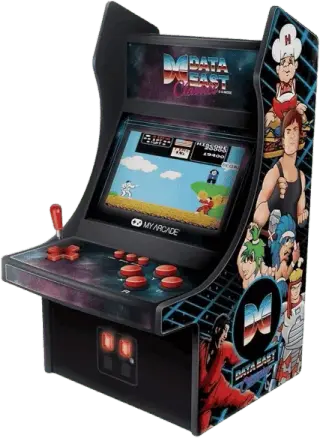
Arcade
Karate Champ
Karate Champ ist ein Arcade-Kampfspiel von 1984, entwickelt von Technōs Japan und veröffentlicht von Data East. Es gilt als eines der ersten Kampfspiele und führte viele Konventionen des Genres ein. Spieler steuern einen Karateka, der in Eins-gegen-Eins-Kämpfen mit verschiedenen Schlägen, Tritten und Blocks antritt.
Erscheinungsdatum
January 1, 1984
Spieler
1
Region
US
ROM-Größe
108 KB
Spiel teilen
Spielsysteme
Using two joysticks , players can execute 24 moves. Gameplay consists of a two dimensional fight between the first karateka wearing a white gi who is controlled by player one and the second karateka wearing a red gi who is controlled by either player two or the CPU, followed by various bonus rounds for the successful player. This pattern repeats itself in the next, more challenging round set against a new background, the first level being a dojo and all following levels taking place at the same tournament stadium. Unlike most later fighting games, there is no health bar or hit point system . A hit successfully landed ends the round and earns the hitter either one point or half point (along with a numeric score for the top ten, but this has no effect on winning a match). The first to score two points is the winner. If the player loses a battle, the game ends. The game features digitized speech for the judge to call out such phrases as "Half point" or "Full point". The speech is in Japanese in the original version. Player vs Player Karate Champ — Player vs Player is distinguished from the initial Karate Champ by the addition of a player versus player mode. It is very similar to the original in the sense that they use the same hardware, improved speech, some new sprites and title screen, and the gameplay mechanics are basically the same. Player vs Player has the characters fighting it out over girls in twelve different locations around the world (similar to the later SNK 's Street Smart ). A scene runs as a best out of three rounds competition for one girl. After every competition, the player has a chance to earn bonus points by evading a series of potted plants flying at the player, kicking through a series of boards and stopping a charging bull. The locations of the game are: A harbor, a garden with a view of Mount Fuji , a bamboo forest, on a tree trunk over a chasm, on the stern of a Japanese registered ship, on the side of a road or runway, Holland with windmills, a big city, a North American desert with Indian tipis , a Japanese garden , a dojo, and finally a forest path at night. Afterwards, the game returns to the first scene for a second loop. Completing all 12 scenes again completes the game.
Medienrezensionen
IGN
30
Einige Informationen stammen von Wikipedia, verfügbar unter CC BY-SA 3.0.