SNES
Final Fantasy IV
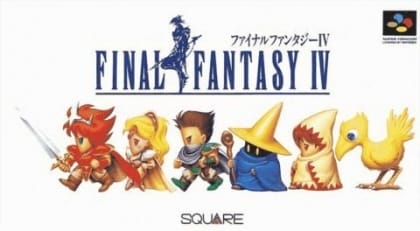
Final Fantasy IV est un jeu de rôle développé et publié par Square pour la Super Nintendo Entertainment System. Sorti en 1991, il introduit le système de combat Active Time Battle et suit l'histoire de Cecil, un chevalier noir qui voyage pour se racheter. Le jeu propose cinq personnages jouables avec des capacités uniques.
Partager ce jeu
Histoire
Setting Most of Final Fantasy IV takes place on Earth, also known as the Blue Planet, which consists of a surface world (or Overworld ), inhabited by humans, and an underground world (or Underworld), inhabited by the Dwarves . An artificial moon orbits the planet, upon which the Lunarians live. The Lunarians are a race of beings originally from a world which was destroyed, becoming the asteroid belt surrounding the Blue Planet, and are identified by a moon-shape crest on their foreheads. They created the artificial moon, resting until a time when they believe their kind can co-exist with humans. A second, natural moon orbits the Blue Planet as well, although it is never visited in the game.
Systèmes de jeu
In Final Fantasy IV , the player controls a large cast of characters and completes quests to advance the story. Characters move and interact with people and objects on a field map, which may represent a variety of settings, such as towers, caves, and forests. Travel between areas occurs on the overworld . The player can use towns to replenish strength, buy equipment, and discover clues about their next destination. Conversely, the player fights monsters at random intervals on the overworld and in dungeons. In battle, the player has the option to fight, use magic or an item, retreat, change character positions, parry, or pause. Certain characters have special abilities. The game was the first in the series to allow the player to control up to five characters in their party; previous games had limited the party to four. Player characters and monsters have hit points (HP), with the characters' HP captioned below the main battle screen. Attacks reduce remaining HP until none are left, at which point the character faints or the monster dies. If all characters are defeated, the game must be restored from a saved game file. The player can restore the characters' hit points by having them sleep in an inn or use items in the party's inventory, such as potions, as well as using healing magic spells. Equipment (such as swords and armor) bought in towns or found in dungeons can be used to increase damage inflicted on monsters or minimize damage received. The player can choose whether characters appear on the front line of a battle or in the back. A character's placement impacts damage received and inflicted depending on the type of attack. Final Fantasy IV introduced Square's Active Time Battle (ATB) system, which differed from the turn-based designs of previous RPGs. The ATB system centers on the player inputting orders for the characters in real time during battles. The system was used in many subsequent Square games. Each character has certain strengths and weaknesses; for instance, a strong magic user may have low defense, while a physical fighter may have low agility. Like other Final Fantasy games, characters gain new, more powerful abilities with battle experience. Magic is classified as either "White" for healing and support; "Black" for offense; or "Summon" (or "call") for summoning monsters to attack or carry out specialized tasks. A fourth type, " Ninjutsu ", consists of support and offensive magic and is available to only one character. Magic users, who account for eight of the twelve playable characters, gain magic spells at preprogrammed experience levels or fixed story events. The game includes balanced point gains, items, and rewards to eliminate long sessions of grinding . Due to the Super NES' greater processing power, Final Fantasy IV contains improved graphics when compared to previous Final Fantasy titles, all of which were released on the NES . The game employs the Super NES' Mode 7 technology to give enhanced magic spell visuals and to make airship travel more dramatic by scaling and tilting the ground for a bird's eye view.
Ventes et performance commerciale
Copies vendues
1.44 million copies
Critiques médias
IGN
8.6/10
GameSpot
8.3/10
Famitsu
8/10
Game Informer
2001
Electronic Gaming Monthly
32/40
Nintendo Power
8
Certaines informations proviennent de Wikipedia, disponible sous CC BY-SA 3.0.