SNES
Mario Paint
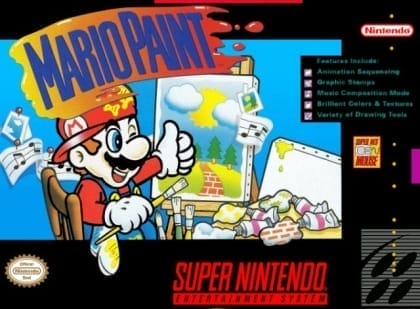
Mario Paint est un logiciel créatif pour SNES utilisant la souris de la console. Ce pack innovant comprend un programme de dessin, un outil d'animation, un compositeur musical et plusieurs mini-jeux. Il devint l'un des premiers logiciels d'art numérique pour consoles et initia de nombreux joueurs à la création numérique.
Partager ce jeu
Systèmes de jeu
According to the manual, two parts of Mario Paint are meant to familiarize the user with the SNES Mouse: the title screen, where users can click on each letter in the logo and each element on the screen to prompt a respective Easter egg ; and a fly-swatting minigame, "Gnat Attack", where the player must swat 100 insects before fighting a boss named King Watinga. The minigame has three levels, and after they are completed, the game starts over with the enemies swarming in and attacking at faster speed. Content creation features of the program include a drawing board , a coloring book , an animation tool (called "Animation Land"), and a music composer. Collages can be saved at a time in the program to be loaded at later usage of the software or recorded to VCR . In the coloring book, the user can color-in and edit four pre-made black-and-white drawings, including one featuring Yoshi and Mario , another featuring various animals, a greeting card, and an underwater scene. The drawing board is where original paintings can be created. A user can choose from 15 colors and 75 patterns. After choosing, the user can draw with a pen (small, medium, or large) and airbrush; fill in a closed area the selected texture with the "paint brush" tool; and create perfectly straight lines, rectangles, and circles that is the color or pattern selected (either fully colored-in, with just an outline, or with a spray-canned outline). Parts of a drawing can be copied, pasted, and moved to other areas, rotated vertically and horizontally, or erased via pens of six various sizes. An entire painting can also be erased via nine unique visual effects. Animation Land involves the use of the drawing board's tools for creating four, six, and/or nine-frame animations. Elements of one frame can be copied to others for smooth animations to be created. If a character is being animated, the animation box can be set on a background and move throughout it in a "path" recorded by using the mouse in the "path lever" feature. In the animation and drawing features, stamps can be added to each painting and frame, with 120 existing stamps included in the software. There is a stamp editor that allows the user to create new stamps or edit existing ones via a large tile grid, with the same 15 colors from the drawing board usable in the stamp editor. Up to 15 user-made stamps can be saved to a "personal stamp database". There are also text stamps, such as English , Hiragana , Katakana , and Kanji characters, that can be added and changed in size and color. The music composer allows users to write pieces either in common time or triple time . There are 15 instruments samples to use that are notated with different icons, including eight melodic sounds (a piano represented by Mario's head, a bell sound represented by a Power Star, a trumpet represented by a Fire Flower, a pulse wave represented by the Game Boy , a horn section sample represented by a goose, a guitar sound represented by an airliner, and an organ represented by a car), three percussion sounds (a bass drum represented by a Super Mushroom, a woodblock represented by a ship, and a bass pluck represented by a heart), and five sound effects (Yoshi's zip, a dog bark, a cat meow, a pig oink, and a baby hiccup). The icons are added to a treble clef . Notes that can be added are limited to a range from the B below middle C to high G . Since no flats or sharps can be added, pieces are restricted to notes of the C major / A minor scale. Other limitations include composing only in quarter notes , a maximum number of three notes on a beat , and a maximum number of measures a song can last (24 bars for 4 4 songs, and 32 bars for 3 4 songs). Pieces made in the composition tool can be played in the animation and coloring book modes.
Récompenses et distinctions
a platinum award at the 1994 Oppenheim Toy Portfolio Award
Ventes et performance commerciale
Copies vendues
1 million copies
Critiques médias
Game Informer
8.75/10
Electronic Gaming Monthly
8/10
Nintendo Power
1
Certaines informations proviennent de Wikipedia, disponible sous CC BY-SA 3.0.