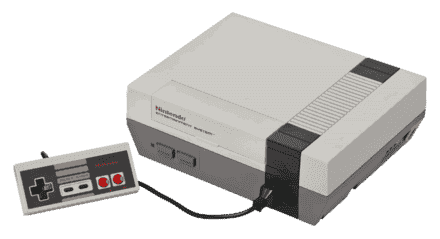
NES
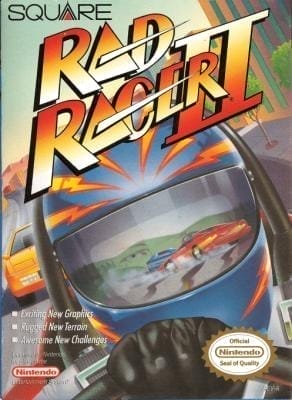
Rad Racer II
Rad Racer II est un jeu de course à haute vitesse développé par Square et sorti sur NES en 1990. Suite du populaire Rad Racer, ce jeu propose des graphismes améliorés, de nouveaux circuits et un gameplay plus rapide. Les joueurs courent contre la montre à travers divers lieux internationaux, avec la possibilité de changer entre perspectives à la première et à la troisième personne.
Partager ce jeu
Systèmes de jeu
Rad Racer is a racing game in which the player races in a "Transamerica" race from the West Coast to the East Coast . The gameplay is sprite-based, and the player controls the car from a "behind the vehicle" perspective. At the start of the game, the player chooses between two types of car to race, either a 328 Twin Turbo or an F1 Machine , though both cars perform exactly the same. The objective is to complete eight driving stages of varying skylines, environments, and locations, including Los Angeles , San Francisco , and Athens . Competitors' vehicles get faster as the stages progress and include Volkswagen Beetles to Ferrari Testarossas . The player's car can accelerate to 100 km/h, which turbo can then be activated to accelerate to a maximum of 255 km/h. The player can brake, steer, and change the background music while driving. Hitting any obstacles or other cars may cause the player's vehicle to flip and crash. Players have a limited amount of time to reach the next "checkpoint" in the course, which is indicated by a checkered flag; passing the flag adds additional time or may signal the end of the course. Players have a simulated dashboard that contains a progress bar, speedometer , tachometer , score, and time remaining. Unlike in Out Run where the game ends immediately, when time runs out, the player's vehicle coasts and decelerates down to 0 km/h before the game ends, giving the player an extra five to ten seconds to possibly reach the next checkpoint. Players can activate a 3D mode during play by pressing the "Select" button and wearing 3D glasses . Players could also use the Power Glove to control their vehicle. The game was also compatible with the Famicom 3D , an accessory to the original Famicom released in Japan that utilized LCD "shutter glasses" to simulate 3D.
Ventes et performance commerciale
Copies vendues
1.96 million copies
Critiques médias
IGN
101
GameSpot
3
Famitsu
32/40
Nintendo Power
30
Certaines informations proviennent de Wikipedia, disponible sous CC BY-SA 3.0.