SCD
Sonic CD
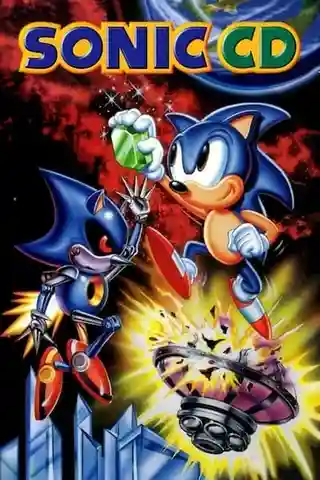
Sonic CD est un jeu de plateforme de 1993 développé par Sonic Team et publié par Sega sur Sega CD. Connu pour introduire Amy Rose et Metal Sonic, le jeu propose des mécaniques de voyage dans le temps entre versions Passé, Présent et Futur de chaque zone. Sonic doit collecter les Pierres du Temps pour empêcher le Dr. Robotnik de conquérir la Petite Planète.
Date de sortie
January 1, 1993
Joueurs
1
Région
US
Taille du ROM
55.2 MB
Partager ce jeu
Histoire
At Never Lake, an extraterrestrial body, Little Planet, appears in the last month of every year. Sonic's nemesis, Dr. Robotnik, has chained the planet to a mountain and begun transforming it into a giant fortress with his robot army. To execute his plan, Robotnik uses the Time Stones, seven diamonds which control the flow of time, hidden in the different zones. Sonic ventures to the planet, followed by the besotted Amy Rose , his self-proclaimed girlfriend. Robotnik dispatches his newest invention, Metal Sonic, to kidnap Amy at Collision Chaos, luring Sonic into danger. After fighting and outrunning Metal Sonic in Stardust Speedway and saving Amy, Sonic fights and defeats Robotnik in his lair, Metallic Madness. Two endings exist, depending on whether or not the player collected the Time Stones or achieved a good future in each level. In the good ending, Little Planet thanks Sonic with a shower of stars and leaves Never Lake; in the bad ending, Little Planet still leaves, but Robotnik uses the Time Stones to bring it back and the player is urged to replay the game to achieve the good ending.
Systèmes de jeu
Sonic CD is a side-scrolling platform game similar to the original Sonic the Hedgehog . Players control Sonic the Hedgehog as he ventures to stop his nemesis Doctor Robotnik from obtaining the magical Time Stones and conquering Little Planet. Like previous games, Sonic can destroy enemies and objects (such as certain walls and television monitors containing power-ups ) by rolling into a ball, and collects rings as a form of health. Sonic can also perform a "spin dash" and a "super peel-out", both of which increase his speed. The game has seven levels ; each is split into three zones, the third of which ends in a boss fight against Robotnik. Players start with three lives , which are lost when they suffer any type of damage without rings in their possession; losing all lives results in a game over . Sonic CD is differentiated from other Sonic games through its time travel game mechanic , which allows players to access different versions of rounds set in the past, present, and future. The music also changes within the different time zones, as remixes of the present music. Sonic starts the first two zones in the present. The third zone is always set in the future, its timeline dependent upon whether the player destroyed both transporters in the past. He travels through time by hitting signs labelled "past" or "future", maintaining his speed afterward. By default, future stages are neglected and littered with machinery after Robotnik has conquered the Little Planet, appropriately named "bad futures." Players are encouraged to convert each zone into a "good future", with bright colors, thriving nature, and few enemies. To achieve a good future in each zone, players must travel to the past and destroy a hidden transporter where enemy robots spawn. Achieving a good future in every zone unlocks the best ending. By finishing a level with more than 50 rings, Sonic can access a special stage, in which he must destroy six UFOs in a pseudo-3D environment within a time limit. Time is reduced swiftly if the player runs through water, though a special UFO that appears when time is running out grants extra time if destroyed. If the player destroys all the UFOs before the time runs out, they earn a Time Stone. Collecting all seven Time Stones automatically creates a good future in every zone, unlocking the best ending. The game also features a time attack mode, where players can replay completed levels for the fastest time possible; a "D.A. Garden", where players can listen to the music of completed zones; and a "Visual Mode", where players can view the opening and closing animations. The game also includes a save feature, which uses the back-up memory of the Sega CD. : 20
Ventes et performance commerciale
Copies vendues
1.5 million copies
Critiques médias
IGN
1990
GameSpot
1996
Eurogamer
2011
Electronic Gaming Monthly
9/10
EGM
1990
Certaines informations proviennent de Wikipedia, disponible sous CC BY-SA 3.0.