GB
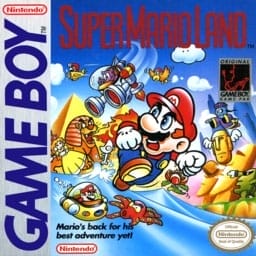
Super Mario Land
Super Mario Land est un jeu de plateforme développé et publié par Nintendo pour Game Boy. Il suit l'aventure de Mario à Sarasaland pour sauver la Princesse Daisy de l'extraterrestre Tatanga, introduisant de nouveaux ennemis et power-ups uniques à cet opus.
Partager ce jeu
Systèmes de jeu
(1985). As Mario, the player advances to the end of the level by moving to the right and jumping across platforms to avoid enemies and pitfalls, the screen only scrolls to the right, as the player advances, but will not scroll back to the left, and sections of a level that have passed off screen cannot be revisited. Mario travels to Sarasaland to save Princess Daisy from Tatanga, an evil spaceman. Two of the game's twelve levels are "forced-scrolling" Gradius -style shooters where Mario helms a submarine or airplane and fires projectiles towards oncoming enemies, destructible blocks and bosses. Levels end with a platforming challenge to reach an alternative exit located above the regular exit, the former leading to a bonus minigame styled after a Ghost Leg lottery that awards 1 to 3 extra lives or a Superball Flower power-up. Unlike other games in the series , Super Mario Land features several differences that sets it apart from the traditional Super Mario premises. Rather than being set in the Mushroom Kingdom , it is set in Sarasaland and drawn in line art . Mario rescues Princess Daisy in her debut, rather than the series' standard damsel in distress Princess Peach . When jumped on, Koopa Troopa shells explode after a short delay, Mario throws black bouncing balls rather than fireballs (referred to as "Superballs" in the manual), 1-Up power-ups are depicted as hearts, and the level-end flagpoles are replaced with a platforming challenge. Compared to Super Mario Bros. , which contains 32 levels subdivided into 8 "worlds" with 4 levels each, Super Mario Land is substantially smaller, with 12 levels subdivided into 4 "worlds" with 3 levels each. There are five unique bosses, one at the end of each of the four worlds, and a fifth and final boss being Tatanga, who appears when the fourth boss is defeated. The first three bosses may be destroyed with projectiles, or the player may move past them to the exit without destroying them first; the last level has no regular exit, and the two bosses at the end of that level must be destroyed with projectiles to complete the level and the game. Few elements recur from the previous Mario games, such as blocks suspended in midair, moving platforms that must be used to traverse pitfalls, pipes that lead to other areas, collectible coins that grant an extra life when 100 are collected, and Goomba enemies. After the player has completed the game they may play through again on a harder mode, in which the levels are the same apart from enemies being more numerous; if the player completes the harder mode, the game allows the player to start another play on any level in the game.
Ventes et performance commerciale
Copies vendues
25 million copies
Critiques médias
Famitsu
6/10
Electronic Gaming Monthly
8/10
Certaines informations proviennent de Wikipedia, disponible sous CC BY-SA 3.0.