
Genesis
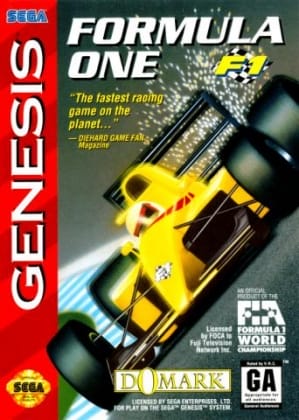
Formula One
An officially licensed F1 racing simulator featuring all 16 tracks from the 1991 season, complete with authentic teams, drivers, and car specifications. Offers both arcade and simulation modes.
Release Date
January 1, 1992
Players
1
Region
US
ROM Size
440 KB
Share this game
Story
The formula is a set of rules that all participants' cars must follow. Before World War II , several Grand Prix racing organisations made suggestions for a new championship to replace the European Championship, but due to the suspension of racing during the conflict, a new International Formula for cars did not become formalised until after the war. Formula One was a formula agreed upon in 1946 to officially become effective in 1947 . The first Grand Prix in accordance with the new regulations was the 1946 Turin Grand Prix , anticipating the formula's official start. The new World Championship was instituted to commence in 1950 . The first world championship race, the 1950 British Grand Prix , took place at Silverstone Circuit in the United Kingdom on 13 May 1950. Giuseppe Farina , competing for Alfa Romeo , won the first Drivers' World Championship, narrowly defeating his teammate Juan Manuel Fangio . Fangio won the championship in 1951 , 1954 , 1955 , 1956 , and 1957 . This set the record for the most World Championships won by a single driver, a record that stood for 46 years until Michael Schumacher won his sixth championship in 2003. A Constructors' Championship was added in the 1958 season . Stirling Moss , despite often being regarded as one of the greatest Formula One drivers in the 1950s and 1960s, never won the Formula One championship. Between 1955 and 1961, Moss finished in second in the championship four times and in third the other three times. Fangio won 24 of the 52 races he entered—still the record for the highest Formula One winning percentage by an individual driver. Promoters also held races following Formula One regulations outside the championship for many years. These events often took place on circuits that were not always suitable for the World Championship and featured local cars and drivers as well as those competing in the championship. For example, South Africa's domestic Formula One championship from 1960 to 1975 used locally built or modified cars in addition to recently retired world championship cars. Similarly, the British Formula One Championship utilised second-hand cars, from manufacturers such as Lotus and Fittipaldi Automotive , fitted with DFV from 1978 to 1980. The increasing cost of competition, however, made such competitions less common in the 1970s. 1983 saw the last non-championship Formula One race; the 1983 Race of Champions at Brands Hatch, won by reigning World Champion Keke Rosberg in a Williams - Cosworth in a close fight with American Danny Sullivan . Technological developments The first major technological development in the series was Bugatti 's introduction of mid-engined cars. Jack Brabham , the world champion in 1959 , 1960 , and 1966 , soon proved the mid-engine's superiority over all other engine positions. By 1961 , all teams had switched to mid-engined cars. The Ferguson P99 , a four-wheel drive design, was the last front-engined Formula One car to enter a world championship race. It entered the 1961 British Grand Prix , the only front-engined car to compete that year. In 1962 , Lotus introduced a car with an aluminium-sheet monocoque chassis instead of the traditional space-frame design. This proved to be the greatest technological breakthrough since the introduction of mid-engined cars. In 1968 , sponsorship was introduced to the sport . Team Gunston became the first team to run cigarette sponsorship on its Brabham cars, which privately entered in the orange, brown, and gold colours of Gunston cigarettes in the 1968 South African Grand Prix on 1 January 1968. Five months later, Lotus, initially using British racing green , became the first works team to follow this example when it entered its cars painted in the red, gold, and white colours of Imperial Tobacco 's Gold Leaf livery at the 1968 Spanish Grand Prix . Aerodynamic downforce slowly gained importance in car design with the appearance of aerofoils during the 1968 season. The wings were introduced by Lotus's owner, Colin Chapman , who installed modest front wings and a rear spoiler on his Lotus 49B at the 1968 Monaco Grand Prix . In the late 1970s, Lotus introduced ground-effect aerodynamics, previously used on Jim Hall 's Chaparral 2J in 1970, that provided enormous downforce and greatly increased cornering speeds. The aerodynamic forces pressing the cars to the track were up to five times the car's weight. As a result, extremely stiff springs were needed to maintain a constant ride height , leaving the suspension virtually solid. This meant that the drivers depended entirely on the tyres for any small amount of cushioning of the car and driver from irregularities in the road surface.
Some information sourced from Wikipedia, available under CC BY-SA 3.0.