
Genesis
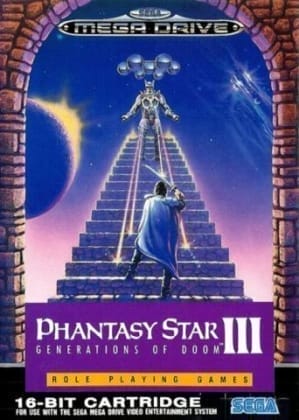
Phantasy Star III: Generations of Doom
This ambitious RPG features a multi-generational storyline where player choices determine bloodlines and alter the narrative across three distinct generations. Set in a floating world system, it combines traditional turn-based combat with groundbreaking marriage and inheritance mechanics.
Share this game
Story
A thousand years before the start of the game, two factions — one led by the swordsman Orakio, the other by the sorceress Laya — were engaged in a bitter conflict. An attempt at peace was made when the two leaders met for an armistice, but soon afterwards they both mysteriously vanished. This placed the two factions in a precarious situation, as each blamed the other for their leader's disappearance. All communication between the Orakians and Layans was suspended, travel between their respective worlds was prohibited, and the two groups teetered on the brink of war. Players take control of Rhys, Crown Prince of the Orakian kingdom of Landen, on the day of his wedding to Maia, a mysterious amnesiac who washed up on Landen's shore two months earlier. During the ceremony, a dragon (identified as a Layan) suddenly appears and snatches Maia, in what seems to be an overt escalation of the Layan-Orakian conflict. During Rhys's search for Maia, he recruits various characters to his cause. Ultimately, it is revealed that Maia herself is Layan, Princess of the kingdom of Cille, and that her kidnapping was actually a rescue attempt by her people, who believed she had been stolen from them by the "hostile" Orakians. It is later revealed in-game that both factions are the descendants of survivors from planet Palm of the Algo System — which was destroyed during the events of the previous game — and that their different kingdoms are sections of a massive colonization-spaceship. After three generations, both factions mix, and their descendants discover that all the conflicts among the different kingdoms were caused by the Dark Force, the main antagonist of the previous games, which is defeated in a final decisive battle that actually takes place 1,000 years after the events from the next game in the series .
Gameplay Systems
Phantasy Star III mostly follows the traditional turn-based role-playing game formula seen throughout the series, with the exploration of several 2-D worlds, character recruitment, and random enemy encounters using a turn-based battle system. Unlike previous games, the "technique" magic system plays a somewhat diminished role in combat. New features in the combat system include the auto-battle feature and the icon-based menu system. The feature that mostly separates Phantasy Star III , however, is that the story spans three generations of characters. At critical points throughout the game, the main character is given the option of marrying one of two women he has encountered during his travels. This choice determines the new main character of the next generation—the child (or children) of the previous lead. The choice also affects the gameplay, as the main character may be Orakian or a mix of Layan and Orakian, which differ in their ability to use techniques and their level of proficiency with them. Two paths in the second generation in turn lead to four paths in the third and final generation, and depending on which of the four main characters is played, the ending will vary.
Media Reviews
Electronic Gaming Monthly
32/40
Some information sourced from Wikipedia, available under CC BY-SA 3.0.