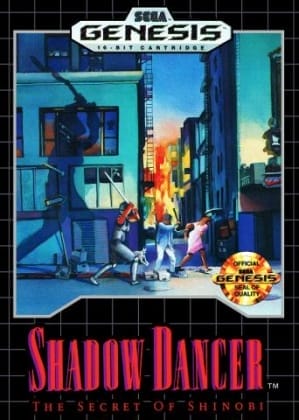

Genesis
Shadow Dancer: The Secret of Shinobi
This sequel to The Revenge of Shinobi introduces a canine companion that attacks enemies on command. Players control ninja Hayate through 5 urban stages featuring subway trains and neon-lit rooftops, culminating in battles against cybernetically enhanced bosses.
Share this game
Story
In 1997, an evil ninja cult, Union Lizard, worshipping a giant reptilian demon, had taken over New York City , turning most of the city to ruins. The few citizens who survived Union Lizard's onslaught of chaos are now kept prisoners by its members. A ninja warrior, accompanied by his faithful dog Yamato ( 大和 ) , emerges from hiding to combat Union Lizard's reign and rescue the hostages. The identity of the protagonist, which is kept ambiguous in the in-game opening, varies between supplemental materials. The Japanese manual identifies him as Hayate ( 疾風 ) , son of Joe Musashi from the previous games in the Shinobi series, while the English language manual identifies him as Joe Musashi himself coming out of retirement.
Gameplay Systems
The play mechanics are similar to the arcade version of Shadow Dancer , with the main difference being the addition of a meter for the dog that accompanies the protagonist. In order for the dog to attack an enemy, the player must hold down the attack button until the meter is filled. The dog will only attack when he is barking towards a nearby enemy. This allows the player to sic the dog on an enemy while standing and jumping, allowing for more versatility than in the arcade game (where the dog only attacked while the player was crouching). The objective of each stage is also slightly changed from retrieving time bombs to rescuing hostages, much like in the original Shinobi . The male hostages give out bonus points and the occasional extra life, while the female hostages will enhance the protagonist's attacks until he reaches the next stage or loses a life. While the one-hit-point-per-life system from the arcade version has been retained, there are numerous bonus lives hidden throughout the game. Between rounds, the player will participate in a bonus stage where the protagonist jumps down from a building and must shoot down an army of 50 enemy ninjas jumping in his direction. After the bonus stage ends, the player will gain a certain number of points or extra lives. If no enemies are hit, the player gains one life. Hitting all enemies rewards the player with three additional lives. There are three difficulty settings in the game, each affecting the enemy placement and the number of continues the player gets. The player can also choose to disable shurikens , using them only for boss battles and bonus stages. Bonus points are awarded at the end of each stage and boss battle (except for the final stage), based on how long it took the player to complete the stage and whether a ninjutsu attack was used or not. There are also hidden bonuses that the player can achieve by completing a stage or boss battle under a certain condition. There are five stages in all. The first four stages consist of three areas each, with the third area being a confrontation with an end boss. The fifth and final stage consists of a series of five rooms filled with various enemies, ultimately leading to Sauros' throne, the game's final boss.
Media Reviews
Electronic Gaming Monthly
32/40
Some information sourced from Wikipedia, available under CC BY-SA 3.0.