Genesis
Super Monaco GP
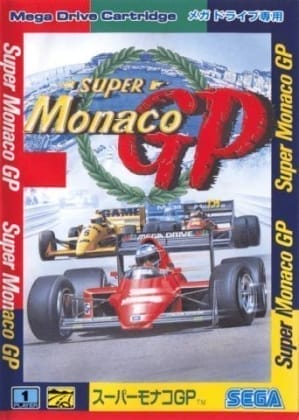
Super Monaco GP is a Formula One racing game developed and published by Sega for the Genesis in 1990. Featuring the official Monaco Grand Prix license, this game combines arcade-style racing with simulation elements. Players compete in a full season championship, managing tire wear and fuel consumption while mastering the twisting Monaco street circuit.
Share this game
Story
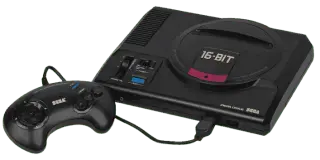
and technical aspects The idea for Super Monaco GP 's arcade version came from Hisao Oguchi , who was at the time a game planner with Sega. At a younger age, Oguchi had played Monaco GP , released by Sega in 1979. When Oguchi decided to design a game based on Formula One, he started with a different name but chose Super Monaco GP after listening to opinions that the name was a good one. He referenced a parallel between the Monaco Grand Prix being the top event in racing and Sega being the top company in arcades. The game was also developed for the tenth anniversary of Monaco GP . Super Monaco GP was the first arcade game where the arcade cabinet gave direct feedback in response to gameplay. The game's steering wheel includes force feedback with precision in response to the player's movements in-game. Utilizing the Sega X Board for an arcade system board , Super Monaco GP runs at 60 frames per second and displays on a 26 inch screen. The cabinet also includes a Fresnel lens to make the image on the game appear larger. The deluxe arcade cabinet came equipped with Sega's "Air Drive" system that would move the driver's seat in order to increase the sense of realism the player would feel. Up to eight cabinets are able to be linked via Sega's "Power Link" cable that was first demonstrated at the 1988 AMOA show. Both a deluxe and an upright version of the cabinet were available, and all models were painted to look like cars from F1 team McLaren , the team of 1988 F1 champion Ayrton Senna . Super Monaco GP was released for arcades in May 1989 in Japan. It debuted in the United States in August the same year, when Sega Enterprises USA president Tom Petit debuted it to arcade distributors at the Sofitel Hotel in Chicago . There, Petit revealed to approximately 40 other companies the success the game had in Europe and Asia, and its successful test results in the US, as well as a North American launch date in September. Shortly after the arcade release, Super Monaco GP was ported to the Sega Genesis, Game Gear , and Master System, and was also released for the Sega CD as part of Sega Classics Arcade Collection . The Game Gear release was one of three launch titles for the system. To make up for the lack of engagement the home game had in comparison to the arcade cabinet, Sega added more tracks and gameplay modes. It was also ported by Probe Software and published by U.S. Gold to computers , including the Amiga, Commodore 64, Atari ST , Amstrad CPC , and ZX Spectrum . According to programmer David Shea, who did the port for the ZX Spectrum, the idea of the port was more about capturing the spirit of the arcade game rather than trying to replicate it. Phillip Morris controversy Although the initial release to distributors of the arcade version had been very popular, Super Monaco GP was the subject of a lawsuit by Philip Morris over its Marlboro brand of cigarettes being parodied in the game as "Marlbobo". It had not been the only brand to be parodied, as brands such as Ford were parodied as "Fodo", BP as "BF", Honda as "Henda", FIA as "EIA" and Canon as "Conan", in addition to use of Playboy images of models edited to wear swimsuits. In-game appearances of "Marlbobo", however, had led to a complaint to the U.S. Federal Trade Commission by a professor from the Medical College of Georgia that Super Monaco GP was advertising cigarettes to children, the majority of players of arcade games. Philip Morris contacted Sega over the issue in November 1989, and Sega agreed to release a conversion kit removing the advertising in March 1990; the offending parody (as well as parody of Foster's called "Hoster's") were replaced with logos for Flicky , an older Sega arcade game. Sega argued the parodies were the attempts of game developers to create a realistic environment. With arcade units still featuring the parody after this release, Philip Morris sued Sega in February 1991. The tobacco company had also sued Namco over Marlboro imagery in its 1987 game Final Lap . Philip Morris wanted a total recall of the game as well as financial compensation and all advertising material destroyed, but settled with Sega in May 1992. As a condition of the settlement, Sega ran advertisements in arcade publications RePlay and Play Meter to offer to replace the chips in the game with new ones without advertising and pay each arcade operator $200 for returning the original chips. After the settlement, some tobacco critics were critical of Philip Morris' actions in the suit, calling the tobacco company's actions a publicity stunt .
Gameplay Systems
In the arcade version of Super Monaco GP , the game is a simulation of the Monaco Grand Prix , although the actual Circuit de Monaco is replaced by a fictional track that includes many features of the actual circuit. Players must qualify for the race around a short circuit before playing the main race; failing to complete the lap before the 45-second timer ends results in a Game Over . Performance on the practice lap will determine the player's starting grid position. The race is then played against 19 computer controlled drivers, and players have to maintain above a position limit which counts down, or else the game ends. Completing the race in third place or better allows the player to race again in wet conditions. Each race consists of three laps on the main track. Before a race begins, the player has selection of the car's transmission , among an automatic, 4-speed manual, and 7-speed manual. Players control their car with a steering wheel and shift with plates mounted behind the wheel, in a similar system to cars made by Ferrari . Acceleration and braking are handled by pedals. The top 20% of the game screen serves like a rear-view mirror , allowing players to see behind their car. Up to eight cabinets are able to be linked via Sega's "Power Link" cable. In addition to the arcade mode, the Sega Genesis version adds a World Championship mode to the gameplay. In the mode, players race against computer-controlled opponents across racetracks including Brands Hatch and Hockenheimring , encompassing all of the tracks of the 1989 Formula One World Championship . The goal of the game is to win the World Championship against other drivers. During the course of a season, players are able to be invited to join a better racing team, giving them a faster car to race. A password system is used to save progress in the World Championship mode, which takes approximately two hours to complete. The Sega CD version is mostly identical to the Genesis version with minor improvements to the game's sound effects. Unlike the Genesis port , the Master System version is not a true conversion of the original arcade game. The game includes a Grand Prix mode, which allows the player to race on a series of tracks, as well as a versus mode where two players can compete in a race between one and nine laps. The transmission selection is also different, allowing selections between 3, 5, and 7 speeds. The Amiga and Commodore 64 ports each offer four tracks for play with arcade mode, and the Amiga release offers the option of steering with either a joystick or a mouse.
Awards & Honors
a Special Award
Media Reviews
IGN
64
Famitsu
7/10
Electronic Gaming Monthly
9/10
Some information sourced from Wikipedia, available under CC BY-SA 3.0.