NES
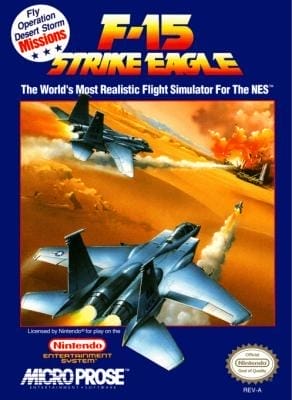
F-15 攻击鹰
《F-15 攻击鹰》是由MicroProse开发的战斗飞行模拟游戏。1987年在NES平台发行,模拟驾驶麦克唐纳·道格拉斯F-15鹰式战斗机的体验。玩家需要在不同战区执行包括空对空和空对地作战在内的各种任务。
发行日期
January 1, 1987
人数
1
地区
US
ROM 大小
512 KB
分享此游戏
故事
Operational history United States The F-15E was first delivered to the U.S. Air Force operational units in 1988. The F-15E reached initial operational capability on 30 September 1989 at Seymour Johnson Air Force Base in North Carolina with the 4th Tactical Fighter Wing , 336th Tactical Fighter Squadron . Gulf War The F-15E was deployed in response to Iraq's invasion of Kuwait in August 1990 for Operation Desert Shield . The 336th Tactical Fighter Squadron flew to Seeb Air Base in Oman to begin training exercises in anticipation of an Iraqi attack on Saudi Arabia ; in December, the 335th and 336th squadrons relocated to Prince Sultan Air Base in Saudi Arabia, closer to Iraq's border. At the start of Operation Desert Storm , 24 F-15Es launched an attack on five fixed Scud installations in western Iraq on 17 January 1991. Missions against Scud sites continued through that night with a second strike of 21 F-15Es. At night-time, F-15Es flew hunter missions over western Iraq, searching for mobile SCUD launchers. By conducting random bombings in suspected areas, it was hoped to deter the Iraqis from setting up for a Scud launch. On the war's opening night, an F-15E failed to hit a MiG-29 with an AIM-9 Sidewinder; other F-15Es also unsuccessfully engaged this lone MiG-29, which was eventually brought down by a missile of unknown origin. On 18 January, during a strike against a petrol oil and lubricant plant near Basrah , an F-15E was lost to enemy fire, killing both pilot and WSO. F-15E crews described this mission as the most difficult and dangerous of the war as it was heavily defended by SA-3s , SA-6s , SA-8s and Rolands as well as by anti-aircraft artillery. Two nights later, a second and final F-15E was downed by an Iraqi SA-2 ; the crew survived and evaded capture for several days and made contact with coalition aircraft, but a rescue was not launched due to security issues over an airman who failed to identify himself with proper codes. The Iraqis later captured both airmen. F-15Es destroyed 18 Iraqi jets on the ground at Tallil air base using GBU-12s and CBU-87s . On 14 February, an F-15E scored its only air-to-air kill of the war: a Mil Mi-24 helicopter. While responding to a request for help by US Special Forces, five Iraqi helicopters were spotted. The lead F-15E of two, via its FLIR, acquired a helicopter in the process of unloading Iraqi soldiers, and released a GBU-10 bomb. The F-15E crew thought the bomb had missed its target and were preparing to use a Sidewinder when the helicopter was destroyed. The Special Forces team estimated that the Hind was roughly 800 feet (240 m) over the ground when the 2,000 lb (910 kg) bomb hit its target. As another Coalition bombing operation had commenced, the F-15Es disengaged from combat with the remaining helicopters. F-15Es struck heavily defended targets throughout Iraq, prioritizing SCUD missile sites. Missions aimed at killing Iraqi President Saddam Hussein were undertaken by F-15Es, bombing several suspected locations. Prior to the ground war, F-15Es flew tank plinking missions against Iraqi vehicles in Kuwait. After 42 days of combat, a cease fire came into effect on 1 March 1991, leading to the creation of Northern and Southern no-fly zones over Iraq .
部分信息来源于 Wikipedia, 授权协议 CC BY-SA 3.0.