Arcade
灵魂能力
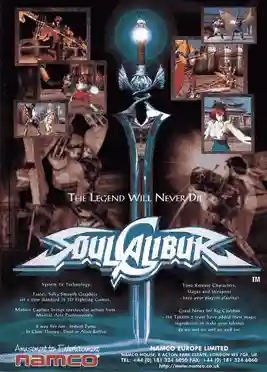
《灵魂能力》是由Project Soul开发、南梦宫发行的3D武器格斗游戏。作为《魂之利刃》的精神续作,它以八方向移动系统、武器格斗和突破性的3D图形革新了格斗游戏类型。玩家将操控寻找传说之剑灵魂能力的独特战士们展开战斗。
发行日期
January 1, 1998
人数
1
地区
US
ROM 大小
22.7 MB
分享此游戏
故事
Presentation Soul Blade and Soulcalibur through Soulcalibur IV provide their story through their "Arcade", "Tale of Souls" or "Story" mode, in which the player picks a character then follows a series of fights culminating in a duel against the wielder of Soul Edge or Soul Calibur. The story is presented through cinematic cutscenes, digital artworks as well as expository text, punctuating the end and sometimes the start of arcade mode. Character episodes are frequently contradictory, depicting the chosen characters destroying Soul Edge or seizing it for their own purposes. These contradictions would only be settled by the next game in the series, where the game manual, promotional material and in-game character biographies explain the events leading up to this point. The games also feature another single-player mode with its own story, alternatively called "Edge Master Mode", "Weapon Master Mode", "Chronicles of the Sword" and more. These stories present their own setting different from that of the Arcade mode, and were largely dismissed when establishing continuity between the different games.
玩法系统
Soulcalibur is a 3D fighting game series, sharing concepts and features with games like Virtua Fighter or Tekken . Both players must pick a character before fighting a duel divided in several rounds . Each character has their own preferred fighting style and weapon. To win a round, players must deplete their opponents' health gauge or propel them out of the arena. The games use a four button layout for control. 'G' is used to Guard, allowing fighters to block incoming attacks. 'A', 'B' and 'K' allow players to perform horizontal weapon attacks, vertical weapon attacks and kick attacks respectively. These buttons are then combined with directions from a d-pad or a joystick to perform one of several dozen moves available to each character. Soulcalibur introduced the series' trademark 8-Way Run system. It allows players to easily move their characters around the arena, taking full advantage of the game's 3D environments. Using this technique, players can maneuver around attacks or away from ring edges. Several attacks are only available from an 8-Way Run state. Soulcalibur also introduced an air control system that allows players to move their characters after they are hit in midair, letting them dodge most aerial juggles . This feature has meant that the Soulcalibur series features shorter combos than many competing fighting games . Introduced in Soul Edge , Guard Impacts are a defensive technique that allows the player to check an incoming strike and create an opening even against otherwise safe moves. These parries require precise timing and expose the fighter performing them to retaliation if used incorrectly. After a successful parry, the opposing player cannot perform any action besides a Guard Impact of their own. Soulcalibur through to Soulcalibur IV required different inputs to counter different moves ; by contrast, Soulcalibur V and Soulcalibur VI allow players to spend resources to counter any incoming attack regardless of attack height, so long as they can predict its timing. Soul Edge featured a mechanic intended to limit blocking in the Weapon Meter. As a player blocked attacks, their Weapon Meter would deplete. Once empty, their character could be disarmed, preventing them blocking any further attacks and forcing them to fight bare-handed until the end of the round. This system was abandoned in Soulcalibur , before being brought back in the form of the Soul Gauge in Soulcalibur IV . There, breaking the opponent's guard allows a player to perform a Critical Finish and win the round immediately. This was amended in Soulcalibur V to only provide an opening for a damaging combo .
销售与商业表现
总销量
13 million copies
部分信息来源于 Wikipedia, 授权协议 CC BY-SA 3.0.