
GB
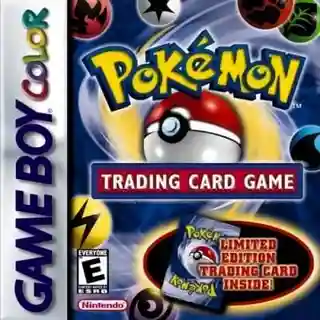
Pokémon Trading Card Game
Adaptation numérique du JCC Pokémon où les joueurs combattent des IA avec des decks personnalisés. Comprend les cartes des extensions Base, Jungle et Fossile avec progression style RPG.
Date de sortie
January 1, 1998
Développeur
Hudson SoftÉditeur
Hudson Soft
Joueurs
1
Région
US
Taille du ROM
457 KB
Partager ce jeu
Systèmes de jeu
The Pokémon Trading Card Game is a strategy-based card game that is usually played on a designated playmat or digitally on an official game client where two players (assuming the role of Pokémon Trainer) use their Pokémon to battle one another. Pokémon that have sustained enough damage from attacks–that reaches or exceeds its HP –is referred to as being "Knocked Out", granting the opponent a prize card; however, powerful card mechanics like Pokémon-V and Pokémon ex grant extra prize cards when Knocked Out. Taking all six prize cards is the most common win condition. Other ways to win are by "Knocking Out" or by removing all opponent's Pokémon in play–the Active and those on the Bench (i.e. the row behind the Active that can house up to five additional Pokémon to support and substitute Active Pokémon if it retreats or is "Knocked Out"), or by Decked Out–if at the opponent's next turn they have no cards left in deck to draw into. Players begin by having one player select heads or tails, and the other flips a coin; the winner of the coin flip will decide who goes first or second. (Dice may be used in place of coins, with even numbers representing heads and odd numbers representing tails; dice are also primarily used in official tournaments organized by The Pokémon Company). The player going first cannot attack or play a Supporter card (powerful Trainer effects card) on their first turn. Players shuffle their decks and draw seven cards, and then each puts one Basic Pokémon in play as their Active Pokémon. This Pokémon is the one that is actively attacking and receiving damage. If a player does not have any Basic Pokémon, they must call mulligan , shuffle, and then draw another hand until they draw a Basic Pokémon; the opponent may draw one additional card per mulligan. Once both players have at least one Basic Pokémon, they can play up to five more Basic Pokémon onto their Bench, and then take the top six cards of their deck and place them to the side as Prize cards. Play alternates between players who may take several actions during their turn, including playing additional Basic Pokémon, evolving their Pokémon, attaching an Energy card, playing Trainer cards, and using Pokémon abilities and attacks. After Trainer cards are played, cards are discarded by effects from Trainer cards or Abilities, and after Pokémon were "Knocked Out", they are put into the discard pile. A player may also retreat their Active Pokémon, switching the Active Pokémon with one on the Bench by paying the Active Pokémon's retreat cost of a certain number of Energies. At the cost of ending the turn, players may use one of their Active Pokémon's attacks once the prerequisite number and types of Energy attached to that Pokémon is fulfilled. Effects from that attack are then activated and damage may be dealt on the defending Pokémon, which may modify based on the defender Pokémon's type weakness or a resistance policies, and/or by any other effects on the defending Pokémon. Players alternate attacking until a player wins either through one of the above win conditions or by concession. Card types Pokémon cards depict one or multiple Pokémon from the Pokémon franchise, one to two elemental types, one or more attacks and/or an Ability, and a certain amount of HP. Basic Pokémon are Pokémon that have not evolved and can be played directly onto the Bench; they have Stage 1, Stage 2, and/or special mechanic evolutions. Each player may have up to six Pokémon in play: one in the Active Spot and five on the Bench. Most Pokémon have attacks that require a certain amount of Energies to use. Attacks deal damage to the opponent's Active Pokémon and sometimes deal additional damage to their Benched Pokémon; they may have additional effects like drawing cards, inflicting Special Conditions (Asleep, Burned, Confused, Paralyzed, or Poisoned) or altering the opponent's deck and/or board state. Abilities, previously called Poké-Powers and Poké-Bodies until 2011, are not attacks, but special effects on Pokémon that may be activated once or multiple times during their turn, such as drawing additional cards or switching the opponent's Active Pokémon with one of their Benched Pokémon, or can be passive, i.e. they remain in effect as long as the Pokémon with the Ability remains in play. The other type of Pokémon cards are Evolution Pokémon. In contrast to a Basic Pokémon, Evolution Pokémon cannot be directly put into play; they must be placed on top of the corresponding previous Stage Pokémon to evolve it, and they cannot be played onto a Pokémon the same turn that Pokémon was put into the Bench or during the player's first turn. Stage 1 Pokémon evolve from Basic Pokémon, and Stage 2 Pokémon evolve from Stage 1 Pokémon. As a Pokémon evolves, it gains HP and their attacks change, usually becoming more powerful. Over the years many different variations to the standard mechanics have been added, the most prominent of which are the signature feature of their respective expansion series. Major Pokémon Card Attributes Card Type Release Expansion Evolution Stage(s) Mechanics Shining Pokémon, Pokémon ☆, Radiant Pokémon Neo Revelation & Shining Legends (Shining), EX Team Rocket Returns (☆), Astral Radiance (Radiant) Basic One per deck (excluding Shining Pokémon released after Shining Legends) Pokémon-ex, Pokémon ex EX Ruby & Sapphire series, Scarlet & Violet series Basic, Stage 1, Stage 2 2 Prizes, official documentation writes the names from the two releases differently but they function the same and are treated as such. Pokémon LV.X Diamond & Pearl series LEVEL-UP Can use attacks, Poké-Powers, and Poké-Bodies from its previous evolution Pokémon LEGEND HeartGold & SoulSilver series LEGEND 2 Prizes, 2 cards must be played onto the Bench at the same time Pokémon-EX Next Destinies Basic 2 Prizes, distinct from Pokémon-ex Mega Pokémon-EX XY series Mega Evolution series MEGA 2 Prizes, turn ends after evolving from Pokémon-EX (XY Series) 3 P
Certaines informations proviennent de Wikipedia, disponible sous CC BY-SA 3.0.