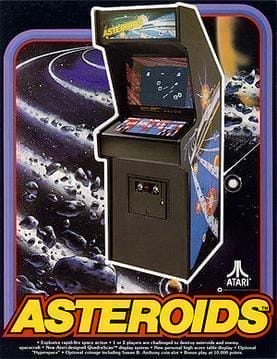

Arcade
Asteroids
The groundbreaking vector arcade shooter where players control a triangular spaceship to destroy asteroids and flying saucers in a wraparound space environment while avoiding collisions.
Release Date
January 1, 1979
Players
1
Region
US
ROM Size
7 KB
Share this game
Story
of observations Despite their large numbers, asteroids are a relatively recent discovery, with the first one—Ceres—only being identified in 1801. Only one asteroid, 4 Vesta , which has a relatively reflective surface , is normally visible to the naked eye in dark skies when it is favorably positioned. Rarely, small asteroids passing close to Earth may be briefly visible to the naked eye. As of May 2025 [ update ] , the Minor Planet Center had data on 1,460,356 minor planets in the inner and outer Solar System, of which about 826,864 had enough information to be given numbered designations. Discovery of Ceres In 1772, German astronomer Johann Elert Bode , citing Johann Daniel Titius , published a numerical procession known as the Titius–Bode law (now discredited). Except for an unexplained gap between Mars and Jupiter, Bode's formula seemed to predict the orbits of the known planets. He wrote the following explanation for the existence of a "missing planet": This latter point seems in particular to follow from the astonishing relation which the known six planets observe in their distances from the Sun. Let the distance from the Sun to Saturn be taken as 100, then Mercury is separated by 4 such parts from the Sun. Venus is 4 + 3 = 7. The Earth 4 + 6 = 10. Mars 4 + 12 = 16. Now comes a gap in this so orderly progression. After Mars there follows a space of 4 + 24 = 28 parts, in which no planet has yet been seen. Can one believe that the Founder of the universe had left this space empty? Certainly not. From here we come to the distance of Jupiter by 4 + 48 = 52 parts, and finally to that of Saturn by 4 + 96 = 100 parts. Bode's formula predicted another planet would be found with an orbital radius near 2.8 astronomical units (AU), or 420 million km, from the Sun. The Titius–Bode law got a boost with William Herschel 's discovery of Uranus near the predicted distance for a planet beyond Saturn . In 1800, a group headed by Franz Xaver von Zach , editor of the German astronomical journal Monatliche Correspondenz (Monthly Correspondence), sent requests to 24 experienced astronomers (whom he dubbed the " celestial police "), asking that they combine their efforts and begin a methodical search for the expected planet. Although they did not discover Ceres, they later found the asteroids 2 Pallas , 3 Juno and 4 Vesta . One of the astronomers selected for the search was Giuseppe Piazzi , a Catholic priest at the Academy of Palermo, Sicily. Before receiving his invitation to join the group, Piazzi discovered Ceres on 1 January 1801. He was searching for "the 87th [star] of the Catalogue of the Zodiacal stars of Mr la Caille ", but found that "it was preceded by another". Instead of a star, Piazzi had found a moving star-like object, which he first thought was a comet: The light was a little faint, and of the colour of Jupiter , but similar to many others which generally are reckoned of the eighth magnitude . Therefore I had no doubt of its being any other than a fixed star. [...] The evening of the third, my suspicion was converted into certainty, being assured it was not a fixed star. Nevertheless before I made it known, I waited till the evening of the fourth, when I had the satisfaction to see it had moved at the same rate as on the preceding days. Piazzi observed Ceres a total of 24 times, the final time on 11 February 1801, when illness interrupted his work. He announced his discovery on 24 January 1801 in letters to only two fellow astronomers, his compatriot Barnaba Oriani of Milan and Bode in Berlin. He reported it as a comet but "since its movement is so slow and rather uniform, it has occurred to me several times that it might be something better than a comet". In April, Piazzi sent his complete observations to Oriani, Bode, and French astronomer Jérôme Lalande . The information was published in the September 1801 issue of the Monatliche Correspondenz . By this time, the apparent position of Ceres had changed (mostly due to Earth's motion around the Sun), and was too close to the Sun's glare for other astronomers to confirm Piazzi's observations. Toward the end of the year, Ceres should have been visible again, but after such a long time it was difficult to predict its exact position. To recover Ceres, mathematician Carl Friedrich Gauss , then 24 years old, developed an efficient method of orbit determination . In a few weeks, he predicted the path of Ceres and sent his results to von Zach. On 31 December 1801, von Zach and fellow celestial policeman Heinrich W. M. Olbers found Ceres near the predicted position and thus recovered it. At 2.8 AU from the Sun, Ceres appeared to fit the Titius–Bode law almost perfectly; however, Neptune, once discovered in 1846, was 8 AU closer than predicted, leading most astronomers to conclude that the law was a coincidence. Piazzi named the newly discovered object Ceres Ferdinandea, "in honor of the patron goddess of Sicily and of King Ferdinand of Bourbon ".
Some information sourced from Wikipedia, available under CC BY-SA 3.0.