NDS
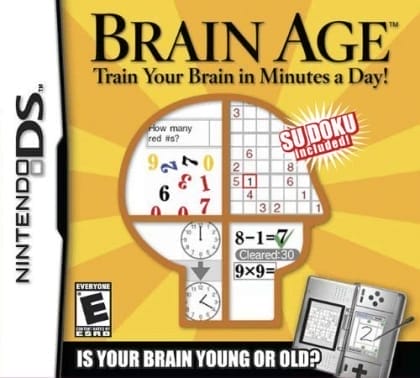
Brain Age: Train Your Brain in Minutes a Day!
Brain Age is a collection of puzzles and exercises designed to stimulate your brain. Based on the research of neuroscientist Dr. Ryuta Kawashima, the game uses the DS touchscreen for quick daily training sessions to improve memory and processing speed.
Share this game
Gameplay Systems
This section does not cite any sources . Please help improve this section by adding citations to reliable sources . Unsourced material may be challenged and removed . Find sources: "Brain Age: Train Your Brain in Minutes a Day!" – news · newspapers · books · scholar · JSTOR ( April 2024 ) ( Learn how and when to remove this message ) Brain Age is designed to be played a little each day, similar to the Nintendogs titles and Animal Crossing: Wild World . The game is played with the DS rotated 90 degrees like a book, with the touch screen on the right for right-handed people and the left for left-handed people. The game is entirely touch and voice-controlled – the player either writes the answer to the puzzle on the touch screen or speaks it into the microphone. Before the player can begin a Brain Age session, they must input information. First, players must confirm the date and select which hand they write with. The player then inputs their name and date of birth. At the end of all Brain Age Check puzzles, Training puzzles, Quick Play puzzles, and Sudoku puzzles, the player is shown how quickly they completed it, the player's speed (according to metaphors such as "bicycle speed" and "jet speed", the highest being "rocket speed"), and a tip for either improving the player's brain or a game-related tip. If the player's time or score in Brain Age Check or Training is high enough, it will appear on one or both of the Top Three. The Top Three shown is the player's own top three attempts at a puzzle, while they can also compare the top three with those of other saved players. The player's score is only counted on their first attempt at a puzzle each day. The player is also awarded stamps for each day they complete the puzzles. When enough is accumulated, the game unlocks certain features such as more puzzles in Training mode, Hard versions of these puzzles, and the ability to customize the player's own stamps. While the player is navigating the menus outside of the puzzles, Professor Kawashima appears to prompt and encourage the user. Brain Age allows up to four players to save profiles on one DS game card, and these players can interact with each other in several different ways. There are five modes of play – Brain Age Check, Training, Quick Play, Download, and Sudoku. When starting a session, Kawashima may ask the player to participate in a Picture-Drawing Quiz, which requires the player to draw a person, place, or thing by memory using the touch screen. After the player has done all three, the game will compare their drawing to an example created by the game developers, along with advice of what to emphasize on below its image. If more than one player profile is saved on the game card, images for the day can be compared to those of other players. Kawashima may also ask the player to participate in a Memory Quiz, which requires the player to recall a recent event, such as what the player ate or the most interesting thing seen on television the day before. Several days later, it will ask for the answer originally provided, and will then compare the answer given several days ago and the answer given on the current day to test the player's recollection skills. The player is not scored on their ability to remember. Brain Age Check The game includes four modes: Brain Age Check, Training, Quick Play, and Sudoku. The Brain Age Check gives the player three puzzle minigames to complete. The first is usually a Stroop test, although the player can choose to skip the Stroop test if they are not in a quiet environment or is otherwise unable to speak into the microphone. At the end of the Brain Age Check, the game reports on the player's "brain age", a theoretical assessment of the age of the player's brain. The higher the brain age, the worse the player performed. The best possible score is 20 and the worst 80, according with Kawashima's theory that the brain stops developing at 20. The player may replay the Brain Age Check, but the brain age is registered per day only. Once the player confirms whether or not they can speak into the microphone, Professor Kawashima will describe the first puzzle. If the player answered that they can speak, the game begins with a Stroop test ; if the player cannot use the microphone, the game picks a random puzzle from the following: Calculations X 20, Word Memory, Connect Maze, and Number Cruncher. During the Stroop Test , the game will display one of four words and colors: blue, black, yellow, and red. One of these words mentioned will appear on screen, in a random color which may not match the color denoted by the word. The player is instructed to say the color of the word, rather than the word itself (e.g., if the word Yellow appears in blue letters, the correct answer is "blue" according to the Stroop effect for details). In Speed Counting , which requires speaking but does not use the microphone, the player counts up from one to 120 as fast as they can without slurring the names of numbers. Word Memory gives the player a list of 30 four-lettered words. The player is given two minutes to study the list and memorize as many words as possible. After the time is up, the player must write down as many words as they can in three minutes. To spell words that were not on the list won't make the player lose marks but the system won't recognize them. On the contrary, spelling an on-list word will count as memorized and even the test will notify the players if they already wrote this word in case they rewrite it. Connect Maze gives players a randomly created group of circles, with letters and numbers in them. The player must follow the pattern A-1-B-2 until reaching M-13 as quickly as possible. Calculations × 20 presents the player with 20 simple calculation equations that includes addition , subtraction , and multiplication . On the top screen are the problems which scroll up as answered whether right or wrong, while the touch screen is used to write out the answer. This test is
Sales & Commercial Performance
Total Copies Sold
2 million copies
Media Reviews
IGN
8
GameSpot
7.2
Edge
06
Some information sourced from Wikipedia, available under CC BY-SA 3.0.