N64
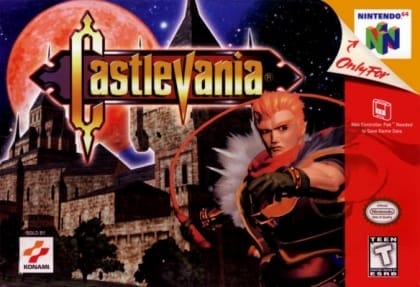
Castlevania
Castlevania for Nintendo 64 is a 3D action-adventure game that brings the vampire-hunting legacy into the third dimension. Players control Reinhardt Schneider or Carrie Fernandez through Dracula's castle, featuring dynamic camera angles and the series' signature whip combat.
Share this game
Story
and setting Creator of the series, Hitoshi Akamatsu, wanted players to feel like they were in a classic horror film. Zombies , werewolves , Frankenstein's monster , and Count Dracula make recurring appearances. Alucard , introduced in Castlevania III: Dracula's Curse , is a reference to the character of the same name from the 1943 film, Son of Dracula . The games include folklore and mythological monsters such as Medusa , as well as direct references to literary horror . Castlevania: Bloodlines explicitly incorporates the events of Bram Stoker 's Dracula into the series, and the recurring character Carmilla is based on the 1872 novel Carmilla by Joseph Sheridan Le Fanu . Castlevania mainly takes place in the castle of Count Dracula , who resurrects every hundred years to take over the world. With the exception of some games, the players assume the role of the Belmonts , a clan of vampire hunters who have defeated Dracula for centuries with the Vampire Killer. The Vampire Killer is a legendary whip that is passed down to their successors and can only be used by them. In Castlevania: Bloodlines , the whip has been inherited by John Morris, the son of Quincey Morris , who is a distant descendant of the Belmonts. Other recurring characters throughout the series include the dhampir Alucard, who sides with Trevor Belmont against his father Dracula in Dracula's Curse . Trevor is joined by Sypha Belnades , a vampire hunter who fights using magic and marries Trevor by the end of the game. Descendants of the Belnades clan, such as Carrie Fernandez and Yoko Belnades , would make appearances as playable characters in later titles. Castlevania: Lords of Shadow is a reboot of the franchise, with its first game set in Southern Europe during the Middle Ages. The main character, Gabriel Belmont, is a member of the Brotherhood of Light, an elite group of holy knights who defend people from supernatural creatures. With a retractable chain whip called the Combat Cross, Gabriel fights a malevolent force known as the Lords of Shadow in order to obtain the God Mask, which he believes can bring back his deceased wife. In Castlevania: Lords of Shadow - Mirror of Fate , Gabriel stars as Dracula, the main antagonist of Simon and Trevor Belmont. The sequel, Castlevania: Lords of Shadow 2 is set during modern times, where Dracula is looking for a way to put an end to his immortality. In 2002, the games Legends , Circle of the Moon , Castlevania (1999), and Legacy of Darkness were retconned from the official chronology by Koji Igarashi , a move which had been met with some criticism by fans. Igarashi noted that Legends conflicted with the plotline of the series, and that the reason for Circle of the Moon ' s removal was not due to his non-involvement with the game, but instead the intention of the game's development team for Circle of the Moon to be a stand-alone title. The American 20th Anniversary Pre-order Bundle for Portrait of Ruin in 2006 featured a poster with a timeline that re-included the games other than Legends . In 2007, Konami still excluded them from the canon on the official Japanese website. Igarashi has said that he considered the titles a "subseries".
Gameplay Systems
Castlevania , released for the NES in 1986, is a platform game in which the player takes the role of the character Simon Belmont, navigating through six levels of Dracula's castle. Each level is divided into six blocks of three stages each. He can navigate the castle's terrain by jumping across platforms and walking up staircases, enabling him to progress to new stages. Simon has a health meter, which decreases upon contact with enemies or hazards. Loss of all health, falling off-screen, or running out of time results in losing a life, with the game ending when all lives are depleted, though players can continue from the last checkpoint. Collecting points throughout the levels can increase the player's score and earn them additional lives. Each level culminates in a boss battle against one of Dracula's monsters, each with their own life meter that needs to be depleted using Simon's attacks. Simon wields the Vampire Killer whip, which can be improved by collecting upgrades hidden in candles. These upgrades extend the whip's length and power, allowing Simon to attack enemies from a greater distance with increased damage. Alongside the whip, Simon can use secondary weapons like throwing knives, holy water, and the boomerang-like cross, which consume hearts collected throughout the levels. While Castlevania' s gameplay set the standard for most titles, Castlevania II: Simon's Quest in 1987 briefly introduced role-playing elements, a departure from the strict platforming format of its predecessor. Unlike the linear progression of the first game, Simon's Quest allows players to explore a freely accessible world map, revisit areas, and engage with a dynamic environment that includes day and night cycles affecting enemy strength and the availability of non-playable characters. Players can interact with villagers who provide hints and visit merchants to buy items using hearts collected from defeated enemies. This installment also introduces experience points where Simon can increase his level and health capacity by gathering hearts. 1997's Castlevania: Symphony of the Night significantly expanded upon the gameplay introduced in Simon's Quest , setting a new formula for the series and influencing subsequent Metroidvania titles. Symphony of the Night also features non-linear exploration, requiring players to gather specific items and abilities to access different areas of Dracula's castle. This installment expanded the role-playing elements by including a more complex attribute and leveling system where the protagonist, Alucard, increases his in-game statistics by gaining experience points from defeated enemies. Alucard's ability to transform into a bat, wolf, or mist also allows him to explore previously inaccessible areas, and he can also use a wider range of equipment. The first 3D installment in the franchise, Castlevania (1999) on the Nintendo 64 adopted gameplay elements distinctly different from its 2D predecessors. Unlike earlier titles, this version implemented a basic targeting and lock-on system for combat for the two playable characters, Reinhardt and Carrie. The new environment itself played a crucial role in the gameplay, with challenges based on precision in jumping across 3D platforms and navigating through hazardous areas, some of which included rotating and crumbling platforms. Castlevania for the Nintendo 64 also incorporated elements of survival horror, such as a sequence where the player must run from a pursuing enemy in a hedge maze. Unlike the earlier 3D installment which involved navigating through various levels with a degree of platforming challenge, 2003's Lament of Innocence focused on a central hub system. This hub allowed access to five main areas from the start, with progress tied to defeating bosses to unlock the final area. The combat system also allows the player to execute a series of fluid and dynamic combos using the primary weapon, the Whip of Alchemy. This system enables players to chain attacks into continuous strikes, enhancing combat engagement and effectiveness against enemies. The 2010 reboot, Lords of Shadow introduced a more diverse range of up to forty unlockable combos with the game's whip, the Combat Cross, integrating both direct and area attacks. Additionally, it functions as a tool for exploration, aiding in scaling walls, rappelling, and swinging across gaps, which deepens the platforming elements central to the franchise. Moreover, Lords of Shadow features massive boss battles against titans, where players must use the Combat Cross to navigate and disable them.
Media Reviews
IGN
100
GameSpot
2
Nintendo Power
200
Some information sourced from Wikipedia, available under CC BY-SA 3.0.