PS1
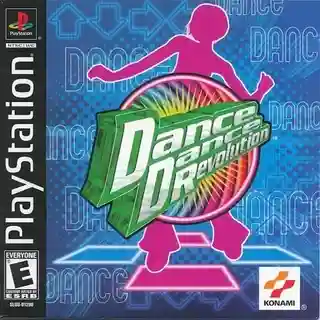
Dance Dance Revolution
The revolutionary music rhythm game that started a global dancing phenomenon. Step to the beat on a dance mat controller with iconic J-pop, eurobeat, and licensed tracks that defined a generation.
Share this game
Gameplay Systems
The core game involves the player stepping their feet to correspond with the arrows that appear on the screen and the beat of the song playing. During normal gameplay, arrows scroll upwards from the bottom of the screen and pass over a set of stationary arrows near the top (referred to as the "guide arrows" or "receptors", officially known as the Step Zone). When the scrolling arrows overlap the stationary ones, the player must step on the corresponding arrows on the dance platform. Upon doing so, they are given a judgement for their accuracy of every streaked note (From highest to lowest: Marvelous, Perfect, Great, Good, Almost, Miss ). Additional arrow types were added in later mixes. Freeze Arrows , introduced in MAX , are long green arrows that must be held down until they completely travel through the Step Zone. Each of these arrows awards an "O.K.!" if successfully pressed or an "N.G." when the arrow is released too quickly. An "N.G." decreases the life bar and, starting with X , also breaks any existing combo. X also introduced Shock Arrows , walls of arrows with lightning effects that must be avoided, which will award an "O.K.!" if successfully avoided or an "N.G." if any of the dancer's panels are stepped on. An "N.G." for shock arrows has the same consequences found with freeze arrows, but hitting a shock arrow additionally hides future steps for a short period. Successfully hitting the arrows in time with the music fills the "Dance Gauge", or life bar , while failure to do so drains it. If the Dance Gauge is fully exhausted during gameplay, the player will fail the song, and the game will be over. Otherwise, the player is taken to the Results Screen, which rates the player's performance with a letter grade and a numerical score , among other statistics. The player may then be given a chance to play again, depending on the settings of the particular machine. The default limit is three songs, though operators can set the limit between one and five. Aside from play style Single, Dance Dance Revolution provides two other play styles: Versus, where two players can play Single simultaneously, and Double, where one player uses all eight panels. Before the 2013 release of Dance Dance Revolution , some games offer additional modes, such as Course mode (players must play a set of songs back-to-back) and Battle mode (two players compete with a tug-of-war life bar by sending distracting modifiers to each other). Earlier versions also have Couple/Unison Mode, where two players must cooperate to play the song. Course Mode was reintroduced to the series starting with A20 . Difficulty Depending on the edition of the game, dance steps are broken into various levels of difficulty, often by color. The difficulty is separated into two to five categories, depending on the game: Game Difficulty Beginner Basic Difficult Expert Challenge SuperNOVA series † 1–4 1–9 2–10 4–10 6–10 X and newer 1–9 2–13 4–16 7–18 4–19 † Dance Dance Revolution Extreme and older also used these difficulties, but with different names and level ranges from game to game. Some difficulties are absent in some games. The first release of Dance Dance Revolution established two difficulties: Basic for Single and Double modes, and Another for Single mode only. Each chart is rated with a level from 1 to 7, and every release through 3rdMix Plus also attributed a title to each level number. The Internet Ranking Version added Another for Double mode, and a new higher difficulty of Maniac for Single mode only, along with several level 8 charts, titled Exorbitant. 2ndMix Club Version 2 introduced several level 9 charts, titled Catastrophic until 3rdMix Plus and Evolutionary in X3 vs. 2ndMix . The Maniac difficulty was renamed SSR and expanded to Double mode for new songs in 3rdMix , with the name reverting to Maniac in 3rdMix Plus . Beginning with 4thMix , all songs featured the Maniac difficulty in Single and Double mode. Also, Another was renamed to Trick . 4thMix Plus introduced new Maniac charts for 16 songs, while the original Maniac charts were labelled Maniac-S and Maniac-D in this game, with only the new charts remaining in 5thMix . DDRMAX introduced the "Groove Radar", showing how difficult a particular sequence was in various categories, such as the maximum density of steps. This release removed the level numbers, and among the 42 songs, two ("Flash in the Night" and "Follow Me") have never received any level numbers due to being DDRMAX exclusives. Additionally, DDRMAX changed the difficulty names to Light , Standard , and Heavy . Beginning with DDRMAX2 , level numbers were reintroduced, along with a level 10 for "MAX 300" and "MAXX Unlimited". Level 10 was titled Revolutionary in X3 vs. 2ndMix . DDRMAX2 also introduced the Challenge difficulty with "Kakumei" ("革命") on One More Extra Stage, and in Nonstop Challenge Mode songs. Extreme introduced the Beginner difficulty, which premiered in Dancing Stage EuroMix , as the game's easiest difficulty. It is only available in Single mode, except in the DDR Universe series for the Xbox 360 , which offers Beginner difficulty in Single and Double modes. Extreme features a total of 37 songs with the Challenge difficulty. Exclusive to Extreme were "flashing 10s" that are harder than regular 10s. SuperNOVA standardizes the naming of difficulty to the Beginner , Basic , Difficult , Expert , and Challenge respectively. Due to the old system not going past level 10 and other outdated reasonings, X overhauls the numbering system, now extending the scale of 1–20. All songs from previous versions were re-rated on the new scale, roughly multiplying the old number to 1.4x (i.e. 9 now being 12 or 13). Even though the rating can go up to 20, no song has reached that level. The highest rated song on X is 18. X2 introduced the first 19: "Valkyrie dimension" Challenge. Although the new rating system is an improvement from the old system, it is common for each sequel to re-rate charts to reflect the prop
Some information sourced from Wikipedia, available under CC BY-SA 3.0.