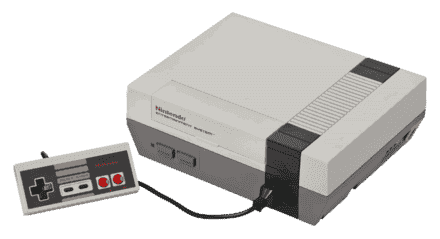
NES
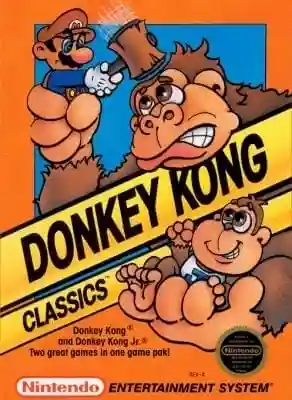
Donkey Kong Classics
A compilation cartridge featuring both the arcade classic 'Donkey Kong' and its sequel 'Donkey Kong Jr.' Relive Mario's first appearances as he rescues Pauline from the giant ape, then play as Donkey Kong Jr. saving his father from Mario's clutches.
Share this game
Story
Donkey Kong is the earliest video game with a storyline that visually unfolds on screen. Set on a construction site in New York City , the eponymous Donkey Kong character is the de facto villain. The hero is a carpenter originally unnamed in the Japanese arcade release, later called Jumpman, then Mario. Donkey Kong kidnaps Mario's girlfriend, originally known as Lady and later renamed Pauline. The player takes the role of Mario to rescue her. This is the first occurrence of the damsel in distress scenario used in countless video games released after. : 82 The game uses graphics and animation for characterization. Donkey Kong smirks upon Mario's demise. Pauline has a pink dress and long hair, : 19–20 and a speech balloon crying "HELP!". Mario, depicted in red overalls and a red cap, is an everyman character, a type common in Japan. Graphical limitations and the low pixel resolution of the small sprites prompted his design. A mustache implies a mouth, : 37 a cap obviates the animation of hair, and colored overalls distinguish his arm movements. : 238 The artwork of the cabinets and promotional materials make these cartoon-like character designs even more explicit. Pauline, for example, is disheveled like King Kong ' s Fay Wray in a torn dress and stiletto heels . : 19–20 Like Pac-Man (1980), Donkey Kong has cutscenes , but innovates by advancing a complete plot. The game opens with the gorilla climbing a pair of ladders to the top of a construction site, accompanied by a variation on the musical theme from Dragnet . He drops Pauline and stomps his feet, warping the steel beams. He moves to his final perch and sneers. A melody plays, and the level starts. This sequence sets the scene and adds background to the gameplay—a first for video games. At the end of the stage, a heart appears between Mario and Pauline, but Donkey Kong grabs her and climbs higher, causing the heart to break. The narrative concludes when Mario reaches the end of the rivet stage, when he and Pauline are reunited. : 40–42
Gameplay Systems
Following 1980's Space Panic , Donkey Kong is one of the earliest examples of the platform game genre, : 94 even prior to the term being coined; the U.S. gaming press used "climbing game" for games with platforms and ladders. As the first platformer game to feature jumping, Donkey Kong requires the player to jump between gaps and over obstacles or approaching enemies whilst Donkey Kong throws barrels at the player, setting the template for the future of the genre. With four unique stages, Donkey Kong was the most complex arcade game of the time, and one of the first arcade games with multiple stages, following games such as 1980's Phoenix and 1981's Gorf and Scramble . : 66 In addition to the goal of saving Pauline , the player has a score. Points are awarded for the following: leaping over obstacles; destroying objects with a hammer power-up; collecting items such as hats, parasols, and purses; removing rivets from platforms; and completing each stage according to a steadily decreasing bonus counter. The player starts with three lives with a bonus life awarded at 7,000 points. A life is lost when Mario touches Donkey Kong or any enemy object, falls too far, or lets the bonus counter reach zero. The game ends when all lives are lost. Each of the four single-screen stages represents 25 meters of the structure Donkey Kong has climbed: 25, 50, 75, and 100 meters. Stage one involves Mario scaling a construction site made of crooked girders and ladders while jumping over or hammering barrels and oil drums tossed by Donkey Kong. Stage two involves climbing a five-story structure of conveyor belts , each of which transport cement pans. The third stage involves the player riding elevators while avoiding bouncing springs. The final stage requires Mario to remove eight rivets from the platforms supporting Donkey Kong; this causes Donkey Kong to fall and the hero to be reunited with Pauline. These four stages combine to form one level. After each level, the stages repeat with increased difficulty. For example, Donkey Kong begins to hurl barrels faster and sometimes diagonally, and fireballs speed up. The victory music alternates between levels 1 and 2. The fourth level consists of five stages with the final stage at 125 meters. Bugs and exploits The first stage of level 22, the 130th stage overall, is colloquially known as the kill screen because of a programming error that kills Mario after a few seconds, effectively ending the game. In January 2025, a glitch was discovered via a tool-assisted superplay which sometimes allows climbing straight to the top of the kill screen from the starting point. This allows continuing the game until the 135th stage. Due to the limits of the joystick used, it is impossible to perform this trick on an actual Donkey Kong arcade machine within the stage's time limit.
Sales & Commercial Performance
Total Copies Sold
8 million copies
Total Revenue
$180 million
Media Reviews
IGN
2
Some information sourced from Wikipedia, available under CC BY-SA 3.0.