Arcade
Double Dragon 3: The Rosetta Stone
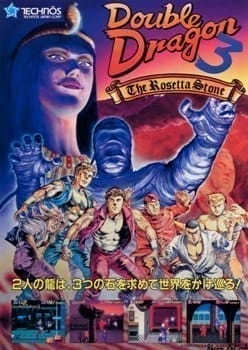
Double Dragon 3: The Rosetta Stone is the 1990 arcade sequel that takes Billy and Jimmy Lee on a global quest for the mystical Rosetta Stone. Introducing weapon shops, multiple playable characters, and a controversial difficulty curve, it expanded the beat 'em up formula with RPG elements.
Release Date
January 1, 1990
Players
1
Region
US
ROM Size
13.5 MB
Share this game
Story
After returning home from a two-year training mission, Billy and Jimmy Lee come across a fortune teller named Hiruko. The woman tells the Lee brothers that in order to challenge the world's strongest adversary, they must seek out the three Rosetta Stones that have been scattered around the world. The game begins in the United States, where the Lee brothers must defeat the remnants of the Black Warriors gang from the previous games before they set off to find the stones. Afterward, the heroes must travel to China, Japan, Italy, and finally Egypt, where each of the stones are being guarded by formidable fighters unique to each country (such as the shinobi in Japan and archers in Italy) who will refuse to give them up without a fight. Once all three Rosetta Stones have been procured, the Lee brothers' journey reaches its final destination in Egypt, where they face all sorts of supernatural creatures as they enter Cleopatra 's tomb to uncover the mystery surrounding the stones.
Gameplay Systems
Double Dragon 3 can be played by up to two or three players simultaneously, similarly to The Combatribes . The first two players control returning heroes Billy and Jimmy Lee respectively, while the third player controls a new character named Sonny (a yellow-clad palette swap of the Lee brothers). The controls consist of an eight way joystick and three buttons again, but the combat system has been greatly altered from previous games. The game discards the directional attack buttons from Double Dragon II: The Revenge , returning to the punch and kick format of the original Double Dragon . However, moves such as the elbow strike and the hair grab had been removed and new abilities replaced them. The player can now run by pushing the joystick left or right twice and perform moves with a second player such as a back-to-back hurricane kick when standing near each other and a triangle jump kick when one player jumps towards the other. Other new moves include a running head-butt, a belly-to-back throw and a jumping knee drop. At the start of certain stages, players will have access to an item shop where they can purchase in-game power-ups by inserting more coins into the cabinet, with each item costing one credit. The item selections varies slightly between stages, but usually includes "Energy" (which restores the player's health up to 150% from the starting value), "Power Up" (which increases the player's attack speed), "Tricks" (which unlocks two additional moves, a solo hurricane kick and a jumping throw) and "Weapons" (which arms the player character with a nunchaku in Mission 2 or a sword in Mission 3 and 5). One item, "Extra Guys", allows the player to control one of three new character types in addition to the Lee brothers ( リー兄弟 ) . These characters form other teams of fighting siblings as well, allowing each player to control a different member of the group. When the player's current fighter is killed, the new one will replace him, essentially substituting the extra lives system from previous games. These new fighters consists of the Urquidez brothers ( ユキーデ兄弟 ) (mixed martial arts champions), the Chin brothers ( 陳兄弟 ) ( tai chi experts) and the Ōyama brothers ( 大山兄弟 ) ( karate masters). Each player can hold up to three extra fighters in reserve and can temporarily cycle between any of them for a second before the next character is automatically chosen. The availability of a fighter type varies depends on the stage (the Urquidez brothers are available in Mission 1 and 5, the Chin brothers in Mission 2 and the Ōyama brothers in Mission 3). The new character will inherit any purchased special techniques that the previous character had, but the increased attack speed must be repurchased. Additionally, unlike the Lee brothers, the other character types cannot purchase nor retrieve weapons. The Japanese version of Double Dragon 3 was finished a bit later than the English version and features drastic changes as a result. Most notably, the item shops were removed from the game and players can instead choose which character to control at the start of the game, allowing the ability to start the game as any of three new fighter types (Urquidez, Chin and Ōyama) in addition to the Lee brothers. Players have access to their character's entire repertoire of moves, although the command input for the Hurricane Kick requires more precise timing in the Japanese version. Since weapons are no longer purchasable items, they can be found lying around on the floor in certain stages, waiting to be picked up by a player controlling a Lee brother. The game was also made easier, with enemies doing 1/3 less damage than in the overseas releases.
Media Reviews
IGN
83
Some information sourced from Wikipedia, available under CC BY-SA 3.0.