N64
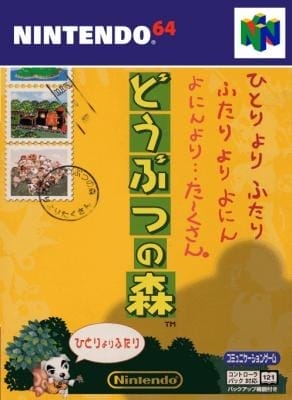
Animal Forest
The groundbreaking life simulation game that spawned the Animal Crossing series. Players move to a village inhabited by anthropomorphic animals, where they can fish, catch bugs, decorate their home, and interact with charming villagers in real-time according to the console's internal clock.
Share this game
Gameplay Systems
In the Animal Crossing games, the player assumes the role of a human character who moves into a rural village populated with anthropomorphic animals and lives there indefinitely. Gameplay is open-ended : players have no defined objectives but are instead encouraged to spend their time in the village performing any number of activities which include collecting items, crafting items, planting plants, insect catching, fishing, and socializing with the village's residents. Animal Crossing games are played in real-time , utilizing the video game console 's internal clock and calendar. Thus, the passage of time in the game world reflects that in reality, as well as the current season and time of day. Some in-game events, such as holidays or the growth of a tree, occur at certain times or require some duration of time to have passed. One notable feature of the Animal Crossing series is the high level of customization available, which affects the outcome of the game. The player character is identified by the real-life player at the start of the game, and their appearance can be modified by buying or designing custom clothes and accessories or changing the hairstyle (introduced in Wild World ). The player's house can also be furnished, decorated, and later expanded: the player can purchase and collect furniture and place it anywhere in the house, as well as change both the wallpaper and floor designs. While its terrain, building locations, and initial residents are randomly generated when the game is first begun (except in New Leaf , in which the player decides between four given towns, and New Horizons , in which the player similarly decides between four given islands), the village's name and anthem, as well as some of the residents' catchphrases, are also determined by the player. Collecting items is a major facet of Animal Crossing : the player can explore the village and gather objects, including fruit from trees, seashells, and discarded items. Nearly all objects can be sold for Bells, the in-game currency. Players collect objects to obtain more Bells, which can then be used to buy furniture and clothing, purchase home expansions, and play games. Many specialized tools are available for other activities such as fishing and insect collecting. Special items, such as fossils and paintings, may be donated to the village museum. The player can choose to socialize with the other animal residents by engaging in conversation, sending and receiving letters, bartering, or playing hide-and-seek. Residents may move in or out of the village depending on the player's actions. All installments of Animal Crossing allow some form of communication between players, both offline and online . A single village can house up to four human players (eight in New Horizons ), though only one can be exploring the village at any given time. The players can interact via written messages through the village post office or bulletin board. The GameCube iteration allows players to travel to other villages by trading memory cards written with the game data, but all subsequent installments allow players to travel and interact online via Nintendo Wi-Fi Connection , although City Folk also allows the DS Suitcase to travel to others' towns.
Media Reviews
IGN
5
Famitsu
6
Some information sourced from Wikipedia, available under CC BY-SA 3.0.