GBA
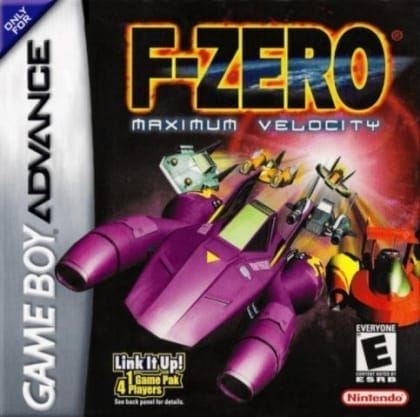
F-Zero: Maximum Velocity
F-Zero: Maximum Velocity is a futuristic racing game developed by NDCube and published by Nintendo for the Game Boy Advance in 2001. As the first F-Zero game on the GBA, it faithfully recreates the high-speed anti-gravity racing of the SNES original while introducing new vehicles, tracks, and gameplay mechanics tailored for handheld play.
Release Date
January 1, 2001
Players
1
Region
US
ROM Size
2.1 MB
Share this game
Gameplay Systems
This section does not cite any sources . Please help improve this section by adding citations to reliable sources . Unsourced material may be challenged and removed . ( February 2024 ) ( Learn how and when to remove this message ) Players lose the race if their machine explodes from taking too much damage, land outside of the track, get ejected from the race due to falling to 20th place, complete a lap with a rank outside of the rank limit of that lap, or forfeit. In the single player Grand Prix mode, all of these conditions require the player to possess and use an extra machine to try again. For each lap completed, the player is rewarded with a speed boost that can be used once; one of the "SSS" marks will be shaded green to indicate that it can be used. A boost will dramatically increase a player's speed, but will decrease their ability to turn. A boost used before a jump will cause the player to jump further, which could make it possible to use a shortcut with the right vehicle. Boost time and speed varies according to the machine, and is usually tuned for proper balance. For example, one machine has a boost time of twelve seconds, yet has the slowest boost speed of the entire game. Players can also take advantage of the varying deceleration of each vehicle. Some vehicles, such as the Jet Vermilion, take longer than others to decelerate from top boost speed to normal speed, once the boost has been used up. Players can also take advantage of this effect on boost pads. The Grand Prix is the main single player component of Maximum Velocity . It consists of four series named after chess pieces: "Pawn", "Knight", "Bishop" and "Queen". The latter of these can be unlocked by winning the others on "Expert" mode. They have five races in four difficulty settings. "Master" mode is unlocked by winning expert mode in each series, and the player unlocks a new machine after completing it. The player must be in the top three at the end of the last lap in order to continue to the next race. If the player is unable to continue, they will lose a machine and will have to try the race again. If the player runs out of machines, the game ends, and the series will have to be restarted from the beginning. Championship is another single player component. It is basically the same as a "Time Attack" mode, except the player can only race on one, special course: the Synobazz Championship Circuit. This special course is not selectable in any other modes. Multiplayer Maximum Velocity can be played in two multiplayer modes using the Game Boy Advance link cable, with one cartridge, or one cartridge per player. Two to four players can play in both modes. In single cart, only one player needs to have a cartridge. All players drive a generic craft, and the game can only be played on one level, Silence. This level, along with Fire Field, are the only areas to return from previous games. Aptly, Silence in Maximum Velocity has no background music, unlike in most other F-Zero games. In multi cart, each player needs to have a cartridge to play. This has many advantages over single cart: All players can use any machine in this game that has been unlocked by another player and can also select any course. After the race is finished, all of the players' ranking data are mixed and shared ("Mixed ranking" is stored in each cart).
Sales & Commercial Performance
Total Copies Sold
1 million copies
Media Reviews
IGN
9/10
GameSpot
8.1/10
Famitsu
7/10
Edge
7/10
Eurogamer
9/10
Game Informer
9/10
Electronic Gaming Monthly
7/10
Nintendo Power
4/5
Some information sourced from Wikipedia, available under CC BY-SA 3.0.