
GBA
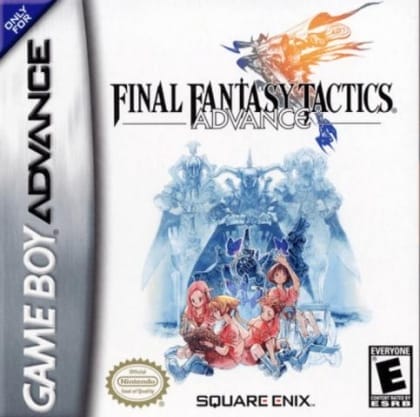
Final Fantasy Tactics Advance
A tactical RPG that transports a group of children into the magical world of Ivalice. Features deep job systems, clan battles, and the revolutionary 'Judge' mechanic that enforces special battle rules. The first Final Fantasy Tactics game designed for handheld systems.
Share this game
Story
After running into school bullies, Marche brings Mewt and Ritz to his house to play with Doned. Mewt has found an old book he wishes to show them; the book is the Gran Grimoire, which transforms St. Ivalice into the fantasy realm of Ivalice. Marche wakes from sleep to find the town transformed and his friends living new and for them more satisfying lives. Mewt has become the respected Prince of Ivalice with his formerly-drunk father as Judgemaster and his once-dead mother as queen, Ritz's white hair has naturally become the red she had dyed it to fit in, and Doned is fully healthy and able to walk. However Marche sees that Mewt's rule and clan wars that have erupted between factions is causing suffering for the transformed townsfolk. Marche begins his search for a way home, aided by Montblanc and his clan, but his quest brings him into conflict with his friends who are attached to the dream world and resent his efforts. His attempts to reach Mewt are blocked by both Cid, and the warrior Llednar Twem, later revealed to be the manifestation of Mewt's negative emotions. To return St. Ivalice to normal, Marche breaks the magical crystals sustaining it, along the way overcoming the Judges' tyranny and reconciling with Doned. He also bests Ritz in combat, and convinces Cid to ally with him. With Cid's help Marche defeats Llednar Twem, but Mewt's mother continues to protect his fantasy; she is a manifestation of the Gran Grimoire's magic shaped by Mewt's longing for his mother. Marche defeats the Gran Grimoire, promising to support Mewt, which causes the dream world to vanish. Back in reality, the four have grown from their experience and are able to improve their lives; Cid finds a new job, Ritz lets her hair return to its natural white, Doned begins making friends, and Marche and Mewt stand up to the bullies. In addition to the main plot, there are two side plots: the Redwing Arc and the Judge Arc. The Redwing Arc centers around the Redwings clan, a foreign crime ring, their subordinate clan Borzoi, and their smuggled foreign monsters. The other is the Judge Arc, unlockable after beating the main three hundred missions. This serves as an alternative ending where Marche never goes on his quest and stays in the dream world, overthrows several corrupt judges, and becomes Cid's successor.
Gameplay Systems
Final Fantasy Tactics Advance is a tactical role-playing game in which players take on the role of Marche Radiuju, a young boy transported to the world of Ivalice who searches for a way home; to fulfil his quest, he takes command of a clan fighting for prominence in Ivalice. Game progress is driven by missions, which are split into different types; standard combat missions often tied to the story, non-combat missions players sent a unit on, and "Encounter" missions that revolve around fights with rival clans. The player can bring special items on mission to influence what happens, with some missions requiring specific items. : 20–22 As the player progresses, they can use items rewarded after some missions to create new areas of the Ivalice map, with some types of positioning rewarding players with more items. Combat uses a turn-based tactical system, with player units placed on a grid-based map viewed from an overhead isometric perspective with maps having different terrain types; each unit has a turn in which to move and act. Units have health points (HP) and magic points (MP), with MP starting at zero and regenerating with each turn. MP are used to perform magic abilities, with more powerful spells costing more MP. When a Unit's HP is depleted, they are knocked out. : 27–35 Units can move and attack within a set range, wait to skip their turn, or perform a non-combat action. : 38–41 Attacks come with a percentage chance, showing how likely it is to connect. There are also status ailments which can impact units, such as blinding them to lower accuracy or silencing magic users. : 38–41 Characters earn experience points from performing actions in combat, which allows them to be strengthened. Units have access to a character class -based Job system , with elements such as unit statistics, armour combatability and the types of abilities available tied to certain jobs. Unit jobs have specialized abilities, such as Thieves being able to steal from other units and Ninjas having high speed. Some jobs are better suited for or exclusive to one of the five races populating Ivalice. Units can learn abilities by equipping weapons and equipment associated with an ability that are won in combat or purchased at in-game shops. After wearing it for a number of battles, the unit learns the ability permanently. Mastered abilities are also retained after changing job roles, : 27–35 and more jobs can be unlocked as characters gain experience and abilities. In most battles, combat is overseen by a neutral Judge who handles the Law system, which imposes restrictions on available actions; these can include prohibiting the use of certain spells, item usage, or attacks with particular weapons. Depending on the type and frequently of violating the Law, the Judge uses a yellow card to inflict a punishment such as lowering hit chance, while a red card causes the unit to be taken from the battlefield. : 42–47 Following the Laws reward and killing enemy units reward Judge Points (JP), which are used to perform special attacks or summon totemas, the game's version of summoned monsters. : 42–47 In areas controlled by Judges, defeated units are revived after combat is finished. : 42–47 After a point in the game, players can use special Law cards to both set their own Laws and erase existing Laws. Some areas of the world are not overseen by the Judges, which removes their associated mechanics. : 42–47 The game features a multiplayer option where two players can connect their Game Boy Advance (GBA) systems via link cable . When linked, players can exchange units and items, and either collaborate on missions or fight each other. Powerful items can be unlocked for players by engaging in the multiplayer. : 48–49 Completing missions rewards players with in-game currency (gil), which is used to buy equipment, items, and new missions. : 20–22 If all player units are defeated in combat in some missions, or Marche is imprisoned for violating a Law, the game ends. : 36–41 In most cases, losing does not end the game, but the mission is considered a failure. : 36–41
Awards & Honors
an award
Sales & Commercial Performance
Total Copies Sold
1.5 million copies
Total Revenue
$22 million
Media Reviews
IGN
9/10
GameSpot
8.2/10
Famitsu
34/40
Edge
7/10
Eurogamer
9/10
Game Informer
9.5/10
Electronic Gaming Monthly
9/10
Some information sourced from Wikipedia, available under CC BY-SA 3.0.