WS
Final Fantasy
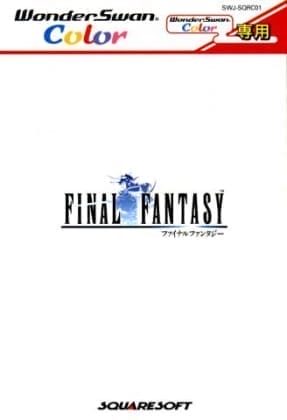
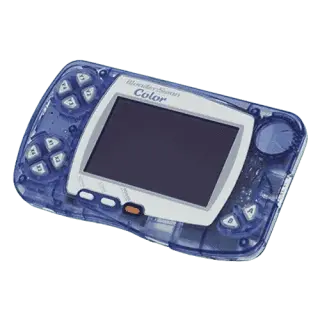
Final Fantasy for the Bandai WonderSwan is a 2000 enhanced remake of the original 1987 NES game. Developed by Square, this portable version features updated graphics, streamlined gameplay, and new content while preserving the classic story of the four Warriors of Light restoring power to the elemental Crystals.
Share this game
Story
and themes The central conflict in many Final Fantasy games focuses on a group of characters battling an evil, and sometimes ancient, antagonist that dominates the game's world. Stories frequently involve a sovereign state in rebellion, with the protagonists taking part in the rebellion. The heroes are often destined to defeat the evil, and occasionally gather as a direct result of the antagonist's malicious actions. Another staple of the series is the existence of two villains; the main villain is not always who it appears to be, as the primary antagonist may actually be subservient to another character or entity. The main antagonist introduced at the beginning of the game is not always the final enemy, and the characters must continue their quest beyond what appears to be the final fight. Stories in the series frequently emphasize the internal struggles, passions, and tragedies of the characters, and the main plot often recedes into the background as the focus shifts to their personal lives. Games also explore relationships between characters, ranging from love to rivalry. Other recurring situations that drive the plot include amnesia , a hero corrupted by an evil force, mistaken identity, and self-sacrifice. Magical orbs and crystals are recurring in-game items that are frequently connected to the themes of the games' plots. Crystals often play a central role in the creation of the world, and a majority of the Final Fantasy games link crystals and orbs to the planet's life force . As such, control over these crystals drives the main conflict. The classical elements are also a recurring theme in the series related to the heroes, villains, and items. Other common plot and setting themes include the Gaia hypothesis , an apocalypse, and conflicts between advanced technology and nature .
Gameplay Systems
Enemies are typically encountered randomly through exploring, a trend which changed in Final Fantasy XI and XII . The player issues combat orders—like "Fight", "Magic", and "Item"—to individual characters via a menu-driven interface while engaging in battles. Throughout the series, the games have used different battle systems. Prior to Final Fantasy XI , battles were turn-based with the protagonists and antagonists on different sides of the battlefield. Final Fantasy IV introduced the "Active Time Battle" (ATB) system that augmented the turn-based nature with a perpetual time-keeping system. Designed by Hiroyuki Ito , it injected urgency and excitement into combat by requiring the player to act before an enemy attacks, and was used until Final Fantasy X , which implemented the "Conditional Turn-Based" (CTB) system. This new system returned to the previous turn-based system, but added nuances to offer players more challenge. Final Fantasy XI adopted a real-time battle system where characters continuously act depending on the issued command. Final Fantasy XII continued this gameplay with the "Active Dimension Battle" system. Final Fantasy XIII ' s combat system, designed by the same man who worked on X , was meant to have an action-oriented feel, emulating the cinematic battles in Final Fantasy VII: Advent Children . Final Fantasy XV introduces a new "Open Combat" system. Unlike previous battle systems in the franchise, the "Open Combat" system (OCS) allows players to take on a fully active battle scenario, allowing for free range attacks and movement, giving a much more fluid feel of combat. This system also incorporates a "Tactical" Option during battle, which pauses active battle to allow use of items. Like most RPGs, the Final Fantasy installments use an experience level system for character advancement, in which experience points are accumulated by killing enemies. Character classes , specific jobs that enable unique abilities for characters, are another recurring theme. Introduced in the first game, character classes have been used differently in each game. Some restrict a character to a single job to integrate it into the story, while other games feature dynamic job systems that allow the player to choose from multiple classes and switch throughout the game. Though used heavily in many games, such systems have become less prevalent in favor of characters that are more versatile; characters still match an archetype, but are able to learn skills outside their class. Magic is another common RPG element in the series. The method by which characters gain magic varies between installments, but is generally divided into classes organized by color: "White magic", which focuses on spells that assist teammates; "Black magic", which focuses on harming enemies; "Red magic", which is a combination of white and black magic, "Blue magic", which mimics enemy attacks; and "Green magic" which focuses on applying status effects to either allies or enemies. Other types of magic frequently appear such as "Time magic", focusing on the themes of time, space, and gravity; and "Summoning magic", which evokes legendary creatures to aid in battle and is a feature that has persisted since Final Fantasy III . Summoned creatures are often referred to by names like "Espers" or "Eidolons" and have been inspired by mythologies from Arabic , Hindu , Norse , and Greek cultures. Different means of transportation have appeared through the series. The most common is the airship for long range travel, accompanied by chocobos for travelling short distances, but others include sea and land vessels. Following Final Fantasy VII , more modern and futuristic vehicle designs have been included.
Sales & Commercial Performance
Total Copies Sold
25 million copies
Media Reviews
IGN
2006
Famitsu
2006
Edge
26
OPM
2009
Some information sourced from Wikipedia, available under CC BY-SA 3.0.