
Arcade
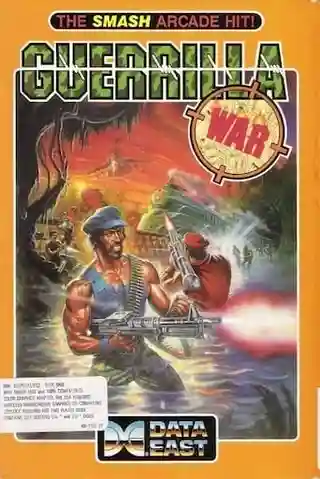
Guerrilla War
Guerrilla War is a classic run and gun arcade game where players take on the role of revolutionary fighters, loosely based on Fidel Castro and Che Guevara, battling through jungles and enemy bases to overthrow a dictatorship. Known for its fast-paced action, unlimited continues, and cooperative two-player gameplay, it became an arcade staple for its satisfying combat and historical-inspired setting.
Share this game
Story
It conducts the basic business of war without recourse to ponderous formations or equipment, complicated maneuvers, strict chains of command, calculated strategies, timetables, or other civilized embellishments. Evidence of conventional warfare , on the other hand, did not emerge until 3100 BC in Egypt and Mesopotamia. The Chinese general and strategist Sun Tzu , in his The Art of War (6th century BC), became one of the earliest to propose the use of guerrilla warfare. This inspired developments in modern guerrilla warfare. In the 3rd century BC, Quintus Fabius Maximus Verrucosus , called Cunctator ("delayer"), used elements of guerrilla warfare, such as the evasion of battle, the attempt to wear down the enemy, to attack small detachments in an ambush and devised the Fabian strategy , which the Roman Republic used to great effect against Hannibal 's army, see also His Excellency : George Washington : the Fabian choice. The Roman general Quintus Sertorius is also noted for his skillful use of guerrilla warfare during his revolt against the Roman Senate . In China, Han dynasty general Peng Yue is often regarded as the inventor of guerrilla warfare due to his use of irregular warfare in the Chu-Han contention to attack Chu convoys and supplies. In the Byzantine Empire , guerrilla warfare was frequently practiced between the eighth through tenth centuries along the eastern frontier with the Umayyad and then Abbasid caliphates. Tactics involved a heavy emphasis on reconnaissance and intelligence, shadowing the enemy, evacuating threatened population centres, and attacking when the enemy dispersed to raid. In the later tenth century this form of warfare was codified in a military manual known by its later Latin name as De velitatione bellica ('On Skirmishing') so it would not be forgotten in the future. The Normans often made many forays into Wales, where the Welsh used the mountainous region, which the Normans were unfamiliar with, to spring surprise attacks upon them. Gonzalo Fernández de Córdoba successfully employed guerrilla warfare during the Italian Wars , where his Italian lieutenant and successor Prospero Colonna was called Cuntatore after Quintus Fabius Maximus due to their similar tactics. Guerrilla warfare eventually became one of the specialties of the Spanish tercios , including techniques like the camisado . Since the Enlightenment , ideologies such as nationalism , liberalism , socialism , and religious fundamentalism have played an important role in shaping insurgencies and guerrilla warfare. In the 17th century, Chatrapati Shivaji Maharaj , founder of the Maratha Kingdom , pioneered the Shiva sutra or Ganimi Kava (Guerrilla Tactics) to defeat the many times larger and more powerful armies of the Mughal Empire . The Dominican Restoration War was a guerrilla war between 1863 and 1865 in the Dominican Republic between nationalists and Spain , the latter of which had recolonized the country 17 years after its independence. The war resulted in the withdrawal of Spanish forces and the establishment of a second republic in the Dominican Republic. The Riffian Berber military leader Abd el-Krim ( c. 1883 – 1963) and his father unified the Berber tribes under their control and took up arms against the Spanish and French occupiers during the Rif War in 1920. For the first time in history, tunnel warfare was used alongside modern guerrilla tactics, which caused considerable damage to both the colonial armies in Morocco. In the early 20th century Michael Collins and Tom Barry both developed many tactical features of guerrilla warfare during the guerrilla phase of the 1919–1921 Irish War of Independence . Collins developed mainly urban guerrilla warfare tactics in Dublin City (the Irish capital). Operations in which small Irish Republican Army (IRA) units (3 to 6 guerrillas) quickly attacked a target and then disappeared into civilian crowds. In County Cork , Tom Barry was the commander of the IRA West Cork brigade . Fighting in west Cork was rural, and the IRA fought in much larger units than their comrades in urban areas. These units, called " flying columns ", engaged British forces in large battles, usually for between 10–30 minutes. The Algerian Revolution of 1954 started with a handful of Algerian guerrillas. Primitively armed, the guerrillas fought the French for over eight years. This remains a prototype for modern insurgency and counterinsurgency, terrorism, torture, and asymmetric warfare prevalent throughout the world today. In South Africa , African National Congress (ANC) members studied the Algerian War, prior to the release and apotheosis of Nelson Mandela ; in their intifada against Israel, Palestinian fighters have sought to emulate it. Additionally, the tactics of Al-Qaeda closely resemble those of the Algerians.
Some information sourced from Wikipedia, available under CC BY-SA 3.0.