GBA
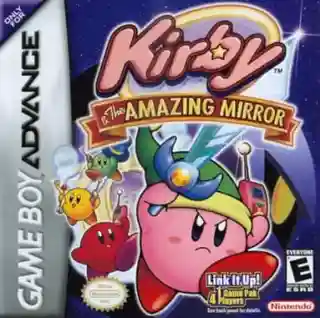
Kirby & the Amazing Mirror
A groundbreaking Metroidvania-style Kirby adventure featuring nonlinear exploration and 4-player cooperative gameplay via link cable. Kirby must navigate a mirror-shattered world to defeat Dark Meta Knight.
Release Date
January 1, 2004
Developer
HAL LaboratoryPublisher
HAL Laboratory
Players
1
Region
US
ROM Size
16.0 MB
Share this game
Story
There is a Mirror World that exists in the skies of Dream Land where any wish reflected in the mirror will come true. However, it copies the mind of a mysterious figure one day and creates a reflected world of evil. Meta Knight notices this and flies up to investigate whether this world will cause any harm to Dream Land. Meanwhile, Kirby is taking a walk when Dark Meta Knight appears. Before Kirby can react, Dark Meta Knight slices Kirby into four different colored Kirbys. They chase after Dark Meta Knight on a Warp Star simultaneously and enter the Mirror World. It is revealed that the two Meta Knights fought each other until the real Meta Knight was defeated. He was then knocked into the Dimension Mirror, which was in turn cut into eight fragments by Dark Meta Knight and scattered across the Mirror World, prompting the Kirbys to save Meta Knight and the Mirror World. After collecting all eight mirror fragments, Kirby enters the Dimension Mirror and battles Dark Meta Knight. After defeating him, Kirby is armed with the real Meta Knight's Master Sword and taken to fight Dark Mind, the true mastermind behind the Mirror World's corruption, multiple times. Upon defeat, the Mirror World is saved, and Shadow Kirby (the Mirror World counterpart of Kirby who was believed to be an enemy, but is now an ally) waves his goodbyes to the four Kirbys as they all exit the Mirror World one by one. Meta Knight also drops his Master Sword before leaving the Mirror World, marking it as a symbol for the Mirror World's protection.
Gameplay Systems
Unlike the other Kirby games, Kirby & The Amazing Mirror features a maze layout, and is traversed into a Metroidvania style. The Mirror World is divided into nine different-themed areas. The player begins in the first area, a loop that connects to a few other areas. From there the game map branches out in several directions and, providing Kirby has the proper power at his disposal, he is able to go anywhere in almost any order, excluding the final sequence. The player explores the Mirror World, solving puzzles, defeating enemies, and collecting items. Occasionally, a sub-boss will be encountered, at which point the screen will lock into place until the boss is defeated. Swallowing a sub-boss after defeat usually grants a rare or exclusive copy ability. Apart from the first, each area of the game houses a major boss who possesses a shard from the broken Dimension Mirror that sits in the center of the hub world . The player must defeat these bosses and reclaim all eight shards to re-assemble the Dimension Mirror, which leads to the final boss. The player can collect various items to improve in-game performance, such as extra health points and lives, food to replenish health, and batteries for the Cellphone. The game also features two other collectibles: music sheets, which act as a sound test mode once the music player item is found, and spray paint, which can be used to recolor the player's Kirby. There are also three minigames accessible from the menu, which support single player and multiplayer: Speed Eaters – A game in which the four Kirbys are seated around a covered platter. Once the lid is whisked away at a random time, the fastest person to press the A button and suck in the food on the platter is filled up more (measured by a gauge above each Kirby). Crackity Hack – A game in which the four Kirbys are challenged to break a rock as much as they can, in a similar style to a microgame from Kirby Super Star . Kirby's Wave Ride – A game in which the Kirbys, atop Warp Stars, race over a water track that varies in length and complexity depending on the difficulty setting, similar to the GameCube racing game Kirby Air Ride . The game also features multiplayer, and the player can call other players or CPU-controlled Kirbys to the location with an in-game cell phone. There are several new powers in The Amazing Mirror , such as Cupid (called Angel in the Japanese version), which allows Kirby to fly around with wings and a halo and fire arrows; Missile, which turns Kirby into a missile that can be guided in any direction and will explode on contact with a wall or an enemy or when the B button is hit; and Smash, which gives Kirby the abilities he had in Super Smash Bros. Melee .
Sales & Commercial Performance
Total Copies Sold
1.47 million copies
Total Revenue
$19 million
Media Reviews
IGN
8/10
GameSpot
8.2/10
Famitsu
36/40
Game Informer
7.75/10
Nintendo Power
4/5
Some information sourced from Wikipedia, available under CC BY-SA 3.0.