PS1
Legend of Mana
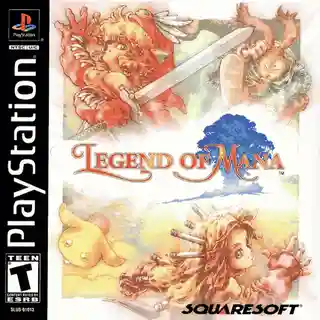
Legend of Mana is an action role-playing game developed and published by Square for the PlayStation. Released in 1999, it features a unique non-linear narrative structure where players create their own world map by placing artifacts across the land of Fa'Diel. The game is renowned for its beautiful hand-painted visuals, deep crafting systems, and multiple interconnected storylines.
Share this game
Story
Setting Legend of Mana is set in the fictional world of Fa'Diel. The Mana Tree, the giver of mana and life for the world, burned down almost entirely nine centuries prior to the events of the game. A war erupted between faeries, human, and others seeking the scarce power of mana that was left. When the war concluded, the burnt Mana Tree slept as it regrew and the many lands of the world were stored in ancient artifacts. A hero, controlled by the player, is self-charged with restoring the world, and mana, to its former self. The Lands of Fa'Diel are populated with a large number of different creatures, including humans, faeries, demons, the jewel -hearted Jumi race, plant-like Sproutlings and Flowerlings, miner bears called Dudbears, and shadowy beings of the Underworld known as Shadoles. Fa'Diel is also the home of a host of anthropomorphic animals and objects, as well as monsters from other Mana titles such as Rabites, Chobin Hoods, and Goblins. The player controls the protagonist of the game, who is either a male or female silent protagonist . The character is unnamed and no information is given about their past; their history and personality is meant to be determined by the player.
Gameplay Systems
Like previous games in the Mana series , Legend of Mana displays an angled top-down perspective , in which the player characters navigate the terrain and fight off hostile creatures. The player controls the unnamed main character, and is assisted by up to two companions. One of these companions is an optional support character, which depends on what quest the player is performing, while another companion can be chosen by the player out of a roster of monsters, pets, and golems . Both companions are typically controlled by the game's AI , though a second player can take control of the support character, or load in their own character from a different save file, if present. The main character and companions each have their own set of numerical attributes including hit points and strength, which represent the amount of damage the player can take or cause. These stats grow whenever the player advances a level, after gaining enough experience points from battle with enemies. Battles occur when the player character encounters an enemy while traversing the world. Combat takes place in real-time, and in the location the player found the enemy rather than a separate battle screen. The main character can equip a variety of weapons, armors, and accessories. Weapons let the player perform abilities in combat. Referred to as Special Techs, these abilities are powerful attacks by the main characters and support characters that can be used when the special move meter is full. This meter fills as the player damages enemies. Each weapon, such as a sword or spear, has a set number of special attacks to learn, which can hit single or multiple targets and can be assigned to different buttons on the controller. Legend of Mana , unlike previous games in the Mana series, does not feature a set journey through a fixed world. Instead, it features a unique "Land Make" system where the player generates the structure of the game world by placing objects, named Artifacts, on empty square plots on a map. This map takes the form of a grid of spaces presented in an isometric viewpoint on a map screen. When an Artifact is placed in a space on the map, it creates a Land, and the player can enter that Land by selecting the position on the map. Adjacent Lands are not connected; to move from one land to another the player must first return to the map screen. Different Lands are generated from different Artifacts, each containing a quest which upon completion usually gives the player another Artifact to place. Lands can also contain additional quests. Each Land is ranked from 0 (no presence) to 3 (strong presence) in its strength in each Spirit of Mana ; this in turn causes magic of that element to be stronger in that Land. The strength of the rankings is dependent on the Artifact, its position on the Map, and the rankings of adjacent Lands. Many locations have non-player characters who give quests and information or sell equipment. Other areas feature enemies and bosses with which the player can battle. In addition to the main game, after certain quests are completed Legend of Mana gives the player the option to delve into optional gameplay aspects centered around the hero or heroine's house. The player can forge or improve weapons and armor using raw materials found throughout the game, or combine equipment with items to change their power or add special effects. They can grow different types of fruit in the orchard, raise pets to use as adventuring companions, create items, and build golems. Pets can also be raised with the Japan-only PocketStation peripheral, and two players can battle each other in an arena.
Awards & Honors
an award for best graphics at the 4th Japan Game Award
Media Reviews
IGN
8.3/10
GameSpot
7/10
Famitsu
31/40
Electronic Gaming Monthly
2
Some information sourced from Wikipedia, available under CC BY-SA 3.0.