N64
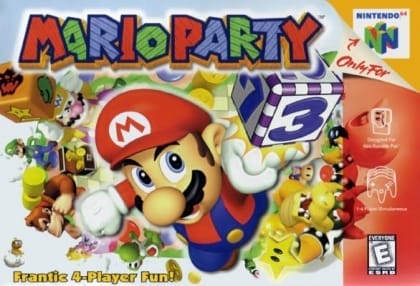
Mario Party
Mario Party is a 1998 party video game developed by Hudson Soft for the Nintendo 64. The first entry in the Mario Party series features a board game format where up to four players compete in over 50 mini-games. Players roll dice, navigate themed boards, and collect stars to win.
Release Date
January 1, 1985
Players
1
Region
US
ROM Size
32.0 MB
Share this game
Gameplay Systems
Over the course of the Mario Party series, gameplay has changed to suit the technology of the hardware. There are several game modes available in each of the games, each of which provides its own rules and challenges. Party Mode Every game in the main series has a standard Party Mode in which up to four players play through a board, trying to collect as many stars as possible. In every turn, each player rolls a die (Dice Block) and progresses on the board, which usually has branching paths. Coins are primarily earned by performing well in a minigame played at the end of each turn. On most boards, players earn stars by reaching a star space and purchasing a star for 20 coins (traditionally). The star space appears randomly on one of several pre-determined locations and moves every time a star is purchased, usually occupying a blue space. On some boards, the star location is fixed. Every Mario Party game contains at least 50 minigames with a few different types. Four-player games are a free-for-all in which players compete individually. In 2-vs-2 and 1-vs-3 minigames, players compete as two groups, cooperating to win, even though they are still competing individually in the main game. Some minigames in Mario Party are 4-player co-op, even though it doesn't say it. In most situations, winners earn ten coins each. Battle minigames first appeared in Mario Party 2 . These games are like the four-player games, but instead of winners earning ten coins each, each player contributes a randomly selected number of coins (or all coins if the player falls short of the pot amount). The winner of the minigame receives approximately 70% of the pot, the second-place winner receives the other 30%, and a random player occasionally gets coins left over from rounding. Duel minigames debuted in Mario Party 2 , and were omitted in Mario Party 4 (although the story minigames are all duels) but return again in Mario Party 5 . Duel games pit two players against each other. In Party Mode, one player initiates the duel, wagering coins or even a star against another player. The winner of the duel receives all coins or stars wagered. Starting with Mario Party 7 , the player no longer chooses the wager in a duel, rather, the duel takes place and the prize to the winner, if any, is randomly determined. Bowser minigames are introduced in Mario Party 4 in which players try to avoid being burned by Bowser's fire breath if they lose. When this happens, players must give up coins, stars, or items . In Mario Party 7 , a single-player version of the games was introduced and only one person can play. Mario Party 9 introduced a new set of Bowser Jr. -related minigames. In these minigames, Bowser Jr. challenges two players to compete in a minigame to battle him. If they successfully defeat him, both players will receive five Mini Stars. If not, then Bowser Jr. will take five from each player. Mario Party 9 also introduced a car mechanic. In Mario Party 9 and Mario Party 10 , every player navigates the board in a car rather than move independently of one another. Mario Party 9 has a lesser focus on strategy, and its minigames do not impact the board game in ways that the previous Mario Party games did. Critics heavily censured the car mechanic; Destructoid noted, "An over-reliance on random chance over strategy can quickly derail the experience when things go awry at the worst possible time ..." The car mechanic was kept in Mario Party 10 , although Super Mario Party finally lets players move individually on the board again. Super Mario Party Jamboree introduced a new feature called “Jamboree Buddy”, where players can earn that character from winning a Showdown Minigame. Each character has a different ability like buying Stars and items at half price. In addition, players can earn double the benefits or penalties with the Jamboree Buddy for up to three turns. Super Mario Party Jamboree features the most minigames in Mario Party history with 112. In most Mario Party games, at the end of a board game, bonus stars can be awarded to players. Three specific stars are awarded in the first six games. All later games have six possible bonus stars, but up to three of those stars are awarded per game. These stars add to the player's overall total. If there’s a tie in coins and stars, then a Dice Block tiebreaker will determine the overall ranking.
Sales & Commercial Performance
Total Copies Sold
21.16 million copies
Some information sourced from Wikipedia, available under CC BY-SA 3.0.