NES
Mega Man
The debut of Capcom's iconic Blue Bomber in a revolutionary non-linear platformer. Defeat Robot Masters to gain their weapons in any order, culminating in Dr. Wily's fortress.
Share this game
Story
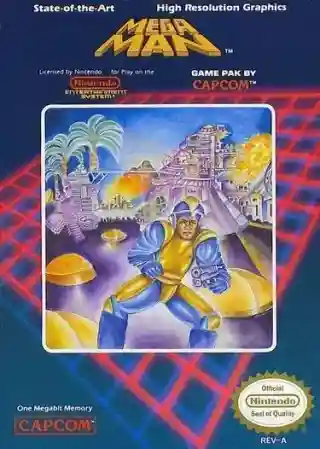
1987: Conception and first game In the mid-1980s, Capcom made plans to develop Mega Man specifically for the Japanese home console market. They decided to bring in fresh, young talent for the small team, including artist Keiji Inafune , a recent college graduate who started on the Street Fighter team. Inafune recalled that the Mega Man development team worked extremely hard to complete the final product, with a project supervisor and lead designer who sought perfection in every possible aspect of the game. The development team for Mega Man consisted of only six people. Inafune (credited as "Inafking") designed and illustrated nearly all of the game's characters and enemies, and the Japanese Rockman logo, box art, and instruction manual. He was responsible for rendering these designs into graphical sprite form. He said, "We didn't have [a lot of] people, so after drawing character designs, I was actually doing the dotting ( pixelation ) for the Nintendo. Back then, people weren't specialized and we had to do a lot of different things because there was so few people, so I really ended up doing all the characters." Inafune was influenced by the eponymous protagonist of Osamu Tezuka 's manga Astro Boy in his Mega Man designs. Mega Man is colored blue because it seemed that the color had the most shades in the console's 56-color palette ( cyan included), and that selection was used to enhance Mega Man's detail. Although he is often credited for designing the character, Inafune insists that he "only did half of the job in creating him", as his mentor, director Akira Kitamura , developed the basic character concept before Inafune's arrival. The basic sprites for Roll and Dr. Light were created before Inafune joined the project, and the designs for Cut Man, Ice Man, Fire Man, and Guts Man were in process. Aside from normal enemies, Inafune's first character was Elec Man, inspired by American comic book characters. The artist has commented that Elec Man has always been his favorite design. The designs for Dr. Light and Dr. Wily were based on Santa Claus and Albert Einstein , respectively; the latter character was meant to represent an archetypal " mad scientist ". The team had initially considered names such as "Mighty Kid", "Knuckle Kid", and "Rainbow Man" before settling on their final decisions. The "Rainbow" name was considered because the character could change into seven colors based on the weapon selected. The production team chose a music motif when naming the main characters in Mega Man . The protagonist's original name is Rock and his sister's name is Roll, a play on the term " rock and roll ". This type of naming would later be extended to many characters throughout the series . One of the original storylines considered by the team but not used in the final game was to have Roll be kidnapped, and Rock had to rescue her. Another idea had included a boss fight against a giant Roll near the end of the game. Mega Man's gameplay was inspired by rock paper scissors , where certain bosses are weak to other weapons, e.g. Cut Man is weak to Guts Man's weapon because Guts Man's weapon specializes in picking up and throwing rocks and rock beats scissors. The team decided to incorporate anime elements for the game's animation. Inafune explained, "[Mega Man's] hand transforms into a gun and you can actually see it come out of his arm. We wanted to make sure that the animation and the motion was realistic and actually made sense. So with Mega Man, we had this perfect blending of game character with animation ideas." The gameplay for Mega Man was inspired by the game rock paper scissors . The project supervisor wanted a simple system that offered "deep gameplay". Each weapon deals a large amount of damage to one specific Robot Master, others have little to no effect against them, and there is no single weapon that dominates all the others. Mega Man was originally able to crouch, but the team decided against it since it made players' ability to determine the height of onscreen projectiles more difficult.Naoya Tomita (credited as "Tom Pon") began work on Mega Man' s scenic backgrounds immediately after his Capcom training. Tomita proved himself amongst his peers by overcoming the challenges of the console's limited power through maximizing the use of background elements. Mega Man was scored by Manami Matsumae (credited as "Chanchacorin Manami"), who composed the music, created the sound effects, and programmed the data in three months, using a sound driver programmed by Yoshihiro Sakaguchi (credited as "Yuukichan's Papa"). The musical notes were translated one by one into the computer language. Matsumae was challenged by the creative limits of three notes available at any one time, and when she was unable to write songs, she created the sound effects. When the game was localized for distribution in America, Capcom changed the title of the game from Rockman to Mega Man . This moniker was created by Capcom's then-Senior Vice President Joseph Morici, who claimed it was changed merely because he did not like the original name. "That title was horrible," Morici said. "So I came up with Mega Man , and they liked it enough to keep using it for the U.S. games." 1UP.com 's Nadia Oxford attributed this change to Capcom's belief that American children would be more interested in a game with the latter title. Capcom's sales department originally believed that the game would not sell, but after Japan had received limited quantities, it had been seen as successful enough to quickly commission an American localization. With little overseas press coverage save for a full-page advertisement in Nintendo Fun Club News , sales gained momentum over word of mouth , making the game a sleeper hit .
Media Reviews
IGN
100
GameSpot
1
Game Informer
120
Electronic Gaming Monthly
1
EGM
1
Nintendo Power
1
Some information sourced from Wikipedia, available under CC BY-SA 3.0.