NES
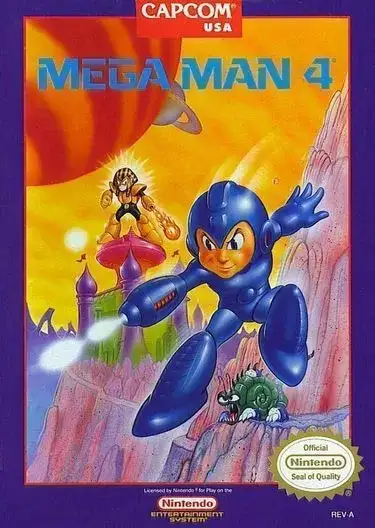
Mega Man 4
The Blue Bomber returns to face a mysterious new enemy, Dr. Cossack, and his eight Robot Masters. Introduces the Mega Buster charge shot and the first appearance of Eddie, the item-delivery robot.
Share this game
Story
Mega Man 4 takes place in an unspecified year during the 21st century, described as the year "20XX". One year after the events of Mega Man 3 , a mysterious Russian scientist, Dr. Cossack , unleashes an army of robots with the intention of world domination, much like Dr. Wily before him. Concerned over the situation, Dr. Light calls upon his own greatest creation, the hero Mega Man , to go after Cossack's Robot Masters , who have seized control of eight cities. He also creates the support robot Eddie and equips Mega Man with the New Mega Buster, an upgrade for his Mega Buster. Upon defeating the eight Robot Masters — Toad Man, Bright Man, Pharaoh Man, Ring Man, Dust Man, Skull Man, Dive Man, and Drill Man — Mega Man makes his way to Cossack's icy fortress. However, in the middle of his battle with Cossack, Mega Man's brother Proto Man teleports in with Cossack's daughter, Kalinka . The girl begs Mega Man to stop fighting and explained that Dr. Wily had kidnapped her, forcing her father to build an army of robots and antagonize Mega Man as ransom. With Wily's plan undone by Proto Man, he steps out of the shadows, furious for his betrayal. Mega Man pursues his nemesis and fights through the scientist's Wily Castle, but Wily manages to escape in the end. Mega Man escapes as the fortress begins to self-destruct, and rides home on the top of a passing train, where he is greeted by Roll and Rush.
Gameplay Systems
Mega Man 4 features similar gameplay to the previous three games. The player must complete a series of eight stages in an order of the player's choosing. The protagonist, Mega Man, is able to run, jump, shoot, and climb his way past obstacles and enemies; the game also retains the slide ability which debuted in Mega Man 3 . At the end of each stage is a Robot Master boss. Upon defeating a Robot Master, Mega Man gains the Robot Master's signature weapon, which can then be used by the player in subsequent stages. Once all eight Robot Masters are destroyed, two separate sets of linear stages must be completed to finish the game. One major addition to the gameplay in Mega Man 4 is the "New Mega Buster", an upgraded version of Mega Man's arm cannon. By holding down the firing button, the player can now charge a shot, resulting in a blast far more powerful than the standard shot. This feature was later used in subsequent incarnations of the franchise. The hero's dog Rush makes a return from Mega Man 3 with the ability to transform into "Coil", "Jet", and "Marine" modes for navigating different environments. Aside from Rush, two additional support items called the "Wire Adaptor" and the "Balloon Adaptor" also aid the player in reaching areas not normally accessible. However, these hidden adaptors must be found in the stages rather than being awarded for defeating a Robot Master. Like the Master Weapons, the three Rush modes and the two adaptors are each limited to an amount of weapon power that drains when in use. The character "Flip Top" Eddie is introduced in Mega Man 4 . Eddie, who went on to appear in later Mega Man games, provides the player with a random item (such as health, ammunition, or an E-Tank) at designated points in some of the levels.
Media Reviews
IGN
100
GameSpot
1
Nintendo Power
4
Some information sourced from Wikipedia, available under CC BY-SA 3.0.