NES
Metroid
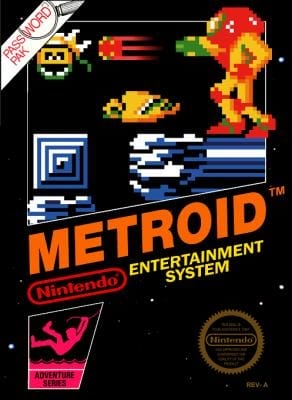
Metroid is a groundbreaking action-adventure game developed and published by Nintendo for the NES in 1986. Players control bounty hunter Samus Aran as she explores the labyrinthine planet Zebes to defeat the Space Pirates and their biological weapon, the Metroid species. Revolutionary for its non-linear exploration, atmospheric isolation, and iconic female protagonist reveal.
Share this game
Story
Setting Other races are both a part of the Federation as well as close allies, the most prolific being the Chozo, an avian species possessing advanced technology and skills in bioengineering. The mutual nemesis of the Federation and the Chozo are the Space Pirates, a villainous interstellar cabal comprising multiple alien races of disreputable nature that all refuse to abide to the Galactic Federation's rule. They are led by the dragon -like warlord Ridley , and plot to develop weapons of mass destruction from hazardous life forms and materials to destroy the Federation and secure galactic dominance. The eponymous Metroids are a species of predatory, jellyfish -like organisms that feed on an undetectable life energy found in all living creatures. The Chozo engineered the Metroids as a biological weapon to eradicate a parasitic, shapeshifting virus known as the "X" that threatened their civilization. While the Metroids succeeded in stopping the X, they became a danger to the Chozo themselves when they developed the ability to evolve into different and far deadlier forms. Most of the games center around the efforts of various organizations, including the Space Pirates, the Galactic Federation, and rogue members of the Chozo race, to weaponize the Metroids and the subsequent conflicts they cause.
Gameplay Systems
The Metroid series contains elements from shooter, platformer , adventure, survival and first-person games. The series is notable for its non-linear progression and solitary exploration format where the player only controls Samus Aran , with few or no other characters to interact with. The player gains items and power-ups for Samus's cybernetic suit primarily through exploration, and occasionally by defeating alien creatures through real-time combat with the suit's arm cannon. Many such upgrades enable further avenues of exploration. A recurring upgrade is the Morph Ball, which allows Samus to curl into a ball, roll into tight places and plant bombs. Another well-known recurring ability is the Shinespark, which enables Samus to charge her Power Suit with energy, and run and dash at tremendous speeds from a running start. The Power Suit, thus empowered, can break through certain walls. This ability, while not mandatory to complete the games, allows access to many secret areas and enables sequence breaking , making it integral in the Metroid speedrunning community. The classic series consists of 2D side-scrollers , while the Metroid Prime series uses a first-person perspective , and first-person shooter mechanics. The 2010 game Other M uses the third-person shooter format. The original Metroid was influenced by two other major Nintendo franchises: Mario , from which it borrowed extensive areas of platform jumping, and The Legend of Zelda , from which it borrowed non-linear exploration. Metroid differed in its atmosphere of solitude and foreboding. Metroid was also one of the first video games to feature an exploration to the left as well as the right, and backtracking to already explored areas to search for secret items and paths. Since the late 1990s, the term " Metroidvania " has been applied to this format. According to Edge , Metroid is "the thinking man's shooter", in which weapons are "more a means of progression than weapon", with the environments posing larger obstacles than enemies. Audio The Metroid series has been noted and praised for its unique style of video game music . Hirokazu "Hip" Tanaka , composer of the original Metroid , has said he wanted to make a score that made players feel like they were encountering a "living creature" and had no distinction between music and sound effects. The only time the main Metroid theme was heard was after Mother Brain is defeated; this is intended to give the player a catharsis . The composer of Super Metroid , Kenji Yamamoto , came up with some themes by humming to himself while riding his motorcycle to work. He was asked to compose the music for Metroid Prime to reinforce the series continuity. Metroid Prime ' s Dolby Pro Logic II surround sound was mixed by a member of Dolby . Developers from Retro Studios noted how the 6 MB memory budget for all sound effects of a level in Metroid Prime was crucial in producing a quality soundtrack, as each sound had to be of high quality to be included. Yamamoto used heavy drums, piano, voiced chants, clangs of pipes, and electric guitar. Metroid Prime 3: Corruption took advantage of the increased RAM in the Wii , allowing for higher-quality audio samples. Kenji Yamamoto, who composed the music for Super Metroid and the Prime trilogy, copied the musical design of the original Metroid in Metroid Prime 3 , by keeping the music and themes dark and scary until the very end, when uplifting music is played during the credits.
Sales & Commercial Performance
Total Copies Sold
17.44 million copies
Some information sourced from Wikipedia, available under CC BY-SA 3.0.