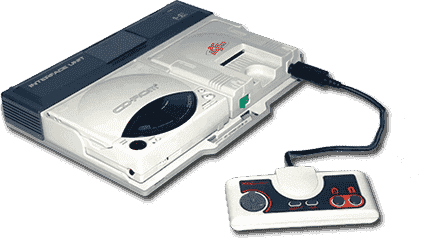
PCE
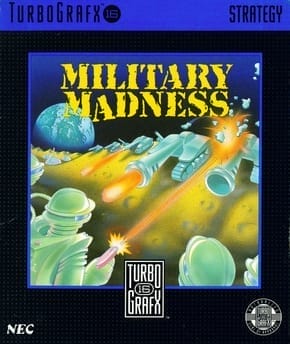
Military Madness
A pioneering turn-based strategy game set on the moon in 2099, where players command either Union or Imperial forces in tactical battles. Introduced the 'Nexus' system affecting unit effectiveness based on positioning.
Share this game
Story
In the twenty-first century, humans made a foray into the Moon but great powers were in fierce conflict over the scarce lunar resources and the Axis-Xenon Empire insisted on their occupation. On 6 April 2089, the Axis-Xenon Empire sent their army to the Moon to occupy almost the entire location and all lunar factories fell into the hands of the Axis-Xenon Empire, mass-producing weapons one after another. Those who disobeyed were captured and placed into prison camps around the Moon, while the Axis-Xenon Empire is preparing to launch the doomsday weapon S.A.M. (Supreme Atomic Missile) to attack Earth. Those who knew the plan, the Allied-Union forces, escaped from their captivity and headed towards the launch base of S.A.M. to thwart the ambitions of the Axis-Xenon Empire.
Gameplay Systems
Top: Moving around the map. Bottom: An attack sequence. (TurboGrafx-16 version shown) Military Madness is a science fiction -themed turn-based strategy game where players assume command of the Allied-Union across sixteen increasingly difficult maps that take place at the Moon in 2089, each one giving a pre-determined set number of units to use, on a desperate offense against the Axis-Xenon Empire before they launch their doomsday weapon S.A.M. (Supreme Atomic Missile) to obliterate Earth. Available modes of play include the main single-player campaign that carries the main storyline, a tutorial mode dubbed "Manual" to learn about the game's overall rules and a two-player versus mode. A password system used to keep progress of the single-player campaign. After completing the first basic set of maps, the game starts again but at a more difficult advanced set of 16 maps once the last basic map is cleared. The main gameplay objective is to either occupy the enemy prison camp to free prisoners or destroy all opposing forces on the playfield and the player that does so first wins. Players command their units on a hex map , using a command box function, and each unit have different mobility range that varies according to their type except aircraft units in addition of possessing different shooting range. Terrain plays an important role during battle sequences, as it can affect the outcome of encounters in terms of terrestrial unit's mobility, attack and defense. Each unit also gains experience when involved in combat, becoming stronger with every encounter, while offensive and defensive capabilities are increased if friendly units are near to another friendly unit. Units cannot be produced, but the Allied-Union forces can capture enemy units if they are in factories, or find unsecured factories and gain units from them. Units can also be repaired by returning them to factories under Allied-Union control, however a stored unit cannot be moved until the current turn ends. Transport units are also available to carry terrestrial units across the map. Selecting the "End" command results with players finishing their current turn. A unique gameplay feature is the "Zone of Control" system; players can surround an enemy unit by forming a circle that decreases both its offensive and defensive capabilities, however players can move to one hex position after a unit was surrounded by enemy units. Synopsis In the twenty-first century, humans made a foray into the Moon but great powers were in fierce conflict over the scarce lunar resources and the Axis-Xenon Empire insisted on their occupation. On 6 April 2089, the Axis-Xenon Empire sent their army to the Moon to occupy almost the entire location and all lunar factories fell into the hands of the Axis-Xenon Empire, mass-producing weapons one after another. Those who disobeyed were captured and placed into prison camps around the Moon, while the Axis-Xenon Empire is preparing to launch the doomsday weapon S.A.M. (Supreme Atomic Missile) to attack Earth. Those who knew the plan, the Allied-Union forces, escaped from their captivity and headed towards the launch base of S.A.M. to thwart the ambitions of the Axis-Xenon Empire.
Media Reviews
IGN
8.5/10
GameSpot
7.5/10
Famitsu
16
Eurogamer
16
Electronic Gaming Monthly
16
Some information sourced from Wikipedia, available under CC BY-SA 3.0.