C64
Paradroid
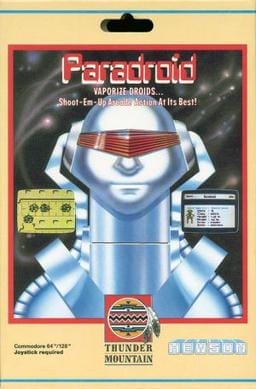
Paradroid is a groundbreaking action-strategy game where players control an infiltration droid battling rogue robots aboard a spaceship. The game pioneered a unique control system where players can 'hack' enemy droids through an innovative circuit-board mini-game.
Release Date
January 1, 1985
Players
1
Region
US
ROM Size
26 KB
Share this game
Story
Development During the development of the original game, Andrew Braybrook kept a diary that was published in Zzap!64 magazine, in which he stated: The thing you actually play with are robots shown from above. There's going to be lots of them. If you want to know more about a particular robot what you do is log-on to a computer terminal. From there you can sift through all the robots and get large side view pictures and you can select things to get more information. I've been working hard on it for about four weeks, but I was working on utilities—programs to help make the finished game—for a couple of weeks before that. I always like to do the character set first because it buys time while you're thinking about the rest of it. It's probably the easiest thing that you can do. It's not really an arcade adventure—it leans more towards arcade. Gribbly's I wanted to be a non-violent game. All of the zapping and violence that I couldn't get into Gribbly's will be going into this one. Last week we designed the game's 20-deck space-ship, but I'd like to actually build one just to make sure it all works—all the lift shafts tie up and the decks fit together. Maybe I'll try using Lego. Dunno, it might work. So far I've got a little robot skating about inside a test deck plan. You can log onto a console, select an option, make an enquiry on the test robot and get a big picture of it. The piccie uses all eight sprites combined (the maximum available on the 64 at any one time). Despite being a view from above, I intend you won't be able to see anything behind a wall. You'll have to go into a room to actually explore it. The game was influenced by several different computer games and movies, and has some similarities to an IBM mainframe game called "Survive" written by Braybrook a few years earlier while working for Marconi . Braybrook said in a Retro Gamer interview that the droid-swapping idea came from an arcade game, Front Line , where the player could enter a tank and had to leave it when it got hit. In another Retro Gamer feature, he stated that the cover of the Black Sabbath album Technical Ecstasy influenced him, where two droids "interfacing" can be observed, along with the corridors of the film Aliens . Development started right after Braybrook finished his previous game Gribbly's Day Out and even shared some code with Gribbly's . Later when Braybrook was working on Morpheus , he did another diary for Zzap!64 where he revealed that the then recently released Competition Edition of Paradroid was 50% faster than the original. In the same series, he revealed that they had redone the Paradroid graphics in the new ( Morpheus ) style, which was later released as Heavy Metal Paradroid . Andrew Braybrook did another diary during the development of Paradroid 90 for Amiga Action . Reception
Gameplay Systems
Enemy forces have hijacked a space fleet by turning its robot consignment against the crew. The goal is to neutralize all the robots, thereby rescuing the humans. The players control a prototype influence device that allows them to move the hostile robots. The game is set on a spaceship viewed from a top-down perspective. The ship consists of numerous rooms and levels, each one populated by hostile robots or androids . The player, in control of a special droid called the Influence Device, must destroy all the other droids on the ship. Each droid (including the player) is represented as a circle around a three-digit number. The numbers roughly correspond to the droid's power or level, in that higher-numbered droids are tougher to destroy; there are 24 droid types. The Influence Device is numbered 001. The primary way in which the Influence Device destroys other droids is by linking with them, effectively taking over them. When the player takes over another droid, the previously controlled droid is destroyed. Taking over a droid is done via a minigame involving basic circuit diagrams and logic gates . Each droid has one side of the screen, with a series of logic gates and circuits connected together. The droids have a number of power supplies that can apply power to one circuit. Higher-numbered droids have more power supplies. At the end of a short time period, the droid supplying the most power to the circuit wins. The logic gates are the key to allowing lower-numbered droids to beat higher-numbered droids. There is also a strategy in timing when power is applied to a circuit (as two supplies of power to the same circuit result in the later supplier of power gaining control of the circuit). It is possible for the transfer game to end in a draw. A replay will take place If this occurs. In either case, the droid being controlled by the player is destroyed. If the player beats the droid in this minigame, they take control of that droid. If not, either the droid is destroyed and the player is returned to the game simply as the Influence Device (if they were previously controlling a different droid), or the player is killed, ending the game, if they were not already controlling another droid before the takeover attempt. While in control of another droid, the player effectively acts as that droid, meaning the player has access to its maneuverability, armor, weapons and power supplies (used during the droid-control minigame). If the droid has weapons, the player can destroy other droids by shooting them instead of taking them over, though higher-numbered droids can require several shots to destroy and might fire back. The player has control of a droid only for a limited amount of time (which is inversely proportional to the droid's number). If that time elapses, the controlled droid self-destructs and the player reverts to the Influence Device (001). The spaceship has 20 decks, each with many rooms; the game has more than 400 screens. Doors and elevators connect the rooms and the decks. Only droids in the player's line of sight are visible, although doors being operated by out-of-sight droids can be seen moving. Many rooms have computer terminals that provide access to maps of the current deck and the entire ship as well as droid information. Each droid can access information about itself and all lower-numbered droids (this access is available to the player based on the droid being controlled). Goals and challenges As well as achieving a high score , Paradroid players can aim to completely clear one or more ships of robots and to attain a successful transfer from the 001 Influence Device to the unstable 999 droid. Despite the instructions referring to a finite fleet, the Commodore 64 game never ends. When clearing the eighth ship called "Itsnotardenuff", the players are just placed back on the ship with higher-ranking droids on each deck.
Some information sourced from Wikipedia, available under CC BY-SA 3.0.