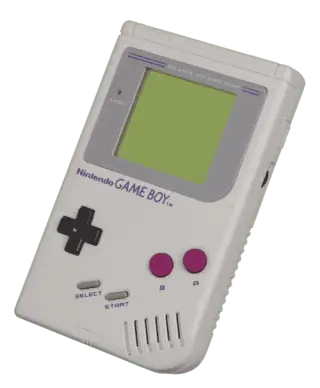
GB
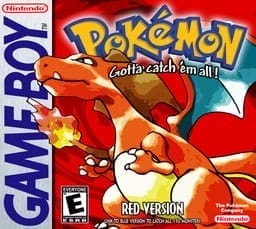
Pokémon Red Version
The revolutionary RPG that started the global Pokémon phenomenon. Begin your journey as a Pokémon Trainer in the Kanto region, capturing and training 151 unique Pokémon while battling Gym Leaders and the criminal Team Rocket.
Share this game
Story
Story After venturing alone into the tall grass, the player is stopped by Professor Samuel Oak , a famous Pokémon Researcher. Professor Oak explains to the player that wild Pokémon may be living there and encountering them alone can be very dangerous. He takes the player to his laboratory where the player meets Oak's grandson, a rival aspiring Pokémon Trainer . The player and the rival are both instructed to select a starter Pokémon for their travels out of Bulbasaur , Squirtle and Charmander . Oak's grandson will always choose the Pokémon which is stronger against the player's starting Pokémon. He will then challenge the player to a Pokémon battle with their newly obtained Pokémon and will continue to battle the player at certain points. While visiting the region's cities, the player will encounter special establishments called Gyms. Inside these buildings are Gym Leaders, each of whom the player must defeat in a Pokémon battle to obtain a total of eight Gym Badges. Once the badges are acquired, the player is given permission to enter the Kanto League in the Indigo Plateau, which consists of the best Pokémon Trainers in the region. There the player will battle the Elite Four and finally the new Kanto League Champion: the player's rival. Throughout, the player battles Team Rocket , a criminal organization that uses the Pokémon for various crimes. They devise numerous plans for stealing rare Pokémon, which the player must foil.
Gameplay Systems
The player can use their Pokémon to battle other Pokémon. When the player encounters a wild Pokémon or is challenged by a trainer, the screen switches to a turn-based battle screen that displays the two engaged Pokémon. During a battle, the player may choose to fight using one of up to four moves , use an item, switch the active Pokémon, or attempt to flee; however, fleeing is not possible in trainer battles. Pokémon have hit points (HP); when a Pokémon's HP is reduced to zero, it faints and can no longer battle until it is revived. Once an enemy Pokémon faints, the player's Pokémon that were involved in the battle receive a certain number of experience points (EXP). After accumulating enough EXP, a Pokémon will level up . A Pokémon's level controls its physical properties, such as the battle statistics acquired, and the moves it has learned. Some Pokémon may also evolve at certain levels. These evolutions affect the statistics and the levels at which new moves are learned. Pokémon at higher stages of evolution gain more statistics each time they level up, although they may not learn new moves as early, if at all, compared with the lower stages of evolution. Catching Pokémon is another essential element. While battling with a wild Pokémon, the player may throw a Poké Ball at it. If the Pokémon is successfully caught, it will come under the player's ownership. Factors in the success rate of capture include the HP of the target Pokémon, whether it is under a status effect, and the type of Poké Ball used: the lower the target's HP, and the stronger the status effect and type of Poké Ball, the higher the success rate of capture. The ultimate goal is to complete the entries in the Pokédex , a comprehensive Pokémon encyclopedia, by capturing, evolving , and trading to obtain all 151 creatures. Pokémon Red and Blue allow players to trade Pokémon between two cartridges via a Game Link Cable . This method of trading must be done to fully complete the Pokédex since certain Pokémon will only evolve upon being traded and each of the two games have version-exclusive Pokémon. The Link Cable also makes it possible to battle another player's Pokémon team. When playing Red or Blue on a Game Boy Advance or SP , the standard GBA/SP link cable will not work; players must use the Nintendo Universal Game Link Cable instead. Moreover, the English versions are incompatible with their Japanese counterparts, and such trades will corrupt the save files, as the games use different languages and therefore character sets. As well as trading with each other and Pokémon Yellow , Pokémon Red and Blue can trade Pokémon with the second generation of Pokémon games: Pokémon Gold , Silver , and Crystal . However, there are limitations: the games cannot link if one player's party contains Pokémon or moves introduced in the second generation games. Also, using the Transfer Pak for the Nintendo 64 , data such as Pokémon and items from Pokémon Red and Blue can be used in the Nintendo 64 games Pokémon Stadium and Pokémon Stadium 2 . Red and Blue are incompatible with the Pokémon games of the later "Advanced Generation" for the Game Boy Advance and GameCube . Bugs and glitches Pokémon Red and Blue are notable for a large quantity of glitches , possibly due to their scope in comparison to Game Freak's development experience at the time. One of the most popular glitches in Red and Blue involves encountering MissingNo. (short for "Missing Number"), a glitch Pokémon with multiple forms that arise when different glitches are performed. Additionally, several other Pokémon can be encountered using glitches, such as the otherwise-unobtainable Mythical Pokémon Mew . Another glitch, dubbed the "EXP underflow glitch", allows players to manipulate unsigned integers in the game's code for Pokémon in the "medium slow" experience group in order to max out the level of any such Pokémon.
Sales & Commercial Performance
Total Copies Sold
1.04 million copies
Total Revenue
$4 billion
Media Reviews
IGN
10/10
GameSpot
8.8/10
Famitsu
8/10
Game Informer
6.5/10
Electronic Gaming Monthly
8.5/10
Nintendo Power
7.2/10
OPM
88
Some information sourced from Wikipedia, available under CC BY-SA 3.0.