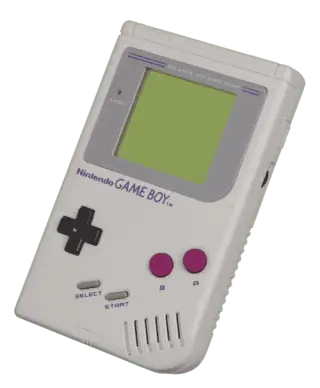
Game Boy
The original handheld gaming revolution. Despite its green-tinted screen, the Game Boy dominated portable gaming for over a decade.
Technical Specs
CPU
Custom Sharp LR35902 (hybrid Z80/8080) @ 4.19 MHz (DMG), dual-speed 4.19/8.39 MHz (GBC)
GPU
Integrated in CPU, tile-based rendering, 160x144 pixel resolution, 4 shades of gray (DMG) or 10-56 colors on-screen from 32,768 palette (GBC), 40 sprites (10 per line)
Memory
8 KB work RAM (32 KB on GBC), 8 KB VRAM (16 KB on GBC)
Storage
Cartridge ROM, 256 Kbit to 16 Mbit typical, optional battery-backed SRAM for saves
Display
2.6-inch reflective STN LCD, 160x144 pixels, no backlight (original), 4 shades of green/gray (DMG) or color (GBC)
Audio
4 channels: 2 pulse wave, 1 programmable wave, 1 noise. Mono speaker, stereo headphone output
Media
32-pin cartridge (proprietary)
History
The Nintendo Game Boy, released on April 21, 1989 in Japan and July 31, 1989 in North America, became the most successful handheld gaming device of its era despite launching with hardware specifications that were already outdated. The original Game Boy featured a Sharp LR35902 CPU running at 4.19 MHz, 8 kilobytes of RAM, and a 160x144 pixel reflective dot-matrix LCD screen capable of displaying four shades of green. While competitors like the Sega Game Gear and Atari Lynx offered full color displays and more powerful processors, the Game Boy dominated the handheld market for over a decade, selling approximately 118.7 million units across all variants (including Game Boy Color units).
The Game Boy's success was rooted in several strategic decisions. Its use of a reflective LCD rather than a backlit color display gave it dramatically superior battery life, lasting approximately 30 hours on four AA batteries compared to the Game Gear's roughly 3-5 hours on six AA batteries. For a portable device aimed partially at children, this practical advantage proved far more important than raw graphical capability. The compact form factor and rugged build quality further reinforced its suitability for on-the-go gaming.
Nintendo's decision to bundle Tetris with the Game Boy in North America was perhaps the single most important marketing decision in handheld gaming history. Tetris, developed by Soviet engineer Alexey Pajitnov, was a perfect match for portable gaming: easy to learn, infinitely replayable, and effective on the monochrome screen. The bundle attracted demographics far beyond Nintendo's traditional audience, including adults and women who had never previously purchased a gaming device. Nintendo of America president Minoru Arakawa reportedly fought internally to secure Tetris as the pack-in over a Mario title, a decision that proved transformative.
The Game Boy's library grew to encompass over 1,000 titles spanning every major genre. Super Mario Land (1989) and its vastly improved sequel Super Mario Land 2: 6 Golden Coins (1992) anchored Nintendo's first-party lineup. The Legend of Zelda: Link's Awakening (1993) demonstrated that handheld games could deliver experiences rivaling home console titles. Kirby's Dream Land (1992), developed by a young Masahiro Sakurai, introduced one of Nintendo's most enduring characters.
The cultural earthquake known as Pokemon arrived in Japan on February 27, 1996, with Pokemon Red and Green. Developed by Game Freak under the direction of Satoshi Tajiri, the games revitalized the aging Game Boy hardware and created a multimedia franchise worth tens of billions of dollars. Pokemon's link cable trading mechanic was perfectly suited to the Game Boy's portable nature, encouraging social interaction in schoolyards worldwide. By the time Pokemon reached North America in September 1998, the Game Boy was nearly a decade old, yet Pokemon drove hardware sales to unprecedented heights.
The Game Boy Color, released in October 1998, provided a color display while maintaining backward compatibility with the original Game Boy library. Running at twice the clock speed with doubled RAM, it extended the platform's commercial viability into the new millennium. The Game Boy Color hosted notable exclusives including Pokemon Crystal, The Legend of Zelda: Oracle of Ages and Oracle of Seasons, and Dragon Quest Monsters. The combined Game Boy and Game Boy Color platform remained commercially relevant until the Game Boy Advance's arrival in 2001, an extraordinary 12-year commercial lifespan that cemented its place as one of gaming's most important devices.
Variants & Revisions
Game Boy (DMG-001)
Released: April 21, 1989
Original model with gray brick design, green-tinted STN LCD, mono speaker, link port, and four AA battery operation (~30 hours).
Game Boy Pocket (MGB-001)
Released: July 21, 1996
Slimmer, lighter redesign with improved gray-scale (non-green) screen, smaller form factor, two AAA batteries. Available in multiple colors.
Game Boy Light (MGB-101)
Released: April 14, 1998
Japan-only variant of the Pocket with an electroluminescent backlight for playing in low-light conditions. Available in Gold and Silver.
Game Boy Color (CGB-001)
Released: October 21, 1998
Color-capable successor maintaining backward compatibility. 56 colors on-screen from 32,768 palette, faster CPU, doubled RAM. Available in Atomic Purple, Berry, Teal, Kiwi, and more.
Development Story
The Game Boy was conceived and developed under the guidance of Gunpei Yokoi, the legendary Nintendo engineer whose design philosophy of "Lateral Thinking with Withered Technology" (Kareta Gijutsu no Suihei Shiko) became one of the most influential principles in gaming hardware design. Yokoi's approach advocated using mature, inexpensive, and well-understood technology in novel and creative ways, rather than pursuing cutting-edge specifications. This philosophy had previously guided his development of the Game & Watch series, which used cheap LCD technology to create compelling portable games, and would define the Game Boy's design from its inception.
Development of the Game Boy began in the mid-1980s at Nintendo R&D1, Yokoi's division. The team deliberately chose a dot-matrix screen over the segmented LCD displays used in Game & Watch devices, enabling the display of arbitrary graphics rather than pre-defined images. The critical decision to use a monochrome reflective STN LCD rather than a backlit color display was controversial even within Nintendo, but Yokoi understood that battery life and cost were paramount for a truly portable device. The reflective screen eliminated the need for a backlight, dramatically reducing power consumption. The resulting green-tinted display became iconic, though it was sometimes criticized for ghosting during fast-moving games.
The CPU, a custom Sharp LR35902, was essentially a hybrid between the Intel 8080 and the Zilog Z80, sharing instruction sets with the Z80 while incorporating some 8080-specific features. Running at approximately 4.19 MHz, it was less powerful than the processors in competing handhelds but proved more than adequate for the types of games the platform hosted. The system included 8 KB of working RAM and 8 KB of video RAM, with game cartridges providing additional ROM and sometimes RAM with battery backup for save functionality.
The audio system provided four channels: two pulse wave generators, one programmable wave channel, and one noise channel. While modest by home console standards, composers like Hip Tanaka and Hirokazu Tanaka (not the same person; Hirokazu composed the original Metroid music) crafted memorable soundtracks that became deeply associated with the platform. The distinctive chiptune sound of the Game Boy later inspired an entire music movement, with artists using original or modified Game Boys as instruments.
Yokoi's team also designed the link cable system, a serial communication port that allowed two Game Boys to connect for multiplayer gameplay. While primarily used for versus modes in games like Tetris, the link cable became essential to the Game Boy's social ecosystem, particularly after Pokemon's arrival made trading between connected units a core gameplay mechanic. The link cable transformed the Game Boy from a solitary entertainment device into a social platform.
The Game Boy's industrial design prioritized durability and ergonomics. The unit was solidly constructed, and iconic stories of Game Boys surviving extreme conditions, including a unit that survived a bombing during the Gulf War and remained playable, became organic marketing for the brand. The compact dimensions, comfortable button arrangement, and front-loading cartridge slot all reflected careful consideration of how the device would be used by players of all ages.
Nintendo's Game Boy Pocket redesign in 1996 slimmed down the unit, improved the screen with better contrast and a true grayscale display rather than the green-tinted original, and reduced the battery requirement to two AAA cells. The Game Boy Light, released only in Japan in 1998, finally added an electroluminescent backlight. The Game Boy Color later that year represented the last evolution of the platform before the Game Boy Advance era, maintaining backward compatibility while finally delivering the color display that competitors had offered since 1989.
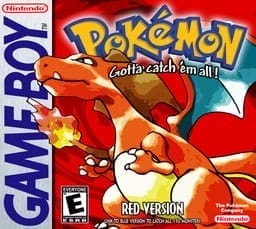
Pokémon Red Version
• 1996
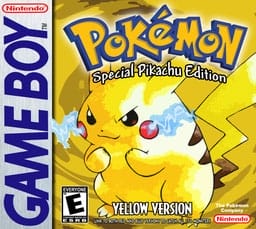
Pokémon Yellow: Special Pikachu Edition
• 1998
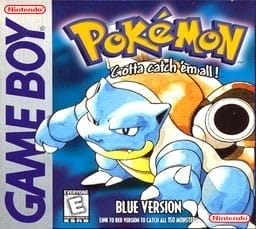
Pokémon Blue Version
• 1996
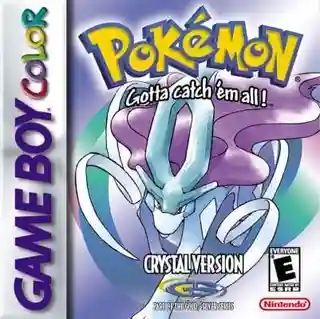
Pokémon Crystal Version
• 2000
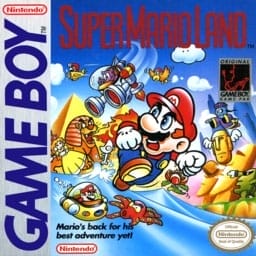
Super Mario Land
• 1989
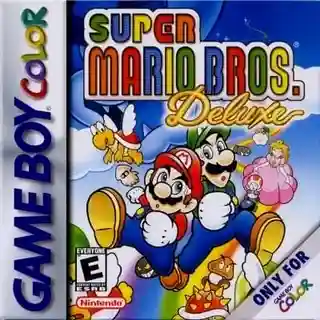
Super Mario Bros. Deluxe
• 1999
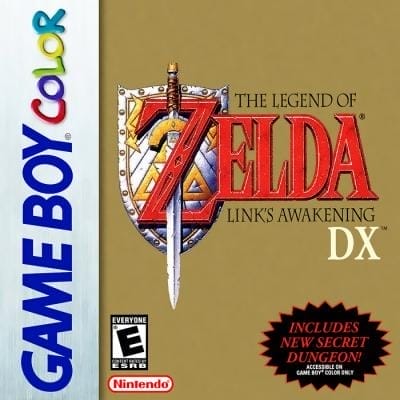
The Legend of Zelda: Link's Awakening DX
• 1998
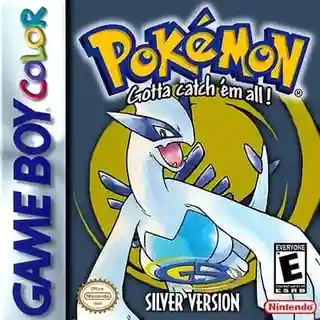
Pokémon Silver Version
• 1985
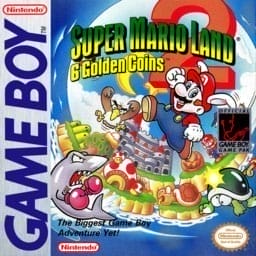
Super Mario Land 2: 6 Golden Coins
• 1992
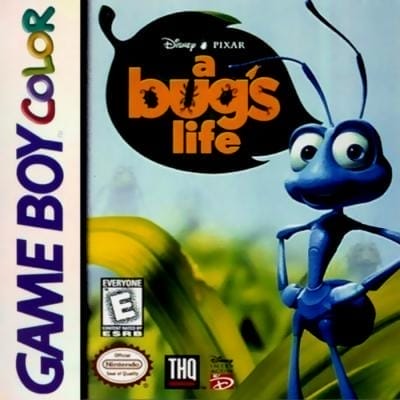
A Bug's Life
• 1998
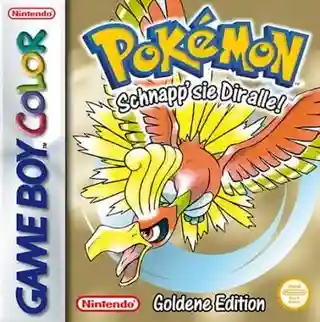
Pokémon Gold Version
• 1999
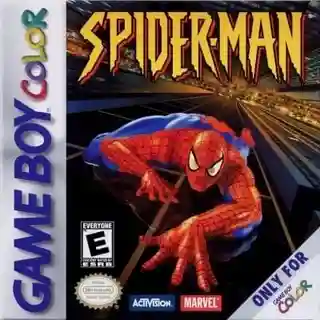
Spider-Man
• 1990
About the Game Boy
The Game Boy (GB) is a handheld gaming device manufactured by Nintendo. Released on April 21, 1989, it belongs to the 3th generation of gaming hardware.
With a library of 90+ ROMs available to download, the GB remains one of the most popular platforms for retro gaming enthusiasts. Each ROM is available for free download and compatible with popular emulators like RetroArch, giving you instant access to classic gaming history.
Whether you're looking for GB ROMs to play on your PC, phone, or dedicated retro handheld, our library has you covered with verified ROM files and complete game information.