NDS
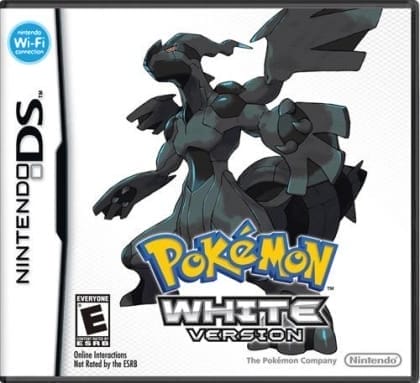
Pokémon White Version
Pokémon White Version is a role-playing game developed by Game Freak for the Nintendo DS, released in 2010 as part of the fifth generation of Pokémon games. Set in the Unova region, the game features 156 completely new Pokémon and introduces dynamic seasonal changes that transform the game world. Players embark on a journey to become Pokémon Champion while exploring themes of truth and ideals, with exclusive content including different locations and Pokémon distributions compared to Pokémon Black Version.
Share this game
Story
Setting Black and White are set in the Unova region, part of a continental mass located far away from the previous regions, Kanto , Johto , Hoenn , and Sinnoh . Unlike the previous regions which were based on real locations in Japan , Unova is modeled after New York City , an idea developed by game director Junichi Masuda when he visited the city for the launch of Diamond and Pearl . One particular example of this is Castelia City, which serves as the region's central metropolis and had such inspirations as Skyarrow Bridge its " Brooklyn Bridge -style suspension bridge" and its "huge skyscrapers". Masuda also wanted to convey a "feeling of communities" in Castelia's streets. Unova is host to large urban areas, a harbor, an airport, an amusement park, several bridges, and several mountain ranges. In addition to a diversity of new landscapes, the Unova region is also home to a diversity of people who vary in skin tone , language, and occupation. The region's Japanese name "Isshu" ( イッシュ ) is derived from the Japanese words tashu ( 多種 , meaning "many kinds") and isshu ( 一種 , meaning "one kind") ; the many kinds of people and Pokémon seen up close look like only one kind of life from afar.
Gameplay Systems
There are three basic screens: an overworld , in which the player navigates the main character; a battle screen; and the menu, in which the player configures their party, items, or gameplay settings. The player controls a Pokémon Trainer who begins the game with a single Pokémon and is able to capture more using Poké Balls. Like all other Trainers, the player can carry up to six Pokémon at one time. However, the game also includes a network of PCs to store hundreds of Pokémon. PCs are found in certain buildings called Pokémon Centers, where the player can heal their Pokémon when they have low health or have fainted. Pokémon can learn up to four moves, including attacking moves, healing moves, and moves that inflict status conditions on the opponent. They have six stats that affect battle performance: maximum hit points (HP), Attack, Defense, Special Attack, Special Defense, and Speed. Attack and Special Attack are distinguished from Defense and Special Defense by the types of moves being considered: generally, moves involving physical exertion are physical, while moves involving supernatural or elemental powers are special. Moves are classed as one of seventeen types: Normal, Water, Grass, Fire, Electric, Ghost, Bug, Fighting, Ice, Steel, Rock, Poison, Psychic, Dark, Dragon, Ground, and Flying; Pokémon can have one or two types. Generally, most of a Pokémon's moves correspond to its typing. A Pokémon's type makes it vulnerable or resistant to others; for example, Fire-type Pokémon are weak to Water-type moves, while Grass-type moves do little damage to them and Electric-type moves do normal damage. When the player encounters a wild Pokémon or is challenged by another Trainer to a battle, the screen switches to a turn-based battle screen where the Pokémon fight. During the battle, the player may use a move, use an item, switch the active Pokémon, or flee. However, the player cannot flee a battle against another Trainer or against certain wild Pokémon that are stronger than the player's. When a Pokémon's HP is reduced to zero, it faints until it is revived. If an opposing Pokémon faints, all of the player's Pokémon who participated in defeating it receive experience points . After accumulating enough experience points, a Pokémon may level up, increasing its stats. Many Pokémon evolve into other forms after certain conditions are met, usually after reaching a certain level threshold or by having a certain item used on them. At the "Day Care" location, the player can breed two of their Pokémon—usually, a male and a female—to create Eggs that hatch into baby Pokémon at level 1. Pokémon Black and White takes place in the Unova region, based on New York City . As with all regions, Unova consists of a number of cities and towns connected by "Routes". Random encounters may take place in tall grass along routes or in bodies of water. The player occasionally battles Trainers in cities and towns, as well as along routes. In addition, eight of the game's cities and towns are homes to "Gym Leaders", powerful Trainers specializing in certain types of Pokémon; beating a Gym Leader gives the player a "Badge". All eight Badges are needed to unlock the Pokémon League, where the player faces off against the "Elite Four" and, finally, the Champion. Across Unova, items can be found on the ground or purchased from "Poké Marts". For example, Hyper Potions restore HP, Antidotes cure poisoning, and Revives revitalize fainted Pokémon. TMs (Technical Machines) teach moves to Pokémon, and HMs (Hidden Machines) are a special class of TMs for important moves that allow the player to traverse the environment. The "Surf" HM move, for example, is used to cross bodies of water. New features The dialog boxes of previous games have been changed to speech balloons that appear over other characters' heads, allowing more than one character to speak at once. Japanese players can have kanji appear on screen, rather than only hiragana and katakana . During battles, the sprites of the Pokémon are fully animated and the camera changes position to highlight specific parts of the battle. In addition to continuing the day and night cycle introduced in Gold and Silver , Black and White introduces a seasonal cycle, with the seasons advancing every month rather than being linked to the calendar. Outside areas appear differently depending on the season, such as changing of leaves in autumn or snow on the ground in winter. Certain areas are only accessible during certain seasons, and different Pokémon can be found in the wild in winter where others are encountered in the other seasons. The Pokémon Deerling and Sawsbuck change their physical appearance to match the seasons. There are two new battle mechanics: Triple Battles and Rotation Battles. In Triple Battles, both teams must send out three Pokémon in a row at once; Some moves only allow Pokémon on the left or right side to attack the opponent's Pokémon on the same side or in the center. Changing position takes up one turn. In Rotation Battles, each side sends out three Pokémon at once, but they are arranged in a circle that can be rotated at will. Black has more Rotation Battles than Triple Battles, and the opposite is true in White . Another introduction is Combination Moves: a starter Pokémon can be taught one of three moves, and using them together in Double or Triple battles produces more powerful attacks. In the wild, walking through darker-colored tall grass can trigger Double Battles against wild Pokémon rather than only Single Battles with lighter-colored grass. Occasionally, the player can find rustling patches of grass and rippling water, where they can encounter either a rare Pokémon, a Pokémon more common in the opposite game version, or the highest evolutionary form of a Pokémon whose lower forms can normally be found in the area. This is the only way to capture Pokémon such as Audino , Emolga , and Alomomola . Also, dust clouds in caves and the shadows of flying Pokémon o
Sales & Commercial Performance
Total Copies Sold
2.6 million copies
Media Reviews
IGN
9/10
GameSpot
7.5/10
Famitsu
40/40
Edge
8/10
Game Informer
8.75/10
Nintendo Power
9/10
Some information sourced from Wikipedia, available under CC BY-SA 3.0.