NES
Soccer
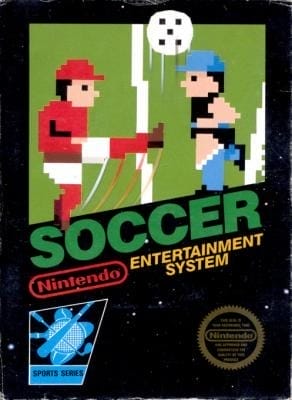
Nintendo's first soccer game for the NES featuring 7-on-7 matches with simple controls and colorful international teams. The foundation for all future NES sports titles with its accessible arcade-style gameplay.
Share this game
Story
Association football in itself does not have a classical history. Notwithstanding any similarities to other ball games played around the world, FIFA has described that no historical connection exists with any game played in antiquity outside Europe. The history of football in England dates back to at least the eighth century. The modern rules of association football are based on the mid-19th century efforts to standardise the widely varying forms of football played in the public schools of England. Ancient precursors On the left, an episkyros player on an ancient stone carving , c. 375–400 BCE , exhibited at the National Archaeological Museum, Athens ; on the right, children playing cuju in Song dynasty China, 12th century Kicking ball games arose independently multiple times across multiple cultures. The Chinese competitive game cuju ( 蹴鞠 , literally "kickball"; also known as tsu chu ) resembles modern association football as well as a mix of basketball and volleyball . This is the earliest form of a kicking game for which there is historical evidence. The game was first recorded as in exercise in the Zhan Guo Ce , a military history from the Han dynasty . Cuju players would pass the ball around, having to avoid it touching the ground at any point. It was then passed to a designated player, who attempted to kick it through the fengliu yan , a circular goal atop 10–11 meter poles. During the Han dynasty (206 BCE – 220 CE), cuju games were standardised and rules were established. The Silk Road facilitated the transmission of cuju outside of China, especially the form of the game popular in the Tang dynasty , the period when the inflatable ball was invented and replaced the stuffed ball. Other East Asian games include kemari in Japan and chuk-guk in Korea, both influenced by cuju . Kemari originated after the year 600 during the Asuka period . It was a ceremonial rather than a competitive game, and involved the kicking of a mari , a ball made of animal skin. In North America, pasuckuakohowog was a ball game played by the Algonquians ; it was described as "almost identical to the kind of folk football being played in Europe at the same time, in which the ball was kicked through goals". Phaininda and episkyros were Greek ball games. An image of an episkyros player depicted in low relief on a stele of c. 375–400 BCE in the National Archaeological Museum of Athens appears on the UEFA European Championship trophy. Athenaeus , writing in 228 CE, mentions the Roman ball game harpastum . Phaininda, episkyros and harpastum were played involving hands and violence. They all appear to have resembled rugby football , wrestling , and volleyball more than what is recognisable as modern football.
Gameplay Systems
Association football is played in accordance with a set of rules known as the Laws of the Game . The game is played using a spherical ball of 68–70 cm (27–28 in) circumference, known as the football (or soccer ball ). Two teams of eleven players each compete to get the ball into the other team's goal (between the posts and under the bar), thereby scoring a goal. There are situations where a goal can be disallowed, such as an offside call or a foul in the build-up to the goal. The team that has scored more goals at the end of the game is the winner; if both teams have scored an equal number of goals then the game is a draw. Each team is led by a captain who has only one official responsibility as mandated by the Laws of the Game: to represent their team in the coin toss before kick-off or penalty kicks . The primary law is that players other than goalkeepers may not deliberately handle the ball with their hands or arms during play, though they must use both their hands during a throw-in restart. Although players usually use their feet to move the ball around, they may use any part of their body (notably, " heading " with the forehead) other than their hands or arms. Within normal play, all players are free to play the ball in any direction and move throughout the pitch, though players may not pass to teammates who are in an offside position. During gameplay, players attempt to create goal-scoring opportunities through individual control of the ball, such as by dribbling , passing the ball to a teammate, and by taking shots at the goal, which is guarded by the opposing goalkeeper. Opposing players may try to regain control of the ball by intercepting a pass or through tackling the opponent in possession of the ball; however, physical contact between opponents is restricted. Football is generally a free-flowing game, with play stopping only when the ball has left the field of play or when play is stopped by the referee for an infringement of the rules. After a stoppage, play recommences with a specified restart. At a professional level, most matches produce only a few goals. For example, the 2022–23 season of the English Premier League produced an average of 2.85 goals per match. The Laws of the Game do not specify any player positions other than goalkeeper, but a number of specialised roles have evolved. Broadly, these include three main categories: strikers , or forwards, whose main task is to score goals; defenders , who specialise in preventing their opponents from scoring; and midfielders , who dispossess the opposition and keep possession of the ball to pass it to the forwards on their team. Players in these positions are referred to as outfield players, to distinguish them from the goalkeeper. These positions are further subdivided according to the area of the field in which the player spends the most time. For example, there are central defenders and left and right midfielders. The ten outfield players may be arranged in any combination. The number of players in each position determines the style of the team's play; more forwards and fewer defenders creates a more aggressive and offensive-minded game, while the reverse creates a slower, more defensive style of play. While players typically spend most of the game in a specific position, there are few restrictions on player movement, and players can switch positions at any time. The layout of a team's players is known as a formation . Defining the team's formation and tactics is usually the prerogative of the team's manager .
Some information sourced from Wikipedia, available under CC BY-SA 3.0.