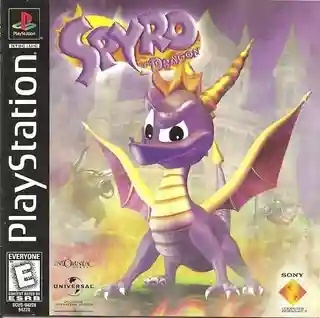

PS1
Spyro the Dragon
Spyro the Dragon is a 3D platformer featuring the energetic purple dragon Spyro on his quest to rescue his fellow dragons from crystal imprisonment. With his flame breath, charging attack, and gliding abilities, Spyro explores six vibrant homeworlds filled with treasure and enemies.
Release Date
January 1, 1998
Players
1
Region
US
ROM Size
335.4 MB
Share this game
Story
In the world of dragons, the Dragon Kingdom consists of five Homeworlds – the Artisans, the Peace Keepers, the Magic Crafters, the Beast Makers, and the Dream Weavers – which have lived in harmony for many years. One day, a TV interview with a pair of dragons from the Artisan realm catches the attention of Gnasty Gnorc, a powerful gnorc (half gnome and half orc ) who was banished from the kingdom due to his abrasive demeanor and sent to an abandoned junkyard, which he renames to "Gnasty's World". The dragons' openly dismissive and derisive commentary concerning Gnasty enrages him, driving him to unleash a full-fledged attack on the kingdom. Using his magic, he casts a spell across the land that encases every dragon in a crystal shell; he also steals the dragons' prized collection of treasure, turning the gemstones into devious gnorc soldiers and other creatures to help him take over the dragon worlds. Spyro , a young purple dragon, is the only dragon that manages to avoid getting crystallized by the attack. Aided by his dragonfly companion, Sparx, Spyro eagerly sets out to locate and defeat Gnasty. Spyro visits each of the dragon homeworlds, defeating Gnasty's forces who have been set out to stop him. Along the way, he frees the crystallized dragons, who give him advice and urge him to recover any stolen treasure and dragon eggs along the way. He eventually makes his way to Gnasty's World, where he finally confronts and defeats Gnasty. After Spyro's quest is over, he has access to Gnasty's treasure portal, which can only be opened if Spyro rescues every dragon in the kingdom and recovers all of the dragons' treasure and retrieves the stolen dragon eggs. A secret ending can then be unlocked by retrieving everything inside of the treasure portal. In this ending, Spyro is seen getting interviewed on TV when another spell is placed on the dragons, prompting Spyro to set out on yet another adventure.
Gameplay Systems
Spyro the Dragon is a 3D platform game ; the player controls the titular character as he ventures across the realms of the Dragon World to defeat the antagonistic Gnasty Gnorc, as well as rescue his fellow dragons and recover all of their stolen treasure. Worlds consist of six dragon "home worlds", each of which acts as a dedicated hub, containing portals that serve as gateways to different levels. The player must progress from one Homeworld to the next by talking to a balloonist , who transports Spyro to the next world on a hot air balloon after the player has found the required collectibles in the current given world. In addition to regular platforming stages, each Homeworld contains a boss fight and a hidden flight stage that involves flying throughout an environment and destroying a number of objects. The levels in Spyro the Dragon are open-ended, and they revolve around exploring and obtaining various collectible items to progress in the game. Each stage contains a number of crystallized dragons, whom Spyro must turn back to normal by locating and stepping on their statue bases. These dragons give the player advice on how to progress through the game, as well as their respective locations acting as save points after the dragon has been freed. Another important collectible in the game is the dragons' stolen treasure, which is dispersed throughout each level in the form of multicolored gemstones . These gems are located in numerous different places, including inside enemies, breakable boxes, and treasure chests, and most stages contain a set amount of treasure to be found. There are also stolen dragon eggs that must be reclaimed by chasing and defeating thieves. Finding every collectible in the game unlocks an additional world that otherwise cannot be accessed. Spyro has two main offensive moves, which are used to attack enemies as well as destroy certain objects: charging, in which Spyro sprints forward and rams into things with his head, and breathing fire. These attacks must be used appropriately for certain enemies and situations; for instance, some enemies carry fireproof metal armor, meaning that they can only be defeated by charging, while larger enemies can only be hit using fire breath, as they will immediately crush Spyro otherwise. Spyro can also use his wings to glide in midair, letting him travel further distances in the air and access areas otherwise unreachable via a regular jump. Throughout the game, Spyro is accompanied by Sparx, a yellow dragonfly who protects Spyro from taking damage and serves as the player's system of health . Sparx's current health is represented by the color of his body; if Spyro is hurt by an obstacle, such as an enemy or by touching water, Sparx changes colors, with yellow, blue and green representing different subsequent amounts of withheld damage. If the player is damaged too many times, Sparx disappears, leaving Spyro vulnerable to losing a life if he is hurt again. Sparx can be rejuvenated by consuming butterflies , which are found by killing passive creatures such as sheep that roam throughout most levels. Sparx also helps Spyro collect items by retrieving any gems that Spyro passes by.
Media Reviews
IGN
9/10
GameSpot
8.3/10
Edge
7/10
Electronic Gaming Monthly
33.5/40
Some information sourced from Wikipedia, available under CC BY-SA 3.0.