PS1
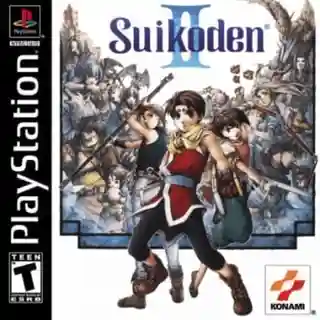
Suikoden II
Suikoden II is a role-playing game developed and published by Konami for the PlayStation. A sequel to the 1995 game Suikoden, it continues the series' tradition of political intrigue, war, and the recruitment of 108 Stars of Destiny. The story follows a young hero caught in a war between rival nations and his childhood friend Jowy.
Share this game
Story
The game begins with Riou and Jowy waking up from their sleep, they are the member of the Unicorn Youth Brigade of the Highland army. On the same night, the maniacal Prince Luca Blight orchestrate false flag attack on Highlander soldier, blaming the Jowstonian and giving the excuse to justify an incursion deep into Jowston territory after the recent peace treaty. After witnessing the slaughter, Riou and Jowy have no choice but to escape by jumping from a cliff into a river, promising to return to that spot if they ever get separated. Riou is rescued from the river by a group of mercenaries working for Jowston, led by Viktor and Flik from the first Suikoden game, but is detained as an enemy soldier of Highland. Jowy is rescued and nursed back to health by the keepers of a mysterious shrine in a nearby town. Learning of Riou's imprisonment, Jowy rescues Riou, and the two escape back to their hometown in Highland. After reuniting with Nanami and recruiting Mukumuku, Riou and Jowy are captured and sentenced to death by the Highland army to silence the truth of the youth brigade massacre. They are once again saved by Viktor and Flik, but the mercenaries prove no match for Blight and the Highland army and are forced to flee. As Luca razes the region, Riou and Jowy return to the now-destroyed town where Jowy was rescued, and discover that the shrine is the resting place of the Rune of the Beginning. Inside the shrine, each receives half of the Rune, with Riou gaining the Bright Shield Rune and Jowy gaining the Black Sword Rune. The ragtag group flees onward to Muse, capital of the Jowston Alliance, where Riou and Jowy are asked to participate in a spy mission to the Highland army camp. During the mission, Jowy is captured by the enemy. He is able to escape back to Muse but begins to act strangely. Meanwhile, while trying to rally against Highland, the individual leaders of the City-States collapse into infighting. As the Highland army approaches, Jowy assassinates Anabelle, the mayor of Muse, and opens the city gates to let the Highland army in. Riou and Nanami, distraught over Jowy's betrayal, flee south across Lake Dunan with the surviving members of Viktor's mercenaries. The group drives the vampire Neclord out of Victor's ruined hometown of North Window, then uses the castle as a new base to build their forces against Highland. With the help of Apple, student of the fallen strategist Mathiu, they recruit a brilliant merchant named Shu as their chief strategist; Shu and Apple are both surprised to learn that Leon Silverberg, last surviving relative of Mathiu and the fallen rebel leader Odessa, is now helping Highland. Leknaat, the magician and True Rune bearer from the original Suikoden who oversees fate, tells Riou that he has been chosen to gather the 108 Stars of Destiny to alter the fate the True Runes impose on the world. Riou and the recruited Stars of Destiny work to rally the remaining City-States under the banner of the New State Army, forming alliances with Two River and the Toran Republic (the setting of the first game). Gordeau, leader of the Knightdom of Matilda, refuses to join the alliance, but many of the knights under his command defect to Riou's cause. While attempting to protect the university town of Greenhill, Riou is shocked to see Jowy in command of Highland forces under Luca Blight. After capturing Greenhill without a battle, Jowy rises through the ranks of the Highland army, marrying Luca's sister Princess Jillia and plotting with Luca to assassinate the King of Highland. However, Jowy reveals to some trusted lieutenants within the Highland army that his support for Luca is a ruse, that he believes Luca's insanity and cruelty are a threat to both Highland and Jowston, and he intends to betray Luca after building his own base of support. After poisoning his father and becoming King of Highland, Luca sacrifices the entire population of Muse in a mysterious ritual, then launches an attack against the New State Army. Jowy uses the pending attack to betray Luca by warning the New State Army and giving Riou information on Luca's whereabouts. Riou and the New State Army ambush Luca and kill him after a lengthy struggle. Jowy then becomes king of Highland through his marriage to Jillia. Unfortunately, even with Luca dead, Jowy is still unwilling to make peace, believing that war will continue as long as two nations inhabit the region of Jowston. Riou learns that the bearers of the two halves of the Rune of Beginning are destined to fight each other, and that his adoptive father, Master Genkaku, had shared the rune 25 years ago with the Highland champion Han Cunningham. The two tried to reunite the rune, but failed due to the animosity between their respective nations, and were forced to seal it in the shrine instead. Riou defeats Neclord once more to free the nation of Tinto, then liberates Greenhill. While Riou besieges Matilda to sever their alliance with Highland, Nanami is gravely wounded in a treacherous attack by Gordeau; Riou and Jowy briefly reunite to take Gordeau down. Despite the best efforts of the New State Army's doctor, Nanami appears to succumb to her wounds. Riou shakes off his grief and leads his completed alliance to attack the Highland capital city of L'Renouille, where he duels and defeats Han Cunningham; before dying, Han expresses the hope that Riou and Jowy can succeed where he and Genkaku failed. Realizing he has lost, Jowy tells Jillia and their adopted daughter Pilika to flee the kingdom. Meanwhile, Leon Silverberg informs Riou that Jowy had been using his Black Sword Rune to suppress the power of the Beast Rune, another of the 27 True Runes that governs animalistic rage, passion, and blood sacrifice. Luca's sacrifice of the people of Muse had filled the Beast Rune with power, and Leon remained with Highland while he sought a way to destroy it. Leon activates the Beast Rune with his own blood, and Riou and his allies defeat it for good. From this p
Gameplay Systems
Suikoden II is a role-playing video game with strategic elements, with multiple gameplay formats ranging from one-on-one combat to large scale confrontations between two armies. The player controls a silent protagonist , advancing the plot by completing tasks and talking with other characters. The player can also recruit over 100 new characters to his cause, often involving a short sidequest to do so. In towns, the player can gather information, sharpen characters' weaponry, and buy equipment and runes; wilderness areas generally feature random encounters with monsters. Like other games of the series, Suikoden II employs a unique character leveling system from most RPGs. There is a fixed amount of experience points needed to gain each level, and experience gained after battles is determined by the difference in levels between the party members and enemies. This allows for low-level characters to catch up to the levels of enemies at later points in the game quickly, reducing the need for level grinding . Runes, the source of all magic in the world of Suikoden II , are handled the same as the original Suikoden . Characters have a certain number of spell usages per "spell level"; for instance, a character with four level 1 spell slots and a Fire Rune could cast "Flaming Arrows" (the level 1 Fire Rune spell) four times. Some specialized runes or skill-based runes have different rules, such as unlimited use or a single use per battle. Updates from the original Suikoden include a grid and unit based tactical battle system, the addition of a three rune slot system which allows for three different runes to be equipped at once, a party inventory system, a "dash" button that allowed the player to move around the screen quicker, and vast graphical improvement. Also notable is the inclusion of a variety of mini-games including one quite reminiscent of Iron Chef . A transfer of data from the prior game in the series enables returning characters to enter the fray with higher levels and improved weapons. References to the original Suikoden are also adapted accordingly for a greater feel in continuity . Following the original Suikoden , Suikoden II contains three different types of combat: Regular battles : Where the majority of combat takes place in the game, the turn-based battle system in Suikoden II is considered typical of JRPGs at the time, containing options for attack, magic (runes), items etc. The player can enter battles through random encounters on the world map and dungeons, or at specific points of the plot. The player may have a party of up to 6 characters in this battle type, against up to 6 enemies. If all six characters lose all their hit points and are thus incapacitated, it is game over and the player must restart (exceptions exist for certain plot battles in which winning is optional). This is the only type of combat where the player can gain experience, items or Potch (the currency of Suikoden II ). Emphasis is placed on "unite attacks," unique combination attacks between specific characters in the party. These special attacks exhibit a wide variety of abilities and usually highlight the personality traits and relationships of the characters. Duels : The main character is pitted against another character in single combat. This style of fighting only has three moves: Attack, Wild Attack, and Defend. This duel is played in a Rock, Paper, Scissors style where "Attack" beats "Defend", "Wild Attack" beats "Attack", and "Defend" beats "Wild Attack". The player must attempt to guess what kind of attack the enemy is going to perform by the dialogue displayed on-screen before each round. Massive battles : More interactivity was added to this element of the gameplay over that of its predecessor. While some of the shades of the old "Rock, Paper, Scissors" style battle of the original (where cavalry beats archers, archers beat magic and magic beats cavalry) remain, Suikoden II introduces a grid style battle system reminiscent to that of the Romance of the Three Kingdoms or Fire Emblem games. As the main character recruits characters for his castle, this opens up more options for more units. Certain characters are 'unit leaders' while others are 'supports'. Every character adds a certain amount of defense or attack to a unit. In addition, certain characters also add special abilities to the unit to which they have been attached. The numbers affect the chances of win or loss as much as the type of units being pitted against each other. Every unit may take up to a total of two 'losses' which are counted when a unit suffers a severe number of casualties. Each skirmish they take part in might result in no loss, loss on one side, or even loss on both sides. As mentioned before, certain characters add special abilities to the units. Examples of these abilities include being able to take more losses than usual, magic or archery to allow attacks from a distance, healing of itself or others, etc. When a unit suffers its maximum losses it will retreat from battle and, when this happens there is a possibility of the characters in the unit being wounded or even killed. Should a character be killed in a massive battle, they are considered permanently dead.
Media Reviews
IGN
9/10
GameSpot
7.6/10
Game Informer
9/10
Electronic Gaming Monthly
7/10
Some information sourced from Wikipedia, available under CC BY-SA 3.0.