
Arcade
Track & Field
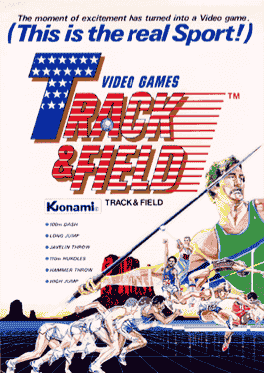
The iconic Olympic sports arcade game that popularized button-mashing gameplay. Compete in six events including 100m dash, long jump, javelin throw, and more with simple two-button controls.
Share this game
Story
The first recorded examples of organized track and field events are the Ancient Olympic games, which included further running competitions, but the introduction of the Ancient Olympic pentathlon marked a step towards track and field as it is recognized today—it comprised a five-event competition of the long jump , javelin throw , discus throw , stadion footrace, and wrestling . Track and field events were also present at the Panhellenic Games in Greece around this period, and they later spread to Rome in Italy around 201 BC. In the Middle Ages , new track and field events began developing in parts of Northern Europe. The stone put and weight throw competitions popular among Celtic societies in Ireland and Scotland were precursors to the modern shot put and hammer throw events. One of the last track and field events to develop was the pole vault , which stemmed from competitions such as fierljeppen in North European Lowlands in the 18th century. Discrete track and field competitions, separate from general sporting festivals , were first recorded in the 19th century. These were typically organised among rival educational institutions , military organisations and sports clubs . Influenced by a Classics -rich curriculum, competitions in the English public schools were conceived as human equivalents of horse racing , fox hunting and hare coursing . The Royal Shrewsbury School Hunt is the oldest running club in the world, with written records going back to 1831 and evidence that it was established by 1819. The school organised Paper Chase races in which runners followed a trail of paper shreds left by two "foxes"; even today RSSH runners are called "hounds" and a race victory is a "kill". The first definite record of Shrewsbury's cross-country Annual Steeplechase is in 1834, making it the oldest running race of the modern era. The school also lays claim to the oldest track and field meeting still extant, the Second Spring Meeting first documented in 1840. This featured a series of throwing and jumping events with mock horse races including the Derby Stakes, the Hurdle Race and the Trial Stakes. Runners were entered by "owners" and named as though they were horses. 13 miles (21 km) away and a decade later, the first Wenlock Olympian Games were held at Much Wenlock racecourse in 1851. It included a "half-mile foot race" (805 m) and a "leaping in distance" competition. The first modern athletics clubs in the world were founded at the University of Cambridge in 1857, and the University of Oxford in 1860; the two universities began an annual varsity match in 1864. The London Athletic Club became the first independent athletic club in 1863. The first modern-style indoor athletics meetings were recorded shortly after in the 1860s, including a meet at Ashburnham Hall in London which featured four running events and a triple jump competition. In 1865, Dr William Penny Brookes of Wenlock helped set up the National Olympian Association , which held their first Olympian Games in 1866 at the Crystal Palace in London. This national event was a great success, attracting a crowd of over ten thousand people. In response, the Amateur Athletic Club was formed that same year and held a championship for "gentlemen amateurs" in an attempt to reclaim the sport for the educated elite. Ultimately the "allcomers" ethos of the NOA won through and in 1880 the AAC was reconstituted as the Amateur Athletic Association , the first national body for the sport of athletics . The AAA Championships , the de facto British national championships despite being for England only, have been held annually since July 1880 with breaks only during two world wars and 2006–2008. The AAA was effectively a global governing body in the early years of the sport, helping to codify its rules. Meanwhile, the New York Athletic Club in 1876 began holding an annual national competition, the USA Outdoor Track and Field Championships . The establishment of general sports governing bodies for the United States (the Amateur Athletic Union in 1888) and France (the Union des sociétés françaises de sports athlétiques in 1889) put the sport on a formal footing and made international competitions possible. The revival of the Olympic Games at the end of the 19th century marked a new high for track and field. The Olympic athletics programme , comprising track and field events plus a marathon , contained many of the foremost sporting competitions of the 1896 Summer Olympics . The Olympics also consolidated the use of metric measurements in international track and field events, both for race distances and for measuring jumps and throws. The Olympic athletics programme greatly expanded over the next decades, and track and field remained among its most prominent contests. The Olympics was the elite competition for track and field, only open to amateur sportsmen . Track and field continued to be a largely amateur sport, as this rule was strictly enforced: Jim Thorpe was stripped of his track and field medals from the 1912 Olympics after it was revealed that he had taken expense money for playing baseball, violating Olympic amateurism rules. His medals were reinstated 29 years after his death. That same year, the International Amateur Athletic Federation (IAAF) was established as the international governing body for track and field, and it enshrined amateurism as a founding principle for the sport. The National Collegiate Athletic Association held their first Men's Outdoor Track and Field Championship in 1921, making it one of the most prestigious competitions for students. In 1923 track and field featured at the inaugural World Student Games . The first continental track and field competition was the 1919 South American Championships , followed by the European Athletics Championships in 1934. Until the early 1920s, track and field was almost an exclusively male pursuit. Many colleges that did offer women's physical education required women to participate in walking
Some information sourced from Wikipedia, available under CC BY-SA 3.0.