NES
Ultima: Exodus
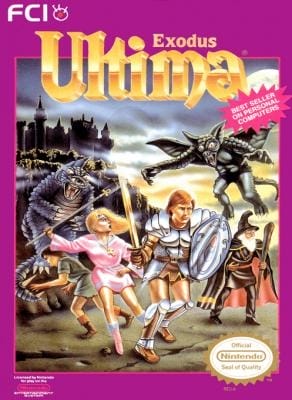
The 1987 NES adaptation of Ultima III, featuring a streamlined console RPG experience. Players lead a party of adventurers to defeat the evil Exodus in a fantasy world with turn-based combat and overworld exploration.
Release Date
January 1, 1987
Players
1
Region
US
ROM Size
256 KB
Share this game
Story
After Ultima II: The Revenge of the Enchantress was set on Earth, the story of Exodus returns the player to Sosaria , the world of Ultima I . The game is named for its chief villain, Exodus, a creation of Minax and Mondain that the series later describes as neither human nor machine. Although a demonic figure appears on the cover of the game, Exodus turns out to be something like a computer (possibly an artificial intelligence ) and to defeat him the player has to acquire four magic (punch)cards and insert them into the mainframe in a specific order. At the beginning of the game, Exodus is terrorizing the land of Sosaria from his stronghold on the Isle of Fire. The player is summoned by Lord British to defeat Exodus, and embarks on a quest that takes him to the lost land of Ambrosia, to the depths of the dungeons of Sosaria to receive powerful magical branding marks and to find the mysterious Time Lord , and finally to the Isle of Fire itself to confront Exodus in his lair. The game ends immediately upon Exodus' defeat; but unlike many games in the genre, Exodus cannot simply be killed in battle by a strong party of adventurers, but only through puzzle -solving and by paying attention to the clues given throughout the game. At the end of the game, players were instructed to "REPORT THY VICTORY!" to Origin. Those who did so received a certificate of completion autographed by Richard Garriott . Places in the game such as Ambrosia and the Isle of Fire make appearances in later games, such as Ultima VII and Ultima Online .
Gameplay Systems
Exodus featured revolutionary graphics for its time, as one of the first computer RPGs to display animated characters. Also, Exodus differs from previous games in that players now direct the actions of a party of four characters rather than just one. During regular play the characters are represented as a single player icon and move as one. However, in battle mode, each character is represented separately on a tactical battle screen, and the player alternates commands between each character in order, followed by each enemy character having a turn. This differs from the two previous games in the Ultima series in which the player is simply depicted as trading blows with one opponent on the main map until either is defeated. Enemies on the overworld map can be seen and at least temporarily avoided, while enemies in dungeons appear randomly without any forewarning. The party of four that a player uses can be chosen at the beginning of the game. There is a choice between 11 classes : Fighter , Paladin , Cleric , Wizard , Ranger , Thief , Barbarian, Lark, Illusionist, Druid , and Alchemist. The player also chooses from among five races : Human, Elf , Dwarf , Bobbit, or Fuzzy. Players then assign points to their statistics : Strength, Dexterity, Intelligence, and Wisdom. The races determine limitations on maximum stat growth, and thus (in the case of Intelligence and Wisdom) maximum spellcasting ability. Character classes differ in terms of fighting skill, magical abilities, and thieving abilities, with varying degrees of proficiency in each. Fighters, for example, can use all weapons and armor, but lack thieving or magic abilities; clerics can use up to maces and chain armor, and all clerical spells; Alchemists can use only daggers and cloth armor, and half wizard spells and half thieving abilities. Each character begins at Level 1 and increases individually. The maximum effective level for characters is 25. Beyond this point the level will continue to increase; however the number of hit points is fixed at 2550. Maximum hit points for a character can be calculated by the following formula: HP = 100 * L + 50 (where L is the current level of the character). When a character has gained enough experience points, they must transact with Lord British for the character to level up. Aside from the ability to talk to townspeople there are other commands that can be used on them. Some of the commands a player can use are bribe, steal, and fight. Bribing can be used to make certain guards go away from their post. Steal can be used on townspeople and some enemies, but can result in conflict with townspeople if caught. A player can choose to fight a townsperson, but it will prompt the guards to chase after the player characters. The guards always come in parties of eight and are very difficult to defeat. You can also choose to fight Lord British, but he cannot be killed, thus resulting in a long, drawn-out fight that the player will ultimately lose. Lord British can be temporarily killed by cannon fire from a ship in the castle moat, but exiting and re-entering the castle restores him. Unlike the two previous Ultima games, which had wire-frame first-person dungeons, Exodus dungeons are solid- 3D in appearance and integrated into the game's plot. Dungeons are necessary to obtain certain marks that are needed to finish the game. Each dungeon has 8 levels , and the deeper the level the more challenging the enemies. Note: the monsters that are spawned in dungeons are not based on character level as the overworld monsters are; rather, they are based on the dungeon level they are encountered in, so going too deep into certain dungeons may be too hard for characters in the early stages of the game. One can find many chests (with gold, weapons, and armor) inside dungeons, but many of them are trapped. Aside from chests and marks, one can find fountains in dungeons: some heal, some cure, and some poison. Peering at gems allows the player to see a map of a given dungeon level; torches or light-casting spells are necessary to be able to see inside dungeons. There are three modes of travel in the game: on foot, horseback, and boat. Getting around on foot is slow and can often lead to monsters catching up to the player character. Horseback gives the player character the advantage of moving faster while consuming less food, making getting away from unwanted fights easier. Getting a boat requires players to reach a certain level so that pirate ships begin appearing. Once a pirate ship is defeated, the boat belongs to the player. Obtaining a boat is necessary in order to visit the island of Ambrosia, and to reach Exodus and thus win the game. By denying the player the ability to see what's behind mountain peaks, forests, and walls, the overland maps contain many small surprises such as hidden treasure, secret paths, and out-of-the-way informants. The look of the game is no longer based on certain characteristics of the Apple II hardware; it is rather a carefully designed screen layout. Beating the game requires the player to get all four marks and all four prayer cards. At the altar of Exodus, the player character must insert the cards in a particular order to defeat Exodus.
Media Reviews
Famitsu
1987
Some information sourced from Wikipedia, available under CC BY-SA 3.0.