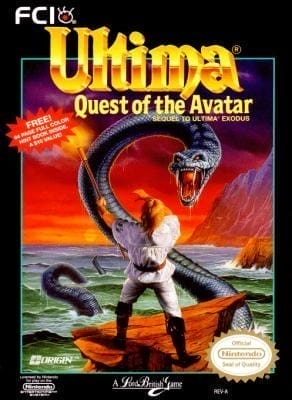

NES
Ultima: Quest of the Avatar
The NES adaptation of Ultima IV, where players embark on a spiritual journey to become the Avatar of virtue in the fantasy world of Britannia. This version simplifies the PC original with streamlined controls and modified gameplay for console audiences.
Release Date
January 1, 1990
Players
1
Region
US
ROM Size
256 KB
Share this game
Story
Ultima IV is among the few role-playing games, and perhaps the first, in which the game's story does not center on asking a player character to overcome a tangible ultimate evil . The story instead focuses on the player character's moral self-improvement. After the defeat of each of the members of the Triad of Evil in the previous three Ultima games, the world of Sosaria underwent some radical changes in geography: Three quarters of the world disappeared, continents rose and sank, and new cities were built to replace the ones that were lost. Eventually the world, now unified under Lord British 's rule, was renamed Britannia. Lord British felt the people lacked purpose after their great struggles against the Triad were over, and he was concerned with their spiritual well-being in this unfamiliar new age of relative peace, so he proclaimed the Quest of the Avatar: He needed someone to step forth and become the shining example for others to follow. Unlike most other RPGs the game is not set in an "age of darkness"; prosperous Britannia resembles Renaissance Italy , or King Arthur 's Camelot. The object of the game is to focus on the main character's development in virtuous life—possible because the land is at peace—and become a spiritual leader and an example to the people of the world of Britannia. The game follows the protagonist's struggle to understand and exercise the Eight Virtues . After proving his or her understanding in each of the Virtues, locating several artifacts and finally descending into the dungeon called the Stygian Abyss to gain access to the Codex of Ultimate Wisdom, the protagonist becomes an Avatar . Conversely, actions in the game could remove a character's gained Virtues, distancing them from the construction of Truth, Love, Courage and the greater axiom of Infinity—all required to complete the game. Though Avatarhood is not exclusive to one chosen person, the hero remains the only known Avatar throughout the later games, and as time passes he is increasingly regarded as a myth.
Gameplay Systems
Instead of simply choosing stats to assign points to as in the first three Ultima games, players are asked various ethical dilemmas by a gypsy fortune-teller using remotely tarot -like cards of the eight virtues. These situations do not have one correct resolution; rather, players must rank the Eight Virtues and whichever stands as their highest priority determines the type of character they will play. For example, choosing Compassion creates a Bard , Honor a Paladin , Sacrifice a Tinker , and so on. This is also the first Ultima where playing as a human is necessary, eliminating other races such as the elves , dwarves , and "bobbits" found in previous games (although even in the first three Ultima s where they could be chosen as player characters, there were never any non-player characters (NPC) of those non-human races). Although each profession embodies a particular Virtue, to become an Avatar the player must achieve enlightenment in all eight virtues. Virtue affects how NPCs interact with the player; enlightenment in the Virtues is achieved through the player's actions as well as through meditation at shrines. Shrines to each of the Virtues are scattered about Britannia, each requiring the player to possess the corresponding Virtue's rune before allowing entry. Through meditation and correctly repeating the Virtue's mantra three times at the shrine, the player gains insight and ultimately enlightenment in the Virtue. The seer Hawkwind in Lord British's castle provides the player with feedback on their progress in the Virtues, offering advice for actions that will improve their standing in each of the Eight Virtues, informing them when they are ready to visit a shrine for elevation, or chastising the character if they "hath strayed far from the path of the Avatar". A player may be encouraged to give alms to the poor to improve their Sacrifice, or never flee from battle to improve their Valor. Players are equally able to lower their virtue by their in-game actions, such as selecting a bragging response in a dialog with certain characters (lowers Humility). While most actions have a minor effect on a Virtue's progress, certain actions can have an immediate and devastating effect on a player's progress on multiple Virtues. Technically, the game was very similar to Ultima III: Exodus , although much larger. It is the first Ultima to feature a dynamic conversation system; whereas NPCs in earlier games would only give one canned answer when talked to, now players could interact with them by specifying a subject of conversation, the subject determined either by a standard set of questions (name, job, health) or by information gleaned from the previous answers, or from other characters. Many sub- quests were arranged around this. Users playing the game a second time could save considerable time by knowing the answers to key questions, which frequently required travel to another city to talk with another NPC. In at least one case, a player is asked "Who sent you?", which may require yet another round trip between cities. Another addition were dungeon rooms, uniquely designed combat areas in the dungeons that supplemented the standard combat against randomly appearing enemies. Ultima IV is an open world game ; most quests can be completed in any order. There are no fetch quests . Although it is a turn-based game, the clock runs while the game was running. If a player does not act for a while, NPCs and monsters may move and time passes. Time is an important aspect to the game, as certain actions can only be performed at certain times. The world of Britannia was first introduced here in full, and the world map in the series did not greatly change in later games. The player may travel about Britannia by foot, on horseback, across the sea in a ship or by air in a "lighter than air device". Speed and ease of travel is affected by the mode of travel as well as terrain and wind. Virtues The Eight Virtues of the Avatar, their relationship to the Three Principles of Truth, Love, and Courage, and how gameplay has been designed around them are as follows: Honesty: Truth When purchasing goods from blind merchants, the player is required to enter the amount of gold they wish to pay. Although the player has the option of paying less than the merchant has asked for, this will mark the player as dishonest. Stealing gold from chests in towns, villages and castles will also penalize the player. This Virtue is embodied by Mariah the Mage. Compassion: Love By using the Give conversation subject, a player can give beggars alms ; doing so demonstrates Compassion. This Virtue is embodied by Iolo the Bard. Valor: Courage Valor is displayed by the player defeating enemies in combat and not fleeing in a cowardly fashion. This means that when retreat is necessary, the player should be the last party member to leave the field of battle. This Virtue is embodied by Geoffrey the Fighter. Justice: Truth and Love Not all of the hostile creatures in Britannia are evil and the player must avoid unprovoked attacks on those that are not. If attacked, he should resort to driving them away rather than killing them. Out of the eight virtues, this one requires the most finesse to embody and is a particularly good example of balancing ethical dilemmas. The player's party must stand their ground for Valor, yet drive their foes away without killing them. This Virtue is embodied by Jaana the Druid. Sacrifice: Love and Courage If the player goes to a place of healing while in good health , the player can make a blood donation and sacrifice some health in doing so. One noted critic, Scorpia of Computer Gaming World , reported that players who wrote her for hints had the most trouble with self -sacrifice, believing that giving gold to others was sufficient, as opposed to donating blood. Helping others retreat from battle and losing Valor points is another way of increasing Sacrifice. This Virtue is embodied by Julia the Tinker. In the NES po
Media Reviews
IGN
26
Famitsu
31/40
Electronic Gaming Monthly
8/10
OPM
1991
Some information sourced from Wikipedia, available under CC BY-SA 3.0.