SNES
Breath of Fire II
Ryu and his companions battle the evil Deathevan across two parallel worlds in this RPG sequel featuring town-building mechanics and an expanded dragon transformation system.
Share this game
Story
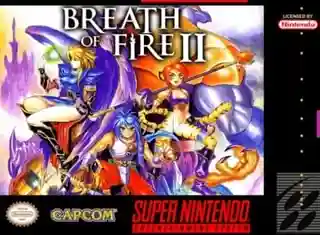
Characters The characters of Breath of Fire II were designed by Capcom artist Tatsuya Yoshikawa, who also provided artwork for the cast of the previous game. Breath of Fire II features nine playable characters who join the player's party at set points throughout the story, each with their own selection of attacks, magic spells, and personal actions which can be used to pass certain obstacles and solve puzzles. The main protagonist is a 16-year-old boy named Ryu Bateson, who shares his name with the main character from the original Breath of Fire , who mysteriously finds himself alone in the world one day after his father and sister disappear and all townspeople in his village forget who he is. As a member of the elusive Dragon Clan, Ryu possess the ability to transform into powerful draconic beings with destructive abilities, and makes his way as a "Ranger", a sword-for-hire. He is joined by his friend and fellow Ranger, Bow ("Boche Doggy" in the Japanese version), a thief and member of the Grassrunner clan of dog-people who uses a crossbow and healing spells. Throughout the game, players recruit additional characters at different points in the story, including Katt ("Rinpu Chuan" in the Japanese version), a member of the Woren clan of cat-people who fights at a coliseum; Rand Marks, muscular pangolin -person who fights with his bare hands; Nina Windia, descendant of the original Nina from Breath of Fire and princess of a clan of winged humans who was exiled due to her black wings, a bad omen in her country; Sten Legacy, a former soldier from a kingdom of monkey-people who makes his way as a trickster and performer; Ekkal Hoppa de Pe Jean, or simply Jean ("Tapeta" in the Japanese version), a love-struck prince of a race of frog-people who struggles to regain his kingdom after his throne is usurped; and Spar ("Aspara Gus" in the Japanese version), an emotionless plant girl who can commune with nature and is held captive by a traveling sideshow. An optional character in the form of the immortal sorceress Bleu ("Deis" in the Japanese version) from the original Breath of Fire may also be recruited.
Gameplay Systems
Breath of Fire II is a traditional role-playing video game featuring two-dimensional character sprites and environments. Players view the game from a top-down perspective and move their characters in four directions across various environments including towns and dungeons while interacting with non-player characters and battling enemies to advance the story. The game features a redesigned, text-based game menu as opposed to the icon-based design of the original Breath of Fire , as well as a new "Monster Meter" that indicates the probability of encountering enemy monsters in a given area. Players are required to venture into dangerous areas throughout the game world as dictated by the story, and randomly encounter enemies every few steps which must be defeated to advance. As the game progresses, new characters, each with their own specific abilities, join the player's party. Like the previous game, only four characters may be in a party at a given time, but now may not be freely switched outside of certain areas. Each character has a unique Personal Action that may be performed outside of combat that allows the player to access certain areas, destroy objects, avoid traps, or move about the game more easily. Breath of Fire II includes a new town-building feature that allows the player to populate their own village with special characters found throughout the game. Each character has their own distinct job, and may be invited to live in houses that the player adds by donating currency to one of three carpenters, each with their own building style. Six special inhabitants known as Shamans may also join the town, each with their own elemental alignment , and up to two at a time may be fused with party members to grant them new forms and abilities. While joined with a shaman, characters become stronger and may gain access to additional abilities while in battle. Combat in Breath of Fire II is presented using a turn-based approach, where the player inputs commands for each character at the start of each round with the actions taking place by order of each character's and enemy's "agility" rating. A new Formation feature allows the player to organize their party into different positions, allowing certain members an increase in speed, defense, or attack power. Players win battles by defeating every enemy present, dealing damage by using normal attacks along with magic spells and items. When all enemies are defeated, they yield experience points that go toward leveling up characters, making them stronger and giving them access to new spells. Each character's health is represented by numerical hit points that indicate their remaining vitality, and are knocked out if the value reaches zero, with the battle ending if each member of a player's party is knocked out. Progress is recorded using the game cartridge 's internal battery back-up memory, which can be accessed at dragon statues throughout gameplay.
Media Reviews
IGN
8.3/10
GameSpot
7.7/10
Famitsu
8/10
Edge
2006
Eurogamer
8/10
Electronic Gaming Monthly
7.5/10
Nintendo Power
3.1/5
Some information sourced from Wikipedia, available under CC BY-SA 3.0.