
SNES
F-Zero
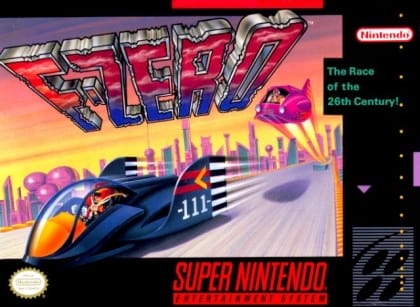
The groundbreaking futuristic racing game that showcased the SNES' Mode 7 graphics. Race at supersonic speeds across alien tracks as Captain Falcon and other anti-gravity pilots.
Share this game
Story
While there were originally four F-Zero pilots in the first game, this has grown with each game to more than 40 characters in the later games of the series. Each character has their own unique vehicle, story and reason for entering the F-Zero Grand Prix, but the most well known character is Captain Falcon. The winner of the Grand Prix receives a huge sum of prize money, but many pilots have been lost pursuing it. The F-Zero games are derived from the 20th and 21st century Formula One races and the fictitious F-Max Grand Prix races from the 24th century. The games portray races in the future as having come under the influence of wealthy ex-space merchants. They thought that a fast and violent race would be an effective way to get people to gamble, so the ex-merchants established the F-Zero Execution Project. The F-Zero Grand Prix dates to the 26th century, and is still sponsored by the wealthy elite who originally organized the Execution Project for those events. These races feature the most technologically advanced racing machines, competing in numerous circuits of fast-paced action. It is known for its wild fans, and usually eccentric competitors. Winners of the Grand Prix receive large sums of money, as well as a great deal of prestige throughout the universe. The F-Zero games are primarily set on a futuristic Earth in the 26th century, although some games take place much earlier and some circuits have been set on different planets. F-Zero X defined the F-Max Grand Prix as the precursor to the F-Zero races which took place during the 24th century. F-Zero begins in the year 2560 where the human race's countless encounters with alien life forms throughout the universe greatly expanded Earth's social framework resulting in trade, technology transfer, and cultural interchange are carried out on an interplanetary basis. An association of wealthy space merchants created the "F-Zero Grand Prix", in an attempt to add some excitement to their opulent lifestyles. When the first race was held, people were angered at the brutality of the competition, due to the various obstacles and traps along the raceway. As time passed, however, they became accustomed to these dangers, and even began to demand more excitement and danger in the races. Winning the F-Zero championship soon became the highest claim to fame in the universe. This period of time is called the "old-school" F-Zero days where the rules seemed non-existent in F-Zero X . F-Zero X ' s storyline starts after the seven-year suspension of Grand Prix races due to the Horrific Grand Finale. The game explains the "Horrific Grand Finale" was a violent and fiery accident that burnt fourteen drivers to death, including Sterling LaVaughn during the old days of F-Zero . A racer named Super Arrow escaped unscathed as the only survivor. No racing was allowed by the Federation after the crash; despite the F-Zero racing prohibition, the sport went underground where many racers went to hone their skills in secret. The crash ushered in the establishment of the "F-Zero Racing Academy", after a speech, by Super Arrow to the Federation Congress, which helped to lift the ban. The fictional competition was brought back with the rules and regulations revised. F-Zero: Maximum Velocity takes place 25 years after the original in the year 2585. Players race against the descendants of the original F-Zero racers. Maximum Velocity is considered a reboot continuity to the rest of the home console games since it has made no indication of the safety revisions carried forth after the huge accident, in fact it states just like the original F-Zero game, the extreme danger involved when participating in those races. F-Zero GX does not mention the Grand Finale event, but instead the game states Sterling LaVaughn was racing during the F-Max era and the F-Zero Grand Prix was suspended four years ago. This game states the character Mighty Gazelle was injured in the huge accident four years ago. The Nintendo 64 game mentions that Mighty Gazelle's accident and the accident that suspended the Grand Prix were two separate events. F-Zero: GP Legend is set in a different continuity and begins in the year 2201. It was continued with F-Zero Climax . These games feature some different incarnations of Captain Falcon, Zoda, and other characters.
Gameplay Systems
Each of the games in F-Zero series requires the player to beat opponents to the finish line while avoiding obstacles such as land mines and slip zones. The games usually require a mixture of memorization of the tracks and quick reflexes for its fast-paced racing gameplay. In F-Zero and F-Zero: Maximum Velocity , a speed boost is given to the player for each lap completed. Starting with F-Zero X , players may execute speed boosts if they have finished at least one lap, but now in exchange for losing energy when boosting. It is therefore necessary to use recharge strips around courses to replenish this energy, or risk exploding when it drops to zero. Strategically situated dash plates allow boosts without energy loss. In combination with course obstacles, drivers are allowed to attack each other with their vehicle bodies. The games' planets include different climates and terrains, and are home to many different races and tribes of aliens. There are geographical differences from game to game, but distinctive locations recur, such as Big Blue, Mute City and Port Town. Circuits are usually set on the outskirts of cities or above them situated high in planet atmospheres at an elevation as much as 300 feet (91 m) above ground. They contain anti-gravitational guide beams on both sides of the course that keep them in place. Rich merchants from cities in the clouds or asteroids with almost uninhabitable environments invested their wealth in the construction of racing circuits. Some cities have multiple circuits—circuits not used for the Grand Prix are open to pilots for practice. The dynamic structure of the courses are colossal in scale, as most circuits feature a single lap that spans over six miles (10 km). The vehicles used to race in these video games are known as "F-Zero machines", which are designed to hover instead of travel on wheels. An anti-gravity unit, known as the "G-Diffuser System" (first used by the Star Fox franchise's Arwing ), allows an F-Zero machine to drive at high speeds while retaining a hold of the track, located from a few inches to a foot below it. However, the slip zones, also referred to as the "magnetic field block coat" in the first F-Zero game, blocks the vehicle from retaining a hold on the track. The racing machines developed for these tracks used the latest in this magnetic technology, and are able to perform tune-ups. Out of the over forty-four known machines, only five do not weigh over a short ton . F-Zero machines have a maximum speed exceeding that of sound. This is possible due to the ultra-compact micro-plasma engines used by the machines. Each machine has four basic performance attributes: body, boost, grip, and weight. Body, boost, and grip are rated on a scale from A to E (A being the best, E, the worst). The higher a machine's Body rating, the more durable it is and the less damage it will sustain in a collision. Machines with a good Body rating are, therefore, able to withstand more attacks before exploding. The Boost rating takes into account the duration of a vehicle's boost, and how great a speed increase it provides. A machine with a high rating can travel at higher than normal speeds for a longer period of time. Grip determines how well a machine negotiates turns. A higher Grip rating means that the player's vehicle will execute steadier turns, while a low one will cause the vehicle to drift more, especially when turning tightly. Weight affects a vehicle's acceleration, grip, cornering ability, maximum speed, and the amount of damage it sustains in a collision. A lighter vehicle is superior in the first three categories, while a heavier vehicle has the advantage in the latter two.
Media Reviews
IGN
2003
Some information sourced from Wikipedia, available under CC BY-SA 3.0.