NES
Felix the Cat
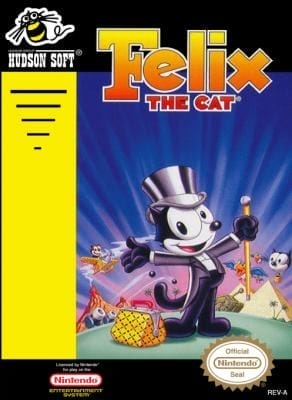
Felix the Cat is a platform game developed by Hudson Soft for the NES. Released in 1992, it follows the adventures of the iconic cartoon cat as he rescues his girlfriend Kitty from the evil Professor. The game features power-up transformations that change Felix's abilities and appearance throughout nine colorful levels.
Share this game
Story
Creation On November 9, 1919, Master Tom, a prototype of Felix, debuted in a Paramount Pictures short titled Feline Follies . Produced by the Manhattan -based animation studio owned by Pat Sullivan, the cartoon was directed by cartoonist and animator Otto Messmer . It was a success, and the Sullivan studio quickly set to work on producing another film featuring Master Tom, in Musical Mews (released on November 16, 1919). It too proved to be successful with audiences. Messmer claimed that John King of Paramount Magazine suggested the name "Felix", as in "feline", and for contrast of the felicity traditionally associated with a black cat. The name was first used for the third film starring the character, The Adventures of Felix (released on December 14, 1919). Sullivan claimed he named Felix after Australia Felix from Australian history and literature. In 1924, animator Bill Nolan redesigned the character, making him both rounder and "cuter". Felix's new looks, coupled with Messmer's character animation , brought Felix to a higher profile. Authorship The question of who created Felix remains a matter of dispute. Sullivan stated in numerous newspaper interviews that he created Felix and did the key drawings for the character. On a visit to Australia in 1925, Sullivan told The Argus newspaper that "he idea was given to me by the sight of a cat which my wife brought to the studio one day". On other occasions, he claimed that Felix had been inspired by Rudyard Kipling 's " The Cat that Walked by Himself " or by his wife's love for strays. Members of the Australian Cartoonist Association have claimed that lettering used in Feline Follies matches Sullivan's handwriting and that Sullivan lettered within his drawings. In addition, at roughly the 4:00 mark in Feline Follies , the words 'Lo Mum' are used in a speech bubble by one of the kittens; this was a term for one's mother not used by Americans, but certainly by Australians. Yet Messmer claimed to have single-handedly drawn Feline Follies from home, raising questions as to why an American would use the term 'Mum' in a cartoon he solely drew himself. Sullivan's supporters also say the case is supported by his March 18, 1917, release of a cartoon short titled The Tail of Thomas Kat more than two years prior to Feline Follies . Both an Australian ABC-TV documentary screened in 2004 and the curators of an exhibition at the State Library of New South Wales in 2005 suggested that Thomas Kat was a prototype or precursor of Felix. Few details of Thomas have survived. His fur color has not been definitively established, and the surviving copyright synopsis for the short suggests significant differences between Thomas and the later Felix. For example, whereas the later Felix magically transforms his tail into tools and other objects, Thomas is a non- anthropomorphized cat who loses his tail in a fight with a rooster, never to recover it. Sullivan was the studio proprietor and—as is the case with almost all film entrepreneurs—he owned the copyright to any creative work by his employees. In common with many animators at the time, Messmer was not credited. After Sullivan's death in 1933, his estate in Australia took ownership of the character; although Messmer told Harry Kopp that Sullivan promised him the rights to Felix in his will, no such will existed by the time he died. Kopp and the estate got the rights in 1934 from King Features Syndicate after numerous conferences with him. It was not until after Sullivan's death that Sullivan staffers such as Hal Walker, Al Eugster , Gerry Geronimi, Rudy Zamora, George Cannata, and Sullivan's own lawyer, Harry Kopp , credited Messmer with Felix's creation. They claimed that Felix was based on an animated Charlie Chaplin that Messmer had animated for Sullivan's studio earlier on. The down-and-out personality and movements of the cat in Feline Follies reflect key attributes of Chaplin's, and, although blockier than the later Felix, the familiar black body is already there (Messmer found solid shapes easier to animate). Messmer himself recalled his version of the cat's creation in an interview with animation historian John Canemaker : Sullivan's studio was very busy, and Paramount, they were falling behind their schedule and they needed one extra to fill in. And Sullivan, being very busy, said, "If you want to do it on the side, you can do any little thing to satisfy them." So I figured a cat would be about the simplest. Make him all black, you know—you wouldn't need to worry about outlines. And one gag after the other, you know? Cute. And they all got laughs. So Paramount liked it so they ordered a series. Further, Messmer told Canemaker that both he and Sullivan drew Felix based on models from the minstrel show tradition and the pickaninny caricature: {{cite book|last1=Sammond|first1=Nicholas|title=Birth of an Industry: Blackface Minstrelsy and the Rise of American Animation|date=2015|location=Durham|isbn=978-0-8223-7578-4|page=71}}</ref>"}},"i":0}}]}' id="mw5A"/> Pat Sullivan... started off on his own, doing his little Negro Pickaninny [Sammie Johnsin]. Which later on became almost Felix, at least in my mind anyway. Same kind of a, only he was a pickaninny. Now that was going along pretty good, but it didn't through the South, that little anti-Negro feeling. They wouldn't run the Pickaninnies. The tropes of minstrelsy were useful for creating a cartoon animal because they cued the audience to expect a lively, amusing and rebellious character. Animation historians back Messmer's claims. Among them are Michael Barrier , Jerry Beck , Colin and Timothy Cowles, Donald Crafton, David Gerstein , Milt Gray, Mark Kausler, Leonard Maltin , and Charles Solomon. Sullivan marketed the cat relentlessly while Messmer continued to produce a prodigious volume of Felix cartoons. Messmer did the animation on white paper with inkers tracing the drawings directly. The animators drew backgrounds onto pieces of celluloid , which were
Some information sourced from Wikipedia, available under CC BY-SA 3.0.