SNES
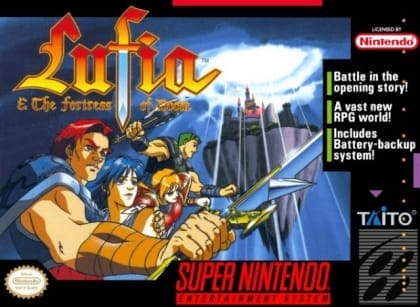
Lufia & The Fortress of Doom
Classic turn-based JRPG following warrior Maxim and the mysterious girl Lufia as they battle the sinister Sinistrals. Features puzzle-filled dungeons and a unique monster-catching system using IP attacks.
Release Date
January 1, 1993
Players
1
Region
US
ROM Size
798 KB
Share this game
Story
Setting The story of Lufia & the Fortress of Doom begins, in accordance with an ancient prophecy of the Lufia world, with a massive floating island with a large castle located on it emerging into the sky one dark day. Dubbed the "Fortress of Doom", this castle served as the base of operations for a group of all-powerful beings known as the Sinistrals, who planned to use their strength to bring the world to its knees. In response, the people sent four of their bravest warriors: Maxim, Selan ("Serena" in Estopolis Denki), Artea ("Arty" in Estopolis Denki), and Guy, to infiltrate the dark fortress and destroy the Sinistrals before they could do any harm. The game begins with the player controlling these characters as they prepare to engage the Sinistrals, and eventually defeat them. After the battle, however, the fortress begins to collapse, with Maxim and Selan becoming trapped on the other side of a deep chasm that forms when the Sinistral throne room splits apart. Unable to teleport them to safety, Artea and Guy leave the falling island alone, and their trapped allies apparently perish when it crashes into the earth below. Peace reigns for ninety years after the heroes' encounter with the Sinistrals, and the actual game is set nine years after that. The story is told from the perspective of a red-haired boy the player is in charge of naming, and along the way he gets caught up in a struggle to save the world once again from the newly emerged Sinistral army.
Gameplay Systems
Lufia & the Fortress of Doom plays much like a traditional role-playing video game and features 2D character sprites and environments. The player advances the story by travelling through several harsh dungeons, encountering monsters along the way. These battles occur randomly (every few steps or so) or in scripted situations, and winning them yields experience points that go towards leveling up the characters, giving them access to new abilities and making them stronger in the process. The battles themselves take place from a first-person perspective, and require the player to use each character's strengths, such as physical attacks or magic use, as in many other mainstream RPGs. An interesting quirk in the battle system, reminiscent of older RPGs like the early Dragon Quest games, makes it such that when ordering two characters to attack a particular enemy, and the first character defeats the enemy, the second character's attack will still target the defeated enemy and thus miss. Thus foresight is required to make sure that no characters' battle moves are wasted, unlike other RPGs, where other enemies will be targeted if the intended enemy has already been defeated. New equipment and restorative items are purchased from vendors in various towns, or found in chests scattered throughout the world. The player's progress is saved in one of three available slots on the cartridge's built-in battery back-up system by speaking to a priest at a church found in most towns.
Media Reviews
Famitsu
28
Electronic Gaming Monthly
7.8
Nintendo Power
86
Some information sourced from Wikipedia, available under CC BY-SA 3.0.