N64
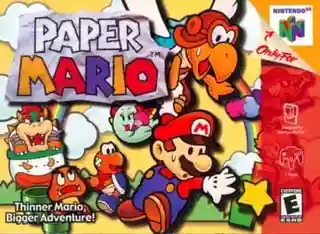
Paper Mario
A revolutionary paper-style RPG! As paper-thin Mario, team up with partners like Goombario to rescue Peach from Bowser using timed-action battles and paper transformations.
Release Date
January 1, 2000
Developer
Intelligent SystemsPublisher
Intelligent Systems
Players
1
Region
US
ROM Size
40.0 MB
Share this game
Story
Development and history 1984–2005: Intelligent Systems founding, Paper Mario , and The Thousand-Year Door Super Mario RPG</i> logo; <i id=\"mwAgo\"><a rel=\"mw:WikiLink\" href=\"./Paper_Mario_(video_game)\" title=\"Paper Mario (video game)\" id=\"mwAgs\">Paper Mario</a></i> is a spiritual successor to <i id=\"mwAgw\">Super Mario RPG</i>."}'> The Super Mario RPG logo; Paper Mario is a spiritual successor to Super Mario RPG . Intelligent Systems was founded after Tohru Narihiro {{Cite web|url=https://kotaku.com/going-to-war-like-only-nintendo-can-5844945|title=Going to War Like Only Nintendo Can|date=2011-09-29|access-date=2021-05-24|website=[[Kotaku]]|last=Plunkett|first=Luke|archive-date=May 24, 2021|archive-url=https://web.archive.org/web/20210524122531/https://kotaku.com/going-to-war-like-only-nintendo-can-5844945|url-status=live}}</ref> in sources."}},"i":0}}]}'> was hired as an employee by Nintendo to port games on the Famicom Disk System to cartridges in the 1980s. Narihiro went on to develop successful games in the Wars and Fire Emblem series, which allowed him to expand his company with additional artists and developers. Super Mario RPG , which was released on the Super Nintendo Entertainment System (SNES), was the first Mario role-playing game and was developed by Square . Square used experimental gameplay mechanics, such as timed button presses to deal more damage in combat, to try to ease fans into finding interest in the genre. Although Nintendo wanted Square to create another RPG game, Square later signed a deal with Sony Interactive Entertainment to create Final Fantasy VII on the original PlayStation . Instead, Nintendo hired Intelligent Systems to create an RPG for their newest console, the Nintendo 64 . Game development began shortly after the console's release in Japan in 1996. The game, produced by Shigeru Miyamoto and a team of about 20 people , was originally planned to be a sequel to Super Mario RPG, Super Mario RPG 2 , used a similar graphics style to its predecessor, and was to be released on the 64DD , a disk drive add-on for the Nintendo 64. Naohiko Aoyama, the game's art designer, later switched the graphics to a paper-like style because he believed players might prefer a game with "cute" 2D character designs instead of one with low-polygon 3D graphics. Development took four years and was released in August 2000 towards the end of the console's lifecycle with the GameCube nearing announcement. The game was titled Mario Story in Japan and Paper Mario in North America. At the 2003 Game Developers Conference , Nintendo announced a direct sequel to the previous game, The Thousand-Year Door . The game had a playable demo at E3 2004 , and was released worldwide later that year as The Thousand-Year Door internationally and Paper Mario RPG in Japan. By the time the game was released, another series of Mario RPGs, Mario & Luigi , was created for Nintendo's handheld consoles. The first game in the series, Superstar Saga , was developed by AlphaDream and released for the Game Boy Advance in 2003. Kensuke Tanabe , the supervisor of The Thousand-Year Door , and assistant producer Risa Tabata drew inspiration from Miyamoto to introduce different gameplay concepts to make the series more entertaining. In a 2020 interview, Tanabe acknowledged the difficulty of maintaining motivation when every game in the series is the same, leading them to explore bigger changes in each game's gameplay and design team.
Gameplay Systems
In the series, Mario is tasked with a quest to explore either the Mushroom Kingdom or a similar world. Each game divides the world into several explorable areas that contain puzzles and interactive elements, such as obstacles that Mario has to hit with his hammer, that need to be completed to progress in the story. The locations are designed to look as if they are made out of paper, and contain coins and other collectibles, such as hidden trophies. There are also non-player characters (NPCs) which Mario can talk to. All games except Super Paper Mario feature a turn-based combat system , where Mario and one or more opponents take turns attacking one another. The first two games, Paper Mario and Paper Mario: The Thousand-Year Door , feature elements similar to that of a typical role-playing video game (RPG). Mario encounters multiple allies that join him on his journey, who can help complete tasks in the worlds and fight in combat, the latter of which is similar to other RPG games. The player can either perform a regular attack, where they time a button-press on the controller to deal more damage, or use a special attack, which is more powerful but consumes flower points (FP)—an in-game statistic—when used. When defeating an enemy, experience points (known in-game as Star Points, or SP) are awarded, which makes Mario and his allies more powerful as they progress. Upgrades to special attacks can be found in the overworlds. Super Paper Mario , the third game in the series, deviates from the RPG genre and plays more as a platform game instead. Unlike the previous two games, which use a turn-based combat system, Mario does not enter a combat phase and instead fights the enemy in the overworld in real-time. XP is still awarded for defeating enemies. Although Mario does not fight alongside unique partners, Luigi , Princess Peach , and Bowser are playable and a part of Mario's party . In addition, allies known as Pixls, which grant abilities for combat and traversing levels, can be summoned and used. Since Paper Mario: Sticker Star , the Paper Mario games were aimed more towards the action-adventure genre. RPG elements, such as experience points, allies, a complex plot and variety of fictional races, were reduced. It instead emphasized puzzle-solving, a new experience point system, and new strategic and somewhat puzzle-like gameplay around combat.
Sales & Commercial Performance
Total Copies Sold
1.3 million copies
Media Reviews
GameSpot
64
Eurogamer
8
Nintendo Power
64
Some information sourced from Wikipedia, available under CC BY-SA 3.0.