SNES
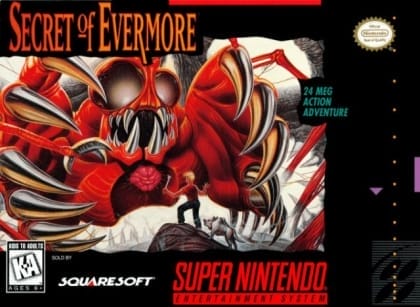
Secret of Evermore
A cult classic action RPG following a boy and his shape-shifting dog transported through time to four distinct eras. Features a unique alchemy-based magic system and dynamic enemy scaling.
Share this game
Story
Setting The plot revolves around a teenage boy and his dog whom the player must name. Most of the game takes place in the fictional world of Evermore. The player explores four main areas within this world, corresponding to different historical eras : Prehistoria contains cavemen and dinosaurs ; Antiqua boasts a colosseum and pyramid theme; Gothica contains medieval castles and is populated by dragons ; Omnitopia is a futuristic space station . Throughout their travels the boy, in the company of his dog, often quotes or mentions fictional B movies that relate to their current situation. For example, he compares himself to "Dandy" Don Carlisle in the film Sink, Boat, Sink after washing ashore at Crustacia. In addition, the dog's body transforms based on the theme of the area that players are in: in the world of Prehistoria, the dog is transformed into a feral wolf ; in the Antiqua region, he becomes a greyhound ; in Gothica, he takes the form of a fancy poodle ; and in Omnitopia, he becomes a robotic dog that resembles a toaster and is capable of shooting laser beams.
Gameplay Systems
Secret of Evermore takes many of its interface and gameplay aspects from Secret of Mana . The game consists mostly of an aerial view setting, where the boy and his dog negotiate the terrain and fend off hostile creatures. The player may choose to control either the boy or the dog, with the other being controlled by the game's artificial intelligence. Both characters can find refuge in caves or a town, where they can regain their hit points or purchase restorative items and equipment. Upon collecting enough experience points in battle, either character can increase in level with improved stats such as strength and evasion. Options including changing equipment or casting alchemy spells; checking status can be performed quickly by rotating through the game's Action Ring system. Combat takes place in real-time. Located below the player's hit points is a percentage gauge that determines the amount of damage done to an enemy, as well as how far the player can run. Swinging a weapon or running causes the gauge to fall to 0%. It then quickly recharges, allowing the character to attack at full strength or to run at full sprint once it is full. The gauge may also fill up to allowing the player to use charged attacks with equipped weapons. The protagonist wields four different styles of weapons throughout the game: sword , spear , axe , and toward the end of the game, bazooka . Repeated use of them can increase their skill levels to a maximum of three, unlocking a new charged attack and increased range and power with each level; for instance, spears at a high enough level may be thrown at an enemy across the screen, while the swords and axes can cut swathes of destruction around the boy's vicinity. The sword, axe, and spear get replaced with a more powerful variant in each realm, resetting their skill levels. Most swords, axes, and spears can cut through vegetation , while some weapons are required to break rocks and other barriers. In the four worlds of Secret of Evermore , the in-game currency changes. The shopkeepers in Prehistoria exchange talons; in Antiqua, gemstones ; in Gothica, gold coins ; in Omnitopia, credits. There are individuals in each region who offer to convert the player's money to the local currency. In either of the game's two marketplaces (in Antiqua and Gothica, respectively), the storekeepers offer to trade in goods instead of money. Certain goods, such as rice, spices, and tapestries, can be bought using the local currency, but others must be exchanged for other goods. Most vendors only specialize in one type of good, and some rare items require an extensive amount of trading to obtain. Alchemy A unique element of Secret of Evermore is its magic system. To cast magic, the boy must be given an "Alchemic Formula" by one of the many non-playable characters called "Alchemists". Some Alchemists make their home in out-of-the-way areas and will dispense rare formulas if the player manages to seek them out. Unlike some role-playing games, there are no magic points needed to cast spells. Alchemy Formulas require pairs of ingredients to be used; some are available throughout the game, and others are only native to certain environments. In the primitive realms, ingredients appear such as wax , limestone , clay , and ash . In the advanced realms, however, the ingredients become more complex, for example ethanol and dry ice . A secondary function of the dog is to "sniff out" ingredients by putting his nose to the ground and smelling for items. The player can command the dog to search the ground at any time, including in huts and cities. If all goes well, the dog will lead his human companion to a certain spot on the map where the player can uncover the unseen ingredients. With repeated use, Alchemy Formulas will increase in level , enhancing their curative, offensive, or support effectiveness. Although there are dozens of Formulas available to be found within the game, only nine can be equipped at a time. To overcome this, there are several Alchemists scattered throughout the game who offer to manage the boy's current Alchemy list; any formula that has already been learned can be stored by the Alchemist for later use.
Media Reviews
IGN
2018
Electronic Gaming Monthly
33.5/40
Nintendo Power
3.8/5
OPM
2018
Some information sourced from Wikipedia, available under CC BY-SA 3.0.