SNES
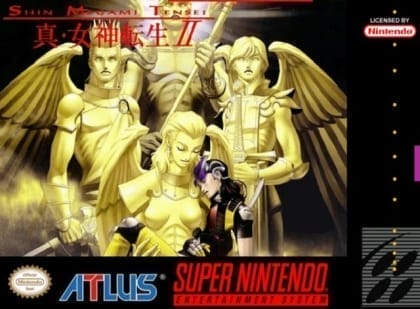
Shin Megami Tensei II
The apocalyptic sequel set in a post-nuclear Tokyo where you recruit demons to battle in a war between God and Lucifer, featuring deep moral choices that shape the world's fate.
Share this game
Story
Setting and characters Shin Megami Tensei II is set in the year "20XX", decades after the events of Shin Megami Tensei , where a war between angels and demons was fought. Opposing both sides, a man called the Hero created a world where both Law and Chaos could co-exist, where people had freedom to choose and believe what they wished. In the time between the two games, the world was plagued by disasters, and the air became unbreathable. People flocked to the encapsulated city Tokyo Millennium, which was built atop the ruins of Tokyo, where mutants, fairies and demons live. The city is ruled by followers of the Messian religion in a central unit called the center, and is divided into districts; the largest one is Valhalla, where people can compete in a gladiator tournament, with the winner gaining citizenship in the luxurious Center, which is out of reach from demons. The game follows Hawk, an amnesic Valhalla gladiator who trains at his mentor Okamoto's gym. Among other recurring characters are Hiroko, a rebellious temple knight; Beth, a woman from the center who vows to always stay by Hawk's side; Daleth, who claims to be the Messiah, and fights Hawk multiple times; Zayin, a temple knight; and Gimmel, a man from the Arcadia forest, who knows Hawk from somewhere. Early in the game, Hawk meets a man named Steven, who grants Hawk the "Demon Summoning Program" for Hawk's arm terminal, allowing him to summon demons.
Gameplay Systems
The gameplay is similar to that of the first Shin Megami Tensei : the game is controlled from a first-person view, and has the player exploring dungeons and navigating outdoor areas, which are presented as 2D maps seen from a top-down perspective. In both these types of areas, the player encounters and battles against demons; a gauge on the bottom of the screen shows the likelihood of a demon encounter. The player is able to speak to demons instead of fighting them, and can try to form an alliance with them; these negotiations involve the player trying to increase the demon's mood, and start with the player picking an attitude – friendly or intimidating – after which they get to choose how to respond to what the demon says or does, and whether to give the demon items or money it asks for. Demons act differently depending on their personality, as well as the in-game phase of the moon; it is impossible to converse with demons during full moon, forcing the player to fight or flee. Depending on choices the player makes throughout the game, their moral alignment changes; the different alignments are "law", "chaos", and "neutrality". These affect how the plot progresses, and how easy or difficult it is to form alliances with certain demon types, depending on how compatible the player's and the demon's alignments are. The player can acquire stronger demons by fusing two or three allied demons together, resulting in a single, predetermined type of demon; there is however a small chance that a "fusion accident" occurs, resulting in a demon other than the type the fusion was thought to produce. Fused demons can "inherit" abilities from the demons used to create it, including ones a demon of its type normally would be unable to have. Demons can also be fused with weapons to create powerful swords for the player to use.
Media Reviews
IGN
1/65536
Famitsu
101
Some information sourced from Wikipedia, available under CC BY-SA 3.0.