
GB
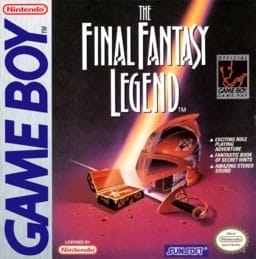
The Final Fantasy Legend
The first game in the SaGa series, initially released as Final Fantasy Legend in North America. This Game Boy RPG features a unique character progression system where humans, mutants, and monsters develop differently. Players explore a tower connecting multiple worlds in this groundbreaking portable RPG.
Share this game
Story
Standing in front of the tower, the hero and party learn that they cannot climb it to paradise without first unsealing its base door. In the base world, three kings named Armor, Sword, and Shield fight for dominance using pieces of legendary equipment corresponding to their names. Visiting King Armor, the party learns that he is in love with a girl who returns his feelings, but cannot marry him, as a bandit holds her village hostage in return for her love. They defeat the bandit, and the king gives them his armor in gratitude. King Sword attacks the heroes, who vanquish him and take the sword. Lastly, King Shield is murdered by his own steward, and after a fight, the party recovers his shield. Restoring the items to a statue of a great hero, they receive the Black Sphere, but are attacked by Gen-bu , one of four fiends controlled by Ashura . They defeat him and use the power of the Sphere to enter the tower. They climb the tower and come to another door; inside lies a world surrounded by large bodies of water. By navigating caves, they find a floating island which allows them to travel around the world by air. They locate an old man, Ryu-O, and solve his riddle to obtain the Airseed, allowing them to breathe underwater and enter the undersea palace. They defeat the second fiend, Sei-ryu , and recover half of the second sphere. Upon returning to Ryu-O, he reveals himself to be the guardian of the other half of the sphere, and the two halves form the Blue Sphere. Using the Blue Sphere to continue up the tower, the party comes to a world of clouds, dominated by Byak-ko and an army of thugs. They learn that Byak-ko recently wiped out an underground resistance movement, except for Millie and Jeanne, the two daughters of its leader. The party temporarily joins Byak-ko's gang to find the girls, and attempt to defend them, but Millie betrays Jeanne and the party is captured. Breaking free, they confront the fiend, who tries to kill Millie; Jeanne takes the blow and dies in her stead. The party defeats the fiend, recovers the White Sphere, and continues their journey. The fourth world is a post-apocalyptic wasteland; Su-Zaku roams the surface defended by an impenetrable forcefield. The party retreats to an abandoned subway for refuge and meets Sayaka, who directs them to the nearest town. There the party is confronted by the leader of a biker gang, So-Cho, but his sister Sayaka intervenes and the two groups agree to work together to defeat Su-Zaku. As they gather the needed parts for a device to deactivate the forcefield, So-Cho sacrifices his life to guide the party through an atomic power plant. Beasts then ambush the town, and Su-Zaku kidnaps Sayaka. The party defeats Su-Zaku, earns the Red Sphere and travels on. Climbing the tower, the party discovers the remains of a family that attempted to reach Paradise but failed, and a library suggesting Ashura is controlled by someone else. They encounter him at the top, guarding the final door; he offers each of them control of one of the worlds, but they refuse and defeat him. Before they can pass through the door, a trap drops them to the bottom floor. Encountering the allies they made along their journey, they decide to rescale the tower. As they climb stairs that wrap outside of the tower, they engage each of the fiends revived and defeat them. They find the Creator at the summit, and learn that the fiends and the tower itself are actually part of a game created by him to see heroes defeat evil; for succeeding they would be granted a wish as a reward. Angry at his manipulation, they reject the reward and challenge the Creator, who insists that because he created everything he was allowed to use them as he saw fit. They then attack and defeat the Creator. The heroes then discover a door leading to an unknown location; they consider entering, but decide to return to their own world.
Gameplay Systems
In The Final Fantasy Legend , the player navigates a character throughout the game world with a party of up to four characters, exploring areas and interacting with non-player characters . Most of the game occurs in towns, castles, caves, and similar areas. To aid exploration on the field screen, the game makes use of various signs within towns. The player is initially limited to the World of Continent to explore, and given access to later worlds as his or her party climbs the Tower. Players can save their game anytime and anywhere when not in combat to a save slot for later play. Players can journey between field screen locations via the world map , a downsized representation of Final Fantasy Legend ' s various worlds. Players can freely navigate around the world map screen unless restricted by terrain, such as water or mountains. The goal in each world is to find the entrance to the next level of the Tower. Random enemy encounters occasionally interrupt travel across the world map screen and hostile areas, as in other Final Fantasy related games. Classes At the beginning of the game, the player must choose a character class , gender, and name for the group's "party leader". There are three available classes: humans , mutants ( espers in the Japanese version), and monsters , each with its own strengths and weaknesses. Character classes cannot be changed once the game has begun. The player may recruit up to three additional party members through a similar process via "Member Guilds" in various towns. Characters may also be recruited to replace fallen party members, though the party leader is irreplaceable. Higher-level party members may be recruited at later towns in the game. A character's performance in battle is determined by numerical values ("statistics") for four categories. Each statistic has a range of 1 to 99. The categories are strength , the effectiveness of physical attacks; defense , the ability to reduce damage received; agility , the effectiveness of ranged weapons or skills and at avoiding attacks; and mana , the effectiveness of magical attacks. A character's health is measured in hit points ( HP ), consisting of a current HP statistic and a maximum HP statistic, ranging from 0 to 999. Character statistics are relative to their class—humans have higher HP levels, strength, and defense, and mutants are physically weaker but enjoy a higher mana statistic. Human and mutant statistics can be amplified by worn equipment of different types. Monster-class characters are dependent on their sub-class, and their statistics vary greatly. Humans raise their statistics through items that grant permanent bonuses, such as "STRENGTH" or "HP200". Mutant attributes simply increase by random increments after battles, and new abilities may be gained (or lost) in the process. Monsters change in power by consuming "meat" dropped in battles; depending on the monster's current sub-class and the meat's origin, the monster may transform into a stronger or weaker sub-class or fully recover health. Later versions of the game released upon the WonderSwan and mobile phones removed the latter effect entirely.
Media Reviews
IGN
1
GameSpot
25
Famitsu
1989
Game Informer
25
Electronic Gaming Monthly
25
Nintendo Power
1997
Some information sourced from Wikipedia, available under CC BY-SA 3.0.