SNES
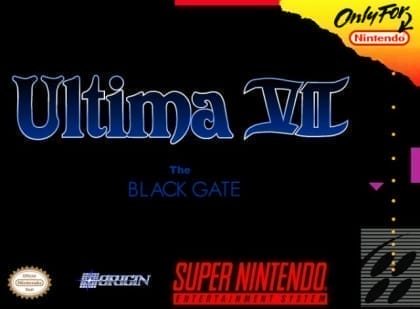
Ultima VII: The Black Gate
The SNES adaptation of the groundbreaking PC RPG, streamlined for console play while retaining the deep narrative. The Avatar investigates murders linked to a sinister cult in Britannia, with real-time party-based combat.
Release Date
January 1, 1994
Players
1
Region
US
ROM Size
578 KB
Share this game
Story
The game begins with what appears to be the game introduction on the Avatar 's own computer screen. Suddenly, the screen is filled with static, and a red creature who calls himself The Guardian proclaims: Avatar! Know that Britannia has entered into a new age of enlightenment! Know that the time has finally come for the one true Lord of Britannia to take His place at the head of His people! Under my guidance, Britannia will flourish. And all the people shall rejoice and pay homage to their new ... Guardian! Know that you, too, shall kneel before me, Avatar. You, too, shall soon acknowledge my authority - for I shall be your companion ... your provider ... and your master! The Orb of the Moons glows, and the Avatar finds that a red moongate has appeared behind the house. The Avatar thus returns to Britannia through the moongate, and arrives in Trinsic, where he meets Iolo . Iolo tells him that two centuries have passed since he left. The whole town is shocked due to a ritualistic murder that occurred the preceding night - the body of the blacksmith Christopher was found in the stable. Finnigan, Mayor of Trinsic, asks the Avatar to investigate the incident. In Trinsic, the Avatar gets to meet several members of a new religious organization called the Fellowship. Eventually, in Britain, he meets Batlin , one of the founders of the Fellowship. He also meets Lord British , who urges the Avatar to join the Fellowship, which, according to him, has done a lot of good things. It also turns out most of the mages of the realm have gone completely insane without any good explanation, and their magic doesn't work as it should. Most of the game is composed of the Avatar's investigation of the Fellowship and the Trinsic murders. During the game, the Avatar finds more and more clues that implicate the Fellowship in shady dealings; more murders appear on the way, and the Avatar himself goes undercover by entering the Fellowship. His quest takes him to most of the cities and towns of Britannia, including Minoc, a destroyed Skara Brae run by a lich , Yew, Moonglow and Buccaneer's Den. The Avatar eventually learns of an astronomical alignment of importance that is supposed to happen very soon, and about the three evil Generators that the Guardian has created, which have been causing most of the problems of the land. After destroying them, he and his companions follow several leads to the Isle of Avatar, where members of the Fellowship are waiting. The Fellowship has fashioned a black moongate out of blackrock on this island to allow the Guardian to enter Britannia when the astronomical alignment happens. The Avatar confronts the Fellowship members and defeats them. As the astronomical alignment begins and the Guardian starts to loom behind the moongate, the Avatar destroys the gate just in time, preventing the Guardian from entering Britannia. As the moongates had been rendered useless by the destruction of one of the generators, the Avatar has to remain in Britannia, with no means to return to Earth.
Gameplay Systems
Game system Ultima VII introduced major changes in the Ultima series. The most serious alteration is that as far as the player is concerned, the world is no longer tile and grid-based; tiles are still used internally (in a largely improved way where the tiles themselves are smaller and frequently grouped), but they no longer affect character and monster movement or the item placement the same way. The maps are also more visibly multi-layered, and objects and things can be stacked on top of each other. This can also affect movement, and be part of puzzles; some places are inaccessible unless the player stacks items to form stairs. A striking visual change is that the gameworld now takes up the entire screen in its original DOS environment, while previous Ultimas used a substantial portion of the screen for text, dialogue, buttons, icons, and the like. The game is the first in the series that is entirely mouse -driven, with optional keyboard hotkeys for some common actions. This is in contrast to earlier entries that are entirely keyboard-driven, and to Ultima VI , which supplements keyboard commands with on-screen command icons. While in Ultima VI , the player has to specifically use a "move" command to move an item from place to place, or "drop" to drop it on the ground, in Ultima VII , items are simply dragged and dropped to their desired locations. While the game can be played entirely with a keyboard, doing so is very difficult, and in-game characters recommend the player use a mouse. Ultima VII introduces Graphical User Menu Pop-ups ("gumps"), which are on-screen representations of containers, later employed in Ultima VIII , Ultima IX and Ultima Online . For example, clicking on a drawer or backpack will show the contents of the container on screen, allowing the items within arranged freely with the mouse. Gumps are also used for books, scrolls, the spellbook, the status display, maps, and character equipment management; double-clicking on the Avatar opens his or her inventory, after which the inventories of other party characters can be opened by double-clicking them in turn. In Ultima VII Part Two: Serpent Isle , the inventory view uses a paper doll concept: equipping items will change the character inventory display to show the worn or held items in place. Another major change from earlier entries is that the game is completely real-time , and only pauses when the inventory, the menu, or a dialogue is open, significantly affecting combat. The combat system is altered accordingly: every party character is controlled by artificial intelligence (AI), and the desired behavior can be chosen for each character (for example, stronger characters can be ordered to autonomously waylay the toughest opponents, while more vulnerable characters will keep their distance), and there is also the option to choose manual targeting for the Avatar. Though the combat is real-time, the player can take their time in performing certain actions – for example, the game pauses when the player prepares to use an item from their backpack. The AI occasionally executes some self-defeating moves (such as firing a triple crossbow into a crowd of allies), but it saves the player the need to micromanage up to eight different characters in battle. The AI can decide on its own to change what weapon a party member has been equipped with if there is a different weapon in their inventory. At times, the AI will make a party member drop their weapon to the ground before retreating. Ultima VII: The Black Gate is the first game in the mainline Ultima series to use dialogue trees. The first trilogy only allows simple interaction while the second trilogy uses a keyword-based dialogue. Ultima VII retains the old keywords themselves, but uses a dialogue tree where dialogue options are picked with a mouse rather than entered on keyboard; in previous games, whether at random or due to having external knowledge about the game, the player can enter keywords and trigger dialog and events before they are intended to be. In Ultima VII , the keywords only appear when they are actually learned beforehand in the game due to the plot – for example, "thief caught" dialogue option won't actually appear until a thief is actually caught.
Media Reviews
Edge
1993
Some information sourced from Wikipedia, available under CC BY-SA 3.0.